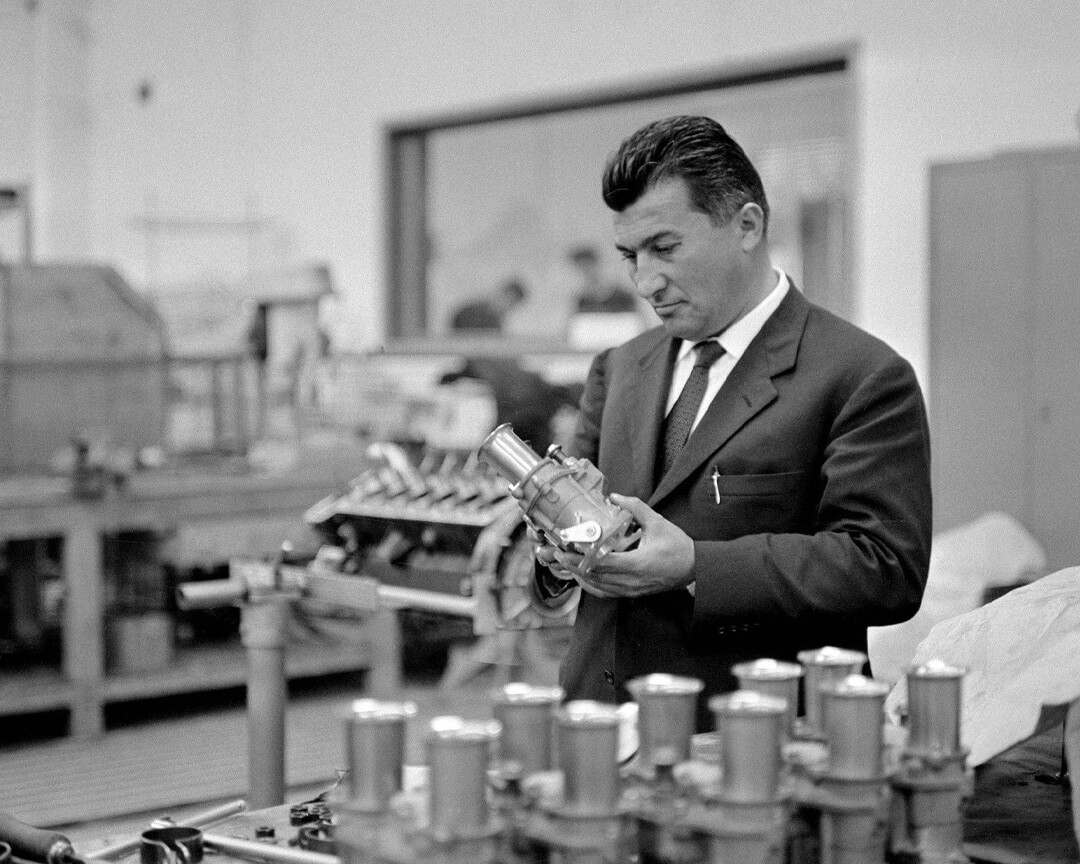
The editorial DNA of these historical figures reveals a singular, unyielding truth: the greatest leaps in luxury and mechanical engineering were never born from corporate focus groups or sterile market research. They were forged in the fires of bruised egos, fierce territorial pride, and an absolute refusal to compromise.

When you strip away the decades of marketing polish, the stories of Enzo Ferrari, Ferruccio Lamborghini, Ferry Porsche, Alfa Romeo, and Carlo Riva bleed into a single, continuous epic. It is a saga where asphalt meets open water, and where the singular pursuit of technical mastery forever changed the landscape of speed.
The Crucible of Pride: Enzo and Alfa Romeo
To understand the explosive rivalries that defined post-war European machinery, one must look back to the dusty, high-stakes paddocks of pre-war Italy. Long before his name became synonymous with scarlet supercars, Enzo Ferrari was a man operating under the shadow of a giant: Alfa Romeo.
As the manager of Scuderia Ferrari—which served as Alfa Romeo’s official racing arm throughout the 1930s—Enzo learned the brutal economics of motorsport. He weaponized Alfa’s roaring inline-eights, managing legendary drivers like Tazio Nuvolari and conquering grueling road races like the Mille Miglia. It was during this intense era that Enzo adopted the Cavallino Rampante (the Prancing Horse), a wartime emblem gifted by the family of legendary Italian fighter ace Francesco Baracca. Originally painted on the fuselage of a fighter plane, Enzo placed it onto the yellow shields of his Alfa Romeo factory racers.

But Enzo was not a man built to take orders. He was an autocrat in training. When Alfa Romeo decided to reabsorb the racing division and place Enzo under a corporate director, the friction was instantaneous and terminal. Enzo walked out, bound by a non-compete clause that banned him from building cars under his own name for four years. The exit was bitter, but the lesson was permanent: absolute control was the only currency that mattered.
The Counter-Philosophy: Ferry Porsche’s Quiet Defiance
While Enzo’s worldview was being shaped by the grand, high-displacement drama of Italian racing, a completely different engineering philosophy was quietly taking root north of the Alps. In 1948, Ferry Porsche found himself looking at a post-war landscape devoid of the machine he truly desired.

“I looked around and could not find quite the car I dreamed of: a small, lightweight sports car that uses energy efficiently. So I decided to build it myself.”
— Ferry Porsche
This realization birthed the Porsche 356. It was a mechanical thesis statement that stood in direct opposition to the brute-force, heavy-iron engineering of the era. Utilizing a rear-engine layout, aerodynamic efficiency, and lightweight construction, Ferry proved that agility, balance, and pure physics could embarrass cars with twice the horsepower.
Where the Italians built temperamental thoroughbreds designed for the track and tolerated on the street, Porsche engineered an unpretentious, surgical precision meant to be driven hard every single day. Two distinct paths to automotive immortality were now running parallel across Europe.
The Sarnico Renaissance: Riva and the Amphibious Aesthetic
As sports cars evolved into symbols of cultural aristocracy in the 1950s, a similar revolution was unfolding on the pristine waters of Lake Iseo. In Sarnico, Carlo Riva took the reins of his family’s historic shipyard with a hyper-focused ambition: to build the absolute mechanical equivalent of a maritime supercar.
Carlo became an obsessive perfectionist. He rejected the traditional, utilitarian approach to boatbuilding, treating mahogany with the sacred reverence an engine builder reserves for a cylinder head. Under his watch, the Maestri d’Ascia (master shipwrights) transformed the Riva workshop into a temple of craft.
Building a Riva—particularly the legendary Aquarama and its long-deck counterpart, the Lungo—was an excruciating exercise in patience. Hulls required deep, multi-layered woodcraft, meticulously seasoned timber, and up to twenty coats of specialized varnish, hand-sanded between applications to achieve a mirror-like, deep-liquid finish.
To complement this breathtaking aesthetic, Carlo bypassed sluggish European marine diesels, opting instead to import raw, thunderous American V8 blocks from Chris-Craft and Cadillac. The result was an unpretentious masterpiece of pure sensory indulgence—an amphibious aesthetic that became the mandatory playground accessory for the global jet-set.
The Palace Revolt and the Ultimate Weapon of Revenge
By the dawn of the 1960s, Enzo Ferrari sat unchallenged at the apex of the automotive world. But the very trait that fueled his rise—his tyrannical, unyielding ego—flirted with self-destruction. In 1961, Maranello was rocked by the infamous “Palace Revolt.” Frustrated by internal politics and the interference of Enzo’s wife in company operations, a faction of Ferrari’s most brilliant minds staged a walkout.
Key figures like chief engineer Carlo Chiti, team manager Romolo Tavoni, and development wizard Giotto Bizzarrini walked out of the factory gates. They formed ATS (Automobili Turismo e Sport) to challenge Enzo on the grid. While ATS burned bright and faded quickly, the fallout of the Great Walkout created a volatile pool of elite, exiled engineering talent looking for a home.
Enter Ferruccio Lamborghini.
Ferruccio was a self-made industrial titan who had built a massive fortune manufacturing tractors. He was also a passionate petrolhead who drove a personal Ferrari 250 GT. Frustrated by a persistent clutch failure that plagued his car, Ferruccio drove to Maranello to confront Enzo directly, suggesting a technical fix for the drivetrain.

Enzo, viewing the tractor magnate as an uncultured interloper, famously dismissed him: “You are a tractor driver. You know how to drive a tractor, but you will never know how to handle a Ferrari.”
It was a fatal miscalculation. A deeply insulted Ferruccio returned to Sant’Agata with a burning mission: to build a grand tourer so mechanically flawless it would render Enzo’s cars obsolete. Capitalizing on the chaos of the Palace Revolt, Ferruccio immediately scooped up the exiled ex-Ferrari masterminds. He hired Bizzarrini to design a ferocious, quad-cam V12 engine and tasked Tavoni with refining the operation. In 1963, out of pure defiance, the Lamborghini 350 GT was born. The modern supercar war had officially begun.
The Collision: Hull #278
For years, these titans operated in their respective domains—Enzo and Ferruccio trading blows on the asphalt, while Carlo Riva ruled the waves. But in 1968, the storylines of defiance and maritime mastery permanently collided in a singular piece of mechanical art.
Ferruccio Lamborghini commissioned a highly customized Riva Aquarama, designated as Hull #278. True to his philosophy of raw engineering dominance, Ferruccio found the standard American V8 propulsion lacking. He demanded that the boat reflect the soul of his automotive rebellion.
The Sarnico shipyards adapted, modifying the engine bay to accommodate not one, but a pair of roaring 4.0-liter V12 engines lifted directly from the Lamborghini 350 GT. To make the high-strung, thoroughbred supercar hearts survive the harsh, continuous load of marine propulsion, Ferruccio’s engineers had to completely redesign the cooling and exhaust systems, crafting custom open pipes that bellowed a mechanical symphony across the water.
Hull #278 became the ultimate physical manifestation of this era. It was a machine born because an industrialist refused to be insulted, a shipyard refused to say a design was impossible, and a V12 engine refused to be contained by dry land.
From the pre-war racing grids of Alfa Romeo to the lightweight precision of Porsche, and from the splintered mahogany of Sarnico to the screaming V12s of Sant’Agata, these icons were bound by a shared golden thread. They proved that true luxury is never a product of compromise—it is the beautiful, chaotic byproduct of individuals who insisted on shaping the world exactly to their vision.