COTA: McLaren Bets on the Hard Tyre as Pirelli’s Strategy Game Takes Centre Stage
The 2026 United States Grand Prix delivered a commanding Mercedes victory, a Ferrari podium, and a difficult strategic afternoon for McLaren. At the centre of the story was a tyre compound that proved more competitive than expected.
The Results: Antonelli Wins, Ferrari Follows, McLaren Falls Short
The Circuit of The Americas once again delivered a Formula 1 race in which outright pace, tyre management and strategic timing proved decisive. At the end of 56 laps in Austin, it was Mercedes’ Kimi Antonelli who took victory, with Ferrari’s Charles Leclerc and Red Bull’s Max Verstappen completing the podium.
The final classification was as follows.
Position| Driver| Team
1| Kimi Antonelli| Mercedes
2| Charles Leclerc| Ferrari
3| Max Verstappen| Red Bull
4| Lewis Hamilton| Ferrari
5| Lando Norris| McLaren
6| Isack Hadjar| Red Bull
7| Oscar Piastri| McLaren
8| George Russell| Mercedes
9| Liam Lawson| Racing Bulls
10| Pierre Gasly| Alpine
11| Nico Hülkenberg| Audi
12| Arvid Lindblad| Racing Bulls
13| Gabriel Bortoleto| Audi
14| Esteban Ocon| Haas
15| Lance Stroll| Aston Martin
16| Fernando Alonso| Aston Martin
17| Alexander Albon| Williams
18| Carlos Sainz| Williams
19| Sergio Pérez| Cadillac
DNF| Valtteri Bottas| Cadillac
DNF| Franco Colapinto| Alpine
DNF| Oliver Bearman| Haas
Antonelli finished 13.078 seconds ahead of Leclerc, with Verstappen another 4.407 seconds behind the Ferrari. Hamilton crossed the line in fourth, while Norris and Piastri finished fifth and seventh respectively. George Russell, meanwhile, could manage only eighth after receiving a five-second penalty for leaving the track and gaining an advantage during his battle with Piastri.
For McLaren, this was a race of opportunities taken, opportunities missed and a strategic decision that deserves closer examination.
McLaren’s Call: Two Drivers, Two Hard Tyres, One Strategic Gamble
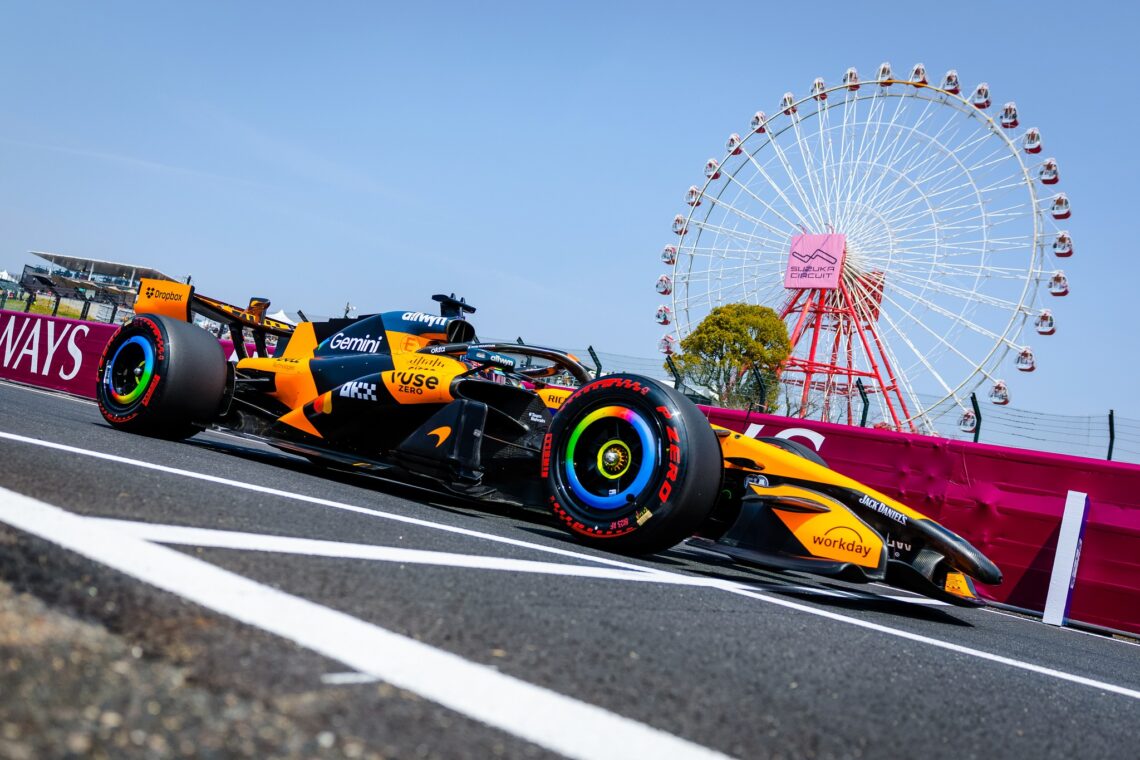
McLaren arrived in Austin with work to do. Despite upgrades to the MCL40, qualifying had left Norris eighth and Piastri seventh, positions that did not reflect the team’s ambitions or its assessment of its longer-run pace.
The team therefore needed to recover ground on Sunday.
Both McLaren drivers started on the medium compound, as did Mercedes. Ferrari and Red Bull took a different approach by starting on the softs, immediately introducing contrasting tyre strategies into the race.
The opening laps also brought an important decision from the McLaren pit wall. After assessing the relative pace of its drivers, the team instructed Piastri to allow Norris through on Lap 8. Norris appeared to have the stronger pace and a better opportunity to challenge the cars ahead.
It was a calculated team decision rather than a simple preference for one driver. McLaren had discussed the possibility beforehand, and Norris subsequently demonstrated the pace that justified the swap.
Then came the tyre decision.
Piastri stopped on Lap 15, switching from mediums to hard tyres. Norris followed on Lap 16, adopting the same compound.
On paper, the move placed both drivers in a position to explore different strategic possibilities. They could attempt a two-stop race if circumstances demanded it, or stretch the hard tyres and convert the afternoon into a one-stop strategy.
That flexibility was important.
The hard compound offered durability, but it also required teams to understand how quickly it could reach its operating window and how much performance it would retain over a long stint. McLaren had struggled to extract consistent one-lap performance from the soft tyres throughout the weekend, so the harder compound offered an opportunity to capitalise on a different set of characteristics.
The gamble was not simply that the hard tyre would last. It was that it would last without surrendering too much lap time.
And for much of the race, the strategy worked.
Norris stayed competitive, while Piastri found himself defending against Russell. The Australian had to manage a substantial tyre-age disadvantage as the Mercedes driver attempted to close the gap, but Piastri kept him behind and secured seventh place.
Norris, meanwhile, benefited from the team’s decision to keep him out as the race developed. At one stage, he occupied second place, with the possibility of a safety car offering an additional incentive to extend his stint.
That opportunity never materialised.
As drivers on fresher tyres began to close in, Norris eventually lost positions to Verstappen, Leclerc and Hamilton. He finished fifth, which McLaren considered a solid recovery from qualifying but not the result its race pace had initially suggested was possible.
The important distinction is that McLaren’s decision was not necessarily a bad one simply because Norris lost positions late in the race.
The team had to weigh the potential gains from track position against the risk of tyre degradation. A second stop would have provided fresher rubber, but it would also have cost time and track position. Staying out offered a chance to protect the result, particularly if a safety car appeared.
McLaren chose to remain on track.
It gained a fifth-place finish for Norris and seventh for Piastri, but the final laps exposed the limitations of asking a tyre to deliver competitive pace for an extended period.
And that brings us to Pirelli.