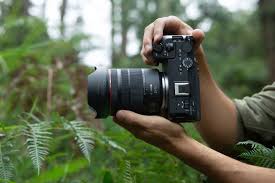
The Canon EOS R6 V (released May 2026) is a radical shift in Canon’s design philosophy. Labeled as a “V-series” camera, it is built from the ground up for video-first creators, stripping away the traditional SLR silhouette for a compact, rangefinder-style body that prioritizes gimbals, vertical content, and long-form recording.
The Comparison: Canon EOS R6 V vs. Sony A7S III
The Sony A7S III has been the “King of Low Light” since 2020. In 2026, the R6 V challenges that throne not through pixel size, but through raw processing power and oversampling.


1. Low Light & ISO Performance
- Sony A7S III: Still retains the cleaner “base” at extreme ISOs (12,800+). Its 12.1MP sensor features massive $8.4\mu m$ pixels that are physically better at light gathering.
- Canon R6 V: Uses a 32.5MP sensor that oversamples from 7K. While the individual pixels are smaller ($5.16\mu m$), the 7K-to-4K downsampling acts as a natural noise reduction filter. In “real-world” ranges (ISO 800–6400), the R6 V appears sharper and holds more detail, though it will show more “grain” than the Sony once you push past ISO 25,600.
2. Dynamic Range
- Sony A7S III: Delivers a reliable 14+ stops in S-Log3.
- Canon R6 V: Canon has finally brought Canon Log 2 to the R6 line, which technically pushes the camera to 15+ stops of dynamic range. The highlight roll-off on the R6 V is notably smoother and more “filmic” than the Sony’s occasionally harsh digital clipping.
Run-and-Gun: Color Beyond the Log
For shooters who don’t want to spend hours grading, the R6 V offers profiles that “pop” straight out of the camera.
- Canon 709 & HDR PQ: The standout for run-and-gun is the Canon 709 profile. Unlike standard Rec.709, it uses the same look-up table as Canon’s high-end cinema cameras, giving you professional contrast and skin tones without the flat, gray look of Log.
- Color Science: Canon’s legendary “skin tone” advantage remains. The R6 V handles red and yellow undertones with a warmth that Sony’s S-Cinetone still struggles to match, particularly under mixed artificial lighting.
- In-Camera LUTs: You can now load 10-bit LUTs directly into the R6 V. You can “bake in” your final look to the footage, allowing for an immediate turnaround for social media.
Ergonomics: The “V-Series” Body
The R6 V is designed for the modern content creator’s workflow.
- No EVF Hump: The flat-top design makes it significantly easier to balance on small gimbals like the DJI RS4.
- Active Cooling: Unlike the A7S III’s passive heat sync, the R6 V has an internal cooling fan. It can record 7K 60p RAW for over two hours without overheating—a feat the Sony can’t match at high frame rates in warm environments.
- Native Vertical Mode: It features a secondary tripod thread on the side and a UI that rotates 90 degrees automatically, making it the first full-frame camera designed for native TikTok/Reels production.
- Zoom Lever: A dedicated rocker switch on the shutter button allows for smooth, variable-speed zooms when using “Power Zoom” (PZ) lenses.
The Cinema Battle: R6 V vs. Canon EOS C70
While the R6 V is a video powerhouse, it still sits below the Cinema EOS C70.

- Sensor Tech: The C70 uses a DGO (Dual Gain Output) sensor, which is technically superior for shadow detail in extreme high-contrast scenes. The R6 V relies on a standard CMOS sensor, though it counters with a higher 32.5MP resolution (vs the C70’s 8.8MP 4K sensor).
- Internal NDs: The C70 has built-in mechanical ND filters—the holy grail for run-and-gun. On the R6 V, you still need to screw on filters or use the EF-RF drop-in adapter.
- Stabilization: The R6 V wins here. Its 7.5-stop IBIS (In-Body Image Stabilization) allows for handheld walking shots that would be shaky on the C70, which relies solely on digital and lens-based stabilization.
| Feature | Canon EOS R6 V | Canon EOS C70 |
| Max Res | 7K RAW (Full Frame) | 4K DCI (Super 35) |
| ND Filters | None (External) | Built-in (Up to 10 stops) |
| Stabilization | 7.5-Stop IBIS | Digital / Lens only |
| Cooling | Active Fan | Active Fan |
| Audio | 3.5mm / Digital Shoe | Dual Mini-XLR / 3.5mm |
Verdict: The R6 V is the ultimate tool for the solo content creator who needs agility and vertical flexibility. The C70 remains the choice for documentary and narrative filmmakers who need the reliability of NDs and XLR audio.