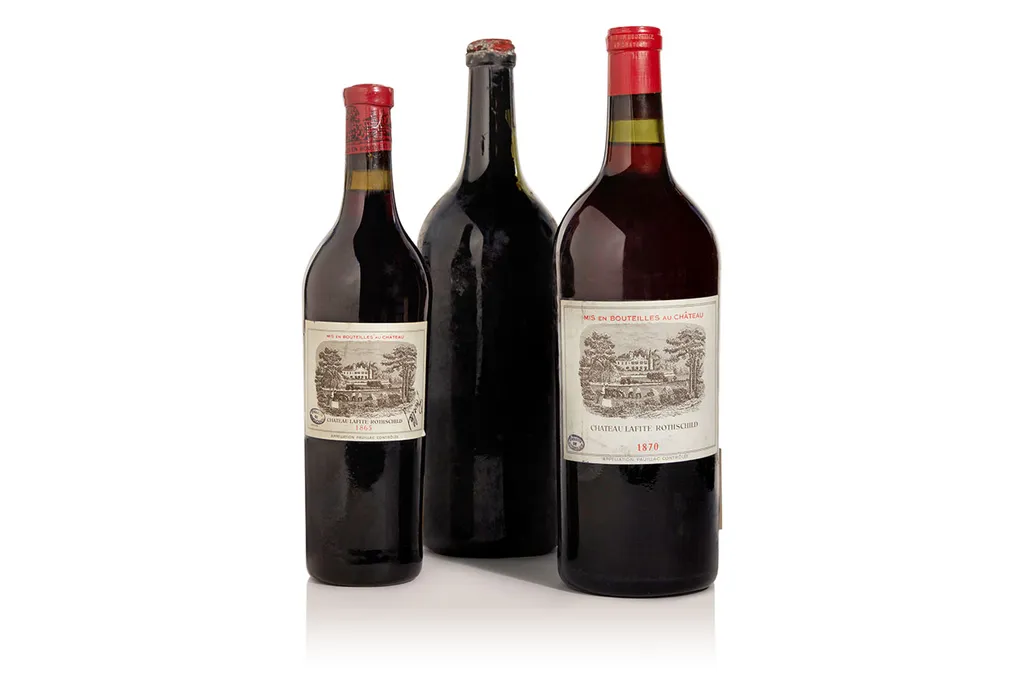
History is often written in ink, but in the case of the Glamis Castle discovery, it was written in fermented grape juice. This past April, the wine world was sent into a frenzy when two magnums of Château Lafite Rothschild 1870 emerged from the “Aladdin’s Cave” of a Scottish cellar to shatter world records at Sotheby’s “Immortal Vintages” auction.

The story sounds like a gothic novel: tucked away for over a century in the dark, damp cellars of the ancestral home of the Earls of Strathmore (and childhood home of the Queen Mother), these magnums were part of a legendary batch purchased in 1878. While the castle above hosted royalty and inspired Shakespearean lore, the wine sat in a state of suspended animation, perfectly preserved by the cold Scottish stone.
The Hammer Falls
The recent Sotheby’s auction in New York proved that time is the ultimate luxury. The two magnums—extraordinarily rare for their size and age sold for a combined $306,250.
- The First Magnum: Set a world record at $106,250.
- The Second Magnum: Topped it moments later, realizing a staggering $200,000 after a four-minute bidding war.
What makes these “Immortal Vintages” so coveted isn’t just the label; it’s the DNA of the vines themselves. These are pre-phylloxera wines, meaning they were produced before a tiny aphid devastated European vineyards in the late 19th century. These grapes grew on original, ungrafted French rootstock a flavor profile that effectively went extinct when the world had to replant using American roots to survive the blight.
The Chemistry of Immortality
How does a liquid survive 156 years without turning into expensive vinegar? The answer lies in the technical trifecta of the 1870 vintage:
- Phenolic Maturity: The 1870 season produced grapes with massive tannins and high acidity. In their youth, these wines were described as “undrinkable” and “stern.”
- The Vessel: Magnums (1.5L) age more slowly than standard bottles. The ratio of oxygen to wine in the neck is lower, slowing the oxidation process to a crawl.
- Perfect Neglect: The Glamis cellar provided a constant, vibration-free, cold environment.
Experts who have tasted samples from this specific cache describe the wine as “defying the laws of nature.” While most century-old wines are fragile, these magnums are reported to be remarkably “sound,” with deep color and an intact “nose” that suggests they are not just survivors, but active, drinkable masterpieces.
The Taste of 1870
What would a 200-year-old Bordeaux (or in this case, a 156-year-old one) actually taste like? Forget the bright, punchy fruit of a modern Napa Cab. This is a journey into tertiary flavors.
- The Appearance: Expect a deep mahogany or brick-red rim. The vibrant purple of youth is long gone, replaced by an autumnal glow.
- The Bouquet: The primary scents of plum and cherry have evolved into a complex “cigar box” aroma. You’ll find notes of cedarwood, old leather, dried tobacco leaf, and “forest floor” (sous-bois).
- The Palate: The once-aggressive tannins have melted into a texture often described as liquid silk or velvet. Because it’s a Lafite, there will be a lingering mineral backbone a ghost of the gravelly soil of Pauillac.
To drink this is to taste a world before the lightbulb, before the automobile, and before the Great War. It is, quite literally, bottled history and for the lucky buyer at Sotheby’s, it’s a $200,000 sip of immortality.