Aston Martin has a long history of competing in some of motorsport’s most prestigious events, but its next challenge is very different. In January 2027, the British marque will take three Dreadnought rally-raid machines into the Dakar Rally, with Prodrive responsible for turning the ambitious project into a competitive reality.
There is a familiar name behind the announcement, one that has been quietly instrumental in Aston Martin’s motorsport ambitions for more than two decades: Prodrive.
The Banbury-based engineering company is not simply a contractor being brought in to prepare three off-road vehicles. Its relationship with Aston Martin stretches back to 2004, when the two organisations joined forces to establish Aston Martin Racing. That partnership would go on to produce some of the marque’s most successful modern competition cars, including the DBR9 and Vantage GTE.
Now, the same engineering relationship is moving away from the smooth tarmac of Le Mans and towards the rocks, dunes and punishing distances of the Dakar.
A partnership that began with a single sheet of paper
Prodrive was founded in 1984 by David Richards, a former rally co-driver who would go on to become one of Britain’s most influential motorsport executives.
The company initially built its reputation in rallying, most notably through its long-running relationship with Subaru. Its World Rally Championship programme helped turn Subaru into one of the defining names of the sport during the 1990s and early 2000s.
Aston Martin’s modern return to international motorsport came through a partnership with Prodrive in 2004. According to Richards, the original agreement between himself and then Aston Martin chief executive Ulrich Bez was remarkably simple, written on a single sheet of paper.
The result was Aston Martin Racing.
The first major product of that relationship was the DBR9, a racing interpretation of the DB9 developed for GT competition. It made its competition debut in 2005 and went on to win the GT1 class at the 24 Hours of Le Mans in 2007 and 2008.
The partnership continued through the Vantage racing programmes, collecting further endurance racing honours and helping establish Aston Martin as a serious presence in international GT competition.
Autosport has reported that the Prodrive-run Aston Martin factory programme produced six Le Mans class victories and nine World Endurance Championship titles during its era.
It is worth understanding the distinction: Prodrive is an independent motorsport engineering company, not Aston Martin’s parent company. David Richards did lead a consortium that acquired Aston Martin in 2007, but Prodrive itself was not financially involved in that acquisition. His personal involvement in the ownership story should not be confused with the commercial relationship between the two businesses.
That relationship has continued through Aston Martin’s customer racing programmes and now extends into rally-raid.
Prodrive’s Dakar story began with Bahrain Raid Xtreme
Prodrive’s Dakar ambitions became public in 2020, when it announced a partnership with Bahrain Raid Xtreme, commonly known as BRX.
The project was developed in collaboration with Bahrain’s motorsport interests, with Prodrive responsible for designing and manufacturing a vehicle capable of challenging for overall victory.
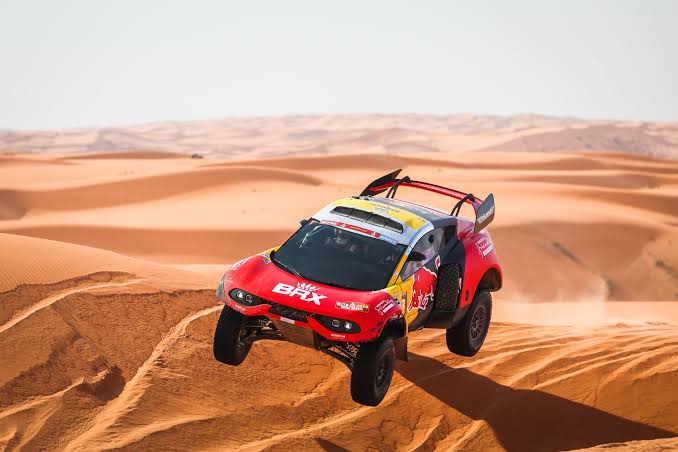
The result was the Prodrive BRX Hunter.
The Hunter was a purpose-built rally-raid machine, rather than a modified production SUV. It featured a tubular steel chassis, bespoke suspension and composite bodywork. Its original engine was a dry-sumped 3.5-litre twin-turbocharged Ford V6, producing approximately 400bhp.
Its first Dakar appearance came in 2021, with Sébastien Loeb and Nani Roma among the drivers. Roma finished fifth in the car category, while Loeb retired.
The following year brought a major breakthrough. Loeb finished second overall in 2022, establishing the Hunter as a genuine contender. He repeated that runner-up finish in 2023, demonstrating that Prodrive’s programme could consistently challenge the established Dakar manufacturers.
The Hunter’s success was not simply about straight-line speed. Dakar rewards reliability, navigation, suspension durability, tyre management and the ability to survive days of punishing terrain. Prodrive had developed a vehicle capable of competing across all those demands.
From Bahrain to Dacia: the Sandrider evolution
In 2024, Prodrive’s Dakar experience entered another chapter when it began working with Dacia on a new factory rally-raid programme.
The Dacia Sandrider was developed from Prodrive’s accumulated knowledge of the Hunter, but it was a substantial new project rather than merely a change of bodywork.
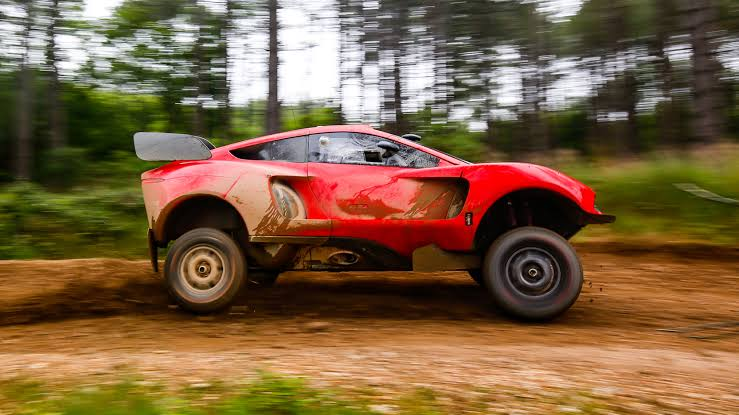
The Sandrider featured a bespoke rally-raid design, a tubular chassis and a Nissan-derived 3.0-litre twin-turbocharged V6 running on sustainable fuel. Prodrive was responsible for the engineering and technical development of the car, while Dacia provided the manufacturer identity and factory-backed programme.
The Sandrider made its Dakar debut in January 2025. Its first outing was a learning experience, but the programme was built around experienced competitors, including Loeb and Nasser Al-Attiyah.
Then came January 2026.
Al-Attiyah, alongside Belgian navigator Fabian Lurquin, secured victory in the Dakar Rally, giving Dacia its first overall Dakar win and Prodrive another major achievement in its rally-raid history.
It was Al-Attiyah’s sixth Dakar victory, and the Sandrider’s first.
That result is important to the Aston Martin announcement. Prodrive is not entering the 2027 Dakar with an untested engineering philosophy. It is bringing experience from a vehicle that has already won the event.
Dacia exits, Aston Martin enters
Dacia’s decision to end its rally-raid programme after the 2026 season might have appeared to leave Prodrive facing an uncertain future in the championship.
Instead, the engineering company has secured a new manufacturer partner.
On 17 November 2026, Aston Martin announced its three-car Dakar programme for January 2027, with the Dreadnought as its competition vehicle.
The Dreadnought has an unusual origin. Its original design was created as a digital-only, military-inspired Aston Martin vehicle for the video game Call of Duty: Modern Warfare 4. The concept was imagined as an extreme all-terrain machine, but it was not initially a production or competition vehicle.
For Dakar, that virtual concept has been reinterpreted as a purpose-built rally-raid machine.
Prodrive has engineered and built the competition vehicles and will exclusively operate all three cars during the event.
The driver line-up is equally ambitious:
- Fernando Alonso, two-time Formula 1 World Champion, returns to Dakar after finishing 13th on his 2020 debut. He will be partnered by five-time Dakar motorcycle winner Marc Coma.
- Sébastien Loeb, nine-time World Rally Champion, returns to the event still pursuing his first overall Dakar victory. He will compete with navigator Fabian Lurquin.
- Lucas Moraes, the reigning 2025 FIA World Rally-Raid Champion, joins the team with navigator Pablo Moreno. Moraes finished third on his Dakar debut in 2023.
This is an interesting combination of experience. Alonso brings circuit racing and previous Dakar knowledge, Loeb brings extensive rally experience, while Moraes arrives with recent success in the rally-raid championship.
The programme will be led by Aston Martin Racing, but the engineering and operational responsibility rests with Prodrive.
What is underneath the Dreadnought?
This is where the technical story becomes particularly interesting.
Aston Martin has confirmed that Prodrive has developed and built the Dreadnought rally-raid cars. However, the manufacturer has not yet released a complete technical specification for the competition vehicle.
The car is understood to draw heavily on Prodrive’s existing T1+ rally-raid architecture and experience with the Dacia Sandrider. That provides a proven engineering foundation, rather than requiring Prodrive to begin an entirely new Dakar development programme.
The distinction matters because Dakar’s Ultimate category is governed by technical regulations that place limits on dimensions, weight, performance and other aspects of the vehicle.
The Dreadnought’s dramatic exterior may look very different from the Sandrider, but the engineering beneath the bodywork is where Prodrive’s previous work could prove valuable.
The engine specification should be treated with caution until Aston Martin or Prodrive confirms it officially. The Dacia Sandrider used a Nissan-derived 3.0-litre twin-turbocharged V6, while the original BRX Hunter used a Ford-derived 3.5-litre twin-turbocharged V6. Those specifications should not automatically be attributed to the new Aston Martin.
What is clear is that Prodrive will be responsible for delivering a machine capable of surviving the conditions of the 2027 event.
Dakar 2027: a new challenge for Aston Martin
The 2027 Dakar Rally is scheduled to run from 9 to 23 January, beginning in Portugal before continuing through Morocco and finishing in Marrakech.
The event will include 12 stages and thousands of kilometres of competition, including more than 4,300 kilometres of timed special stages according to Aston Martin’s announcement.
For Aston Martin, this is its first entry into the world of rally-raid. For Prodrive, it is a continuation of a programme that began with Bahrain Raid Xtreme, developed through the BRX Hunter and reached the top step of the podium with Dacia.
The significance of this partnership is that Aston Martin is not attempting to build an entirely new Dakar operation from scratch. It is adopting the experience of a company that has already spent years developing, testing and operating competitive rally-raid machinery.
And perhaps that is the most interesting part of the story.
Aston Martin’s name will be on the Dreadnought, but the engineering DNA comes from a company that has spent four decades building winning machinery across rallying, endurance racing and off-road competition.
The 2027 Dakar will be the first time that combination is tested under the Aston Martin banner. Prodrive has already won the event with Dacia. Now it has the opportunity to do it again with one of Britain’s most recognisable luxury marques.