Toyota’s New Dakar Weapon: 18 Months of Development, One Radical Change in Direction
The Hilux has traded its traditional combustion engine for hydrogen-electric propulsion. Toyota Gazoo Racing is taking one of its most recognisable rally-raid platforms into unfamiliar territory, and the 2027 Dakar Rally will become its proving ground.
There are few environments capable of exposing the weaknesses of a new vehicle quite like the Dakar Rally. Thousands of kilometres of sand, rocks, extreme temperatures and relentless vibration make it one of the toughest engineering examinations in motorsport.
Toyota Gazoo Racing knows this better than most. Its Hilux has become a familiar presence in rally-raid competition, but the manufacturer is preparing to take the platform in a very different direction.
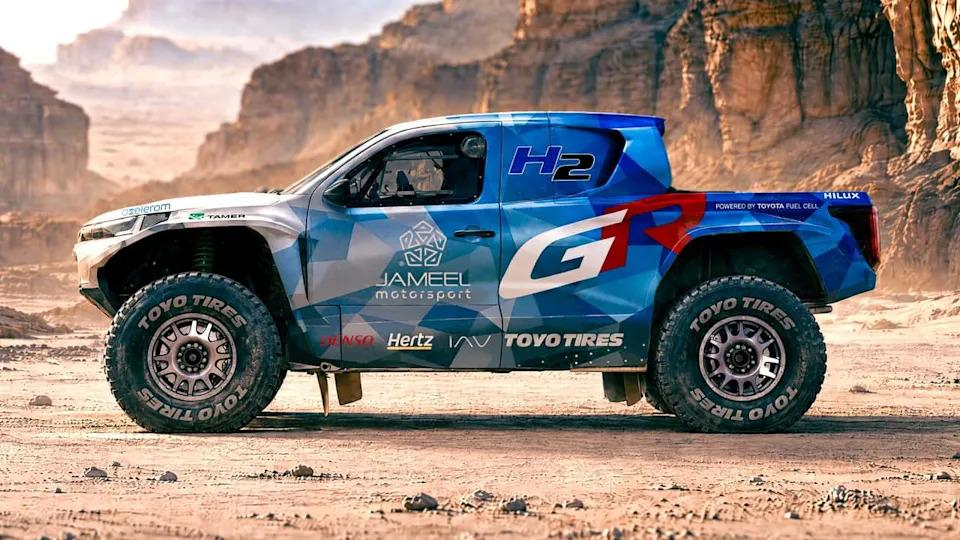
Meet the DKR GR FC Hilux, Toyota’s hydrogen-powered fuel-cell electric rally truck, developed for the 2027 Dakar Rally.
This is not simply another evolution of the competition Hilux. Toyota has replaced the traditional petrol engine with a fuel-cell electric powertrain, introducing a completely different approach to energy production, cooling and vehicle packaging.
From combustion to hydrogen: what actually changed?
The original DKR GR Hilux platform has been developed around a twin-turbocharged V6 petrol engine. Its latest 2026 competition specification uses the V35A engine sourced from the Land Cruiser 300, producing approximately 359 hp and 620 Nm of torque.
The new DKR GR FC Hilux takes a different route.
Instead of burning petrol to generate mechanical power, it uses compressed hydrogen to produce electricity through two fuel-cell stacks. That electricity powers a dedicated electric axle.
Toyota has confirmed a system output of 400 kW, equivalent to approximately 536 hp.
The hydrogen is stored in four high-pressure tanks using technology derived from the Toyota Mirai.
The result is a vehicle that produces no tailpipe CO₂ while driving, with water as its tailpipe emission.
However, this is not a battery-electric truck. Its electricity is generated onboard through the hydrogen fuel-cell system rather than relying exclusively on a large rechargeable traction battery.
What has changed underneath?
Interestingly, Toyota has retained several fundamental elements of the proven Dakar platform.
The DKR GR FC Hilux shares its tubular frame, safety cell, suspension and braking architecture with the existing DKR GR Hilux.
That is an important engineering decision. Rather than starting with an entirely new vehicle, Toyota has retained a proven structural foundation while concentrating development on the powertrain and its supporting systems.
The changes include:
- Powertrain: Two hydrogen fuel-cell stacks replace the petrol engine.
- Electric drive: A dedicated e-axle replaces the conventional engine-driven arrangement.
- Electronics: A new electronics system and IAV Dragoon ECU manage the technology.
- Cooling: A new high-voltage cooling system addresses the demands of the fuel-cell and electric systems.
- Bodywork: Natural-fibre panels replace some carbon-fibre components.
- Fuel storage: Four high-pressure hydrogen tanks hold a combined 8.4 kg of hydrogen.
The suspension remains double-wishbone, with 350 mm of travel.
This is not a complete reinvention of the Hilux. It is a substantial powertrain transformation built around an established competition platform.
The numbers behind Toyota’s new machine
Specification | DKR GR FC Hilux |
|---|---|
Powertrain | Hydrogen fuel-cell electric |
Fuel-cell stacks | 2 |
System output | 400 kW |
Approximate output | 536 hp |
Hydrogen storage | 8.4 kg |
Hydrogen tanks | 4 |
Chassis | Tubular frame |
Suspension travel | 350 mm |
Length | 4,500 mm |
Width | 2,300 mm |
Height | 2,100 mm |
Weight | Under 2,500 kg |
These are Toyota’s published specifications, not independent performance measurements. No official acceleration, range or refuelling-time figures have been published in the technical announcement.
Why the cooling system matters
One of the most important parts of this development is not necessarily the headline power figure.
It is cooling.
Fuel-cell systems operate under different thermal conditions from conventional combustion engines. They must manage the heat generated during electrochemical reactions, while the electric drive and high-voltage components introduce additional thermal requirements.
In the Dakar environment, that becomes particularly challenging.
The vehicle must operate across prolonged stages, at varying speeds, in sand, dust and extreme temperatures. It cannot simply rely on a laboratory-tested cooling solution.
Toyota has specifically identified improved cooling and durability as important development objectives for its fuel-cell technology.
The new high-voltage cooling system is therefore more than a technical specification. It is one of the areas that could determine whether hydrogen fuel-cell technology can become viable in demanding motorsport applications.
A different kind of Dakar challenge
Toyota will enter the DKR GR FC Hilux in the Dakar Future Mission 1000 category.
This is important because the category is designed to accommodate experimental vehicles and emerging propulsion technologies.
The truck is not entering the conventional Ultimate class to compete directly for the overall Dakar victory against the regular DKR GR Hilux, Dacia Sandriders and other established competition machinery.
Instead, Toyota is using the event as a real-world engineering laboratory.
The objective is to understand how hydrogen technology performs under conditions that ordinary road testing cannot fully replicate.
Dania Akeel gets behind the wheel
Toyota has selected Saudi rally driver Dania Akeel to drive the new machine during its testing programme and its first competitive outing.
Akeel brings valuable rally-raid experience, including a Dakar stage victory in 2025 and success in the FIA Middle East Baja Cup.
Her appointment is particularly interesting because the project requires more than a driver capable of extracting speed from a vehicle.
Toyota needs detailed feedback about how this new powertrain behaves across changing terrain, temperatures and operating conditions.
Akeel will be part of the development process, helping engineers understand how the technology responds outside controlled testing environments.
What does this mean for Toyota’s future road cars?
This is arguably the most important part of the project.
Toyota has consistently maintained its multi-pathway approach to reducing emissions, rather than committing exclusively to battery-electric vehicles.
That strategy includes conventional hybrids, plug-in hybrids, battery-electric vehicles, hydrogen combustion engines and hydrogen fuel-cell technology.
The DKR GR FC Hilux gives Toyota another opportunity to investigate the potential of hydrogen fuel cells.
The company has identified three particularly important areas:
- Fuel-cell downsizing.
- Improved thermal management.
- Greater durability under demanding operating conditions.
If the technology proves reliable, the experience could inform future fuel-cell applications beyond motorsport.
There is, however, an important qualification: zero tailpipe CO₂ does not automatically mean zero lifecycle emissions. The environmental impact also depends on how hydrogen is produced, transported and stored.
The bigger engineering story
Toyota’s regular DKR GR Hilux and its new hydrogen-powered counterpart represent two different development directions.
The conventional 2026 DKR GR Hilux received a new, lighter and stiffer tubular chassis, alongside a reinforced transmission designed to improve durability and servicing.
The DKR GR FC Hilux goes considerably further, retaining much of that proven structural architecture while replacing the combustion powertrain with hydrogen-electric propulsion.
Both projects demonstrate Toyota’s willingness to develop its rally-raid machinery beyond incremental cosmetic changes.
The hydrogen truck is particularly significant because the Dakar Rally will provide an opportunity to test the technology under sustained competitive conditions.
It is easy to produce impressive specifications in a press release. It is considerably harder to keep a vehicle operating reliably through the desert.
Toyota’s real test begins when the kilometres start accumulating.