Range Rover returns to Dakar: A 1972 Classic takes on the 2027 rally
More than four decades after the Range Rover helped establish Land Rover’s reputation in the original Paris-Dakar Rally, an American team is preparing to take a 1972 example back into competition. This time, it is not about chasing luxury or modern technology. It is about heritage, endurance and proving that an old-school V8 still has a place in one of motorsport’s toughest challenges.
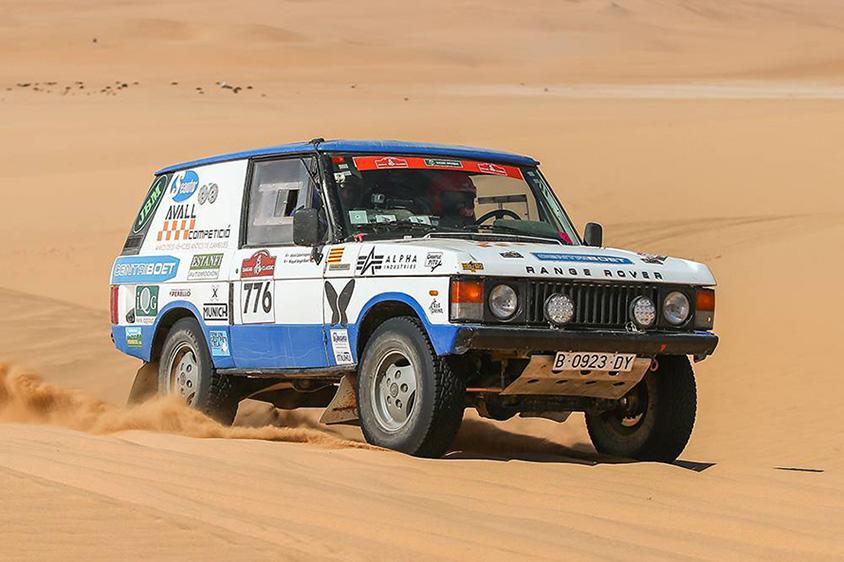
There is something rather special about seeing a classic Range Rover heading back towards Dakar.
Long before the Defender became a household name among off-road enthusiasts, before the modern luxury SUV became a status symbol and before manufacturers began treating rally-raid competition as a global marketing exercise, there was the original Range Rover.
Introduced in 1970, it was an unusual combination of engineering simplicity, practicality and genuine off-road ability. It was comfortable enough for everyday use, but capable of travelling far beyond the boundaries of conventional road-going vehicles.
Its competition history began almost immediately.
In 1979, the Range Rover won the inaugural Paris-Dakar Rally, driven by Alain Génestier, Joseph Terbiaut and Jean Lemordant. It was an important moment for the young event and for Land Rover’s reputation as a manufacturer capable of building vehicles that could survive extraordinary conditions.
Now, an American team wants to revisit that history.
Team Roamerdrive: An old-school approach to a modern challenge
Team Roamerdrive, powered by TWS Motors, announced its intention to enter the 2027 Dakar Classic with a 1972 Range Rover Classic.
The team brings together Jenna Fribley and Liza Beres, two competitors who have developed their rally experience through the all-women Rebelle Rally.
Their partnership is particularly interesting because this is not a conventional factory racing operation. It is a privately developed heritage project, built around an early example of one of Britain’s most recognisable off-road vehicles.
The announcement was made in September 2025, with the original plan calling for a Saudi Arabian event. The Dakar organisers subsequently relocated the 2027 edition to Portugal and Morocco.
The challenge remains the same, however: prepare a vehicle that is more than half a century old to tackle an international endurance rally.
Under the bonnet: The Rover V8 lives on
The most appealing part of the project is its commitment to the original Range Rover character.
Rather than replacing the vehicle’s identity with a modern performance engine, the team has outlined a rebuilt 3.5-litre Rover V8.
The engine is paired with the original LT95 gearbox architecture, which is being upgraded for the demands of competition.
The preparation also includes a Roamerdrive overdrive system, designed to improve gearing flexibility, alongside upgraded differential components and reinforced drivetrain hardware.
The suspension receives a two-inch lift and upgraded shock absorbers, while the axles and associated components are strengthened to cope with repeated impacts.
This is not simply a restoration project. A vehicle intended for Dakar needs to be mechanically prepared for long days of competition, unpredictable terrain and the possibility of repairs far from a conventional workshop.
The original Rover V8 may not offer the sophistication or efficiency of a contemporary competition powertrain, but its character is part of the attraction.
What is the Dakar Classic?
It is worth making an important distinction between the Dakar Rally and the Dakar Classic.
The Dakar Classic is a separate competition designed around historic vehicles, with entries assessed through regularity and navigation challenges rather than simply racing against the clock in the same way as the modern Ultimate category.
It is not a demonstration parade for old machinery. Competitors must manage their vehicles, follow the route and meet the sporting requirements of the event.
That makes the Range Rover an appropriate choice.
Its original engineering was developed during an era when mechanical simplicity and durability were central to off-road vehicle design. The Classic category provides an opportunity to revisit that engineering philosophy in a modern competitive setting.
From the original Range Rover to the Defender D7X-R
There is another Land Rover story unfolding at Dakar.
Defender’s modern D7X-R competition programme entered the 2026 Dakar Rally and won on its debut. The programme represents a very different approach to the one being taken by Team Roamerdrive.
The D7X-R is a modern factory-backed competition machine, based on Defender’s D7X architecture and powered by a 4.4-litre twin-turbocharged V8.
It was developed to compete in the Stock category of the FIA World Rally-Raid Championship, a class focused on production-based vehicles.
Defender’s commitment extends beyond one event, with a three-year World Rally-Raid Championship programme running from 2026.
The contrast is fascinating.
On one side, a 1972 Range Rover, retaining its original V8 heritage and receiving carefully considered mechanical upgrades.
On the other, a modern Defender, engineered with contemporary materials, advanced driveline technology and factory-backed development.
Both represent the same British off-road tradition, but separated by more than half a century of engineering evolution.
Dakar 2027: A different destination
The 2027 Dakar will not follow the Saudi Arabian route originally announced.
Following a change in the event’s location, the 49th edition will take competitors from Portugal into Morocco.
The rally is scheduled for January 9–23, beginning with a prologue around Loulé-Faro and finishing in Marrakech.
The route will cover approximately 7,824 kilometres, including 4,341 kilometres of competitive special stages, with 12 stages and a rest day in Agadir.
For Team Roamerdrive, that means a different preparation environment from the original announcement.
Portugal will provide the opening challenge before competitors cross into North Africa, where Morocco’s varied terrain will test the crews and their machinery.
Why this Range Rover matters
The significance of this entry goes beyond its age or appearance.
The original Range Rover helped define what a luxury off-road vehicle could be. It was not designed to be a soft road-going alternative to a traditional 4×4. Its identity came from its ability to combine comfort with genuine capability.
That philosophy helped establish a vehicle that would eventually influence an entire segment of the automotive industry.
Returning a 1972 example to Dakar is therefore more than a nostalgic exercise. It is an opportunity to revisit the engineering that made the Range Rover special in the first place.
And while the modern Defender programme may be pursuing outright competitive success, Team Roamerdrive is carrying a different kind of ambition.
Sometimes the most interesting vehicle at Dakar is not the newest, the most powerful or the most technologically advanced.
Sometimes it is the one that reminds us where the story began.
For Range Rover, that story began in 1970, and Dakar was one of the places where it learned to prove itself.