
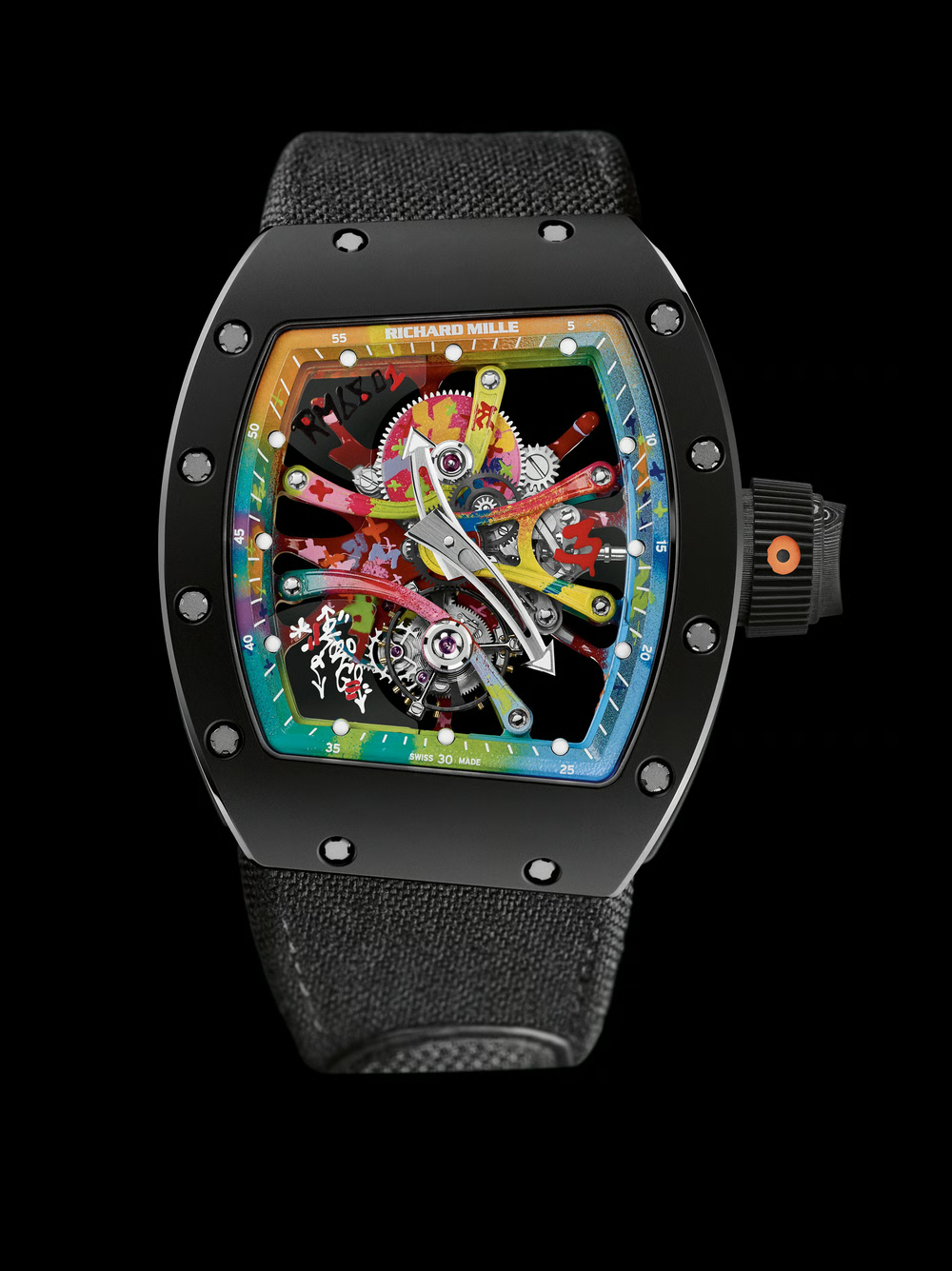
The Anatomy of Appreciation: Why High-End Watches Command Alternative Asset StatusFor decades, the standard financial playbook dictated allocating capital into equities, bonds, and real estate. However, the modern investment landscape has seen a paradigm shift toward alternative assets—specifically, the clinical, mechanically dense world of haute horology. Watches are no longer viewed merely as instruments of utility or expressions of personal style; they have been formalised as sophisticated stores of value that, when selected with engineering and historical rigor, can radically outperform traditional market indices.Unlike standard consumer goods that depreciate the moment they leave the showroom floor, elite timepieces appreciate through a complex matrix of structural levers. When assessing a watch as a financial asset, four foundational pillars dictate its ultimate valuation: brand equity, heritage, condition, and provenance.

[ The Valuation Matrix ]
│
┌────────────────────────┼────────────────────────┐
▼ ▼ ▼
[ Brand & Heritage ] [ Fine Condition ] [ Provenance / Owner ]
(Artisanal scarcity; (Unpolished cases; (Celebrity attachment;
historical depth) original dial patina) historical significance)
The Four Pillars of Horological AppreciationBrand Identity & Technical ScarcityThe bedrock of any appreciating asset is structural scarcity mapped against institutional demand. In watchmaking, this is driven by brands that fiercely protect their production limits while maintaining peerless artisanal standards. Independent watchmakers like F.P. Journe and Akrivia, alongside legacy titans Patek Philippe and Audemars Piguet, do not manufacture to meet market demand; they manufacture to meet the limits of their own technical capacity. This structural deficit ensures that supply remains permanently constrained.

Heritage & Historical Significance A timepiece that introduces a paradigm shift in mechanical engineering or design language carries an inherent premium. Whether it is Patek Philippe’s pioneering execution of the perpetual calendar split-seconds chronograph or early multi-crown world-timers, historical depth transforms a mechanical object into a cultural artifact. Collectors pay for the “firsts,” the prototypes, and the references that defined an era of design. Condition: The Premium of PreservationIn the vintage market, condition is the ultimate arbiter of value. A structurally flawless timepiece that retains its original factory geometry commands an immense premium over an identical reference that has been aggressively serviced.Case Integrity: Collectors hunt for sharp, crisp bevels and unpolished lugs. Industrial polishing removes microscopic layers of metal, permanently softening the original architecture of the watch.Dial
Patina
Originality trumps perfection. Re-dialed or chemically altered faces destroy asset value, whereas natural, structurally stable degradation such as “tropical” fading or uniform tritium oxidation accelerates it.
Provenance: The Multiplier EffectProvenance the documented history of a watch’s ownership is the most volatile and explosive driver of asset appreciation. When a timepiece is directly linked to a high-profile cultural icon, an industrial titan, or a historical event, its valuation decouples from standard market metrics. The watch transitions from a horological asset to a piece of social history, introducing a multiplier effect that can turn a six-figure watch into an eight-figure record-breaker.
Real-World Proof
The 2026 Auction BenchmarkThe reality of this appreciation matrix has been vividly illustrated across major auction houses, where marquee sales have shattered historical records, heavily driven by extraordinary provenance and sheer rarity. [ Notable 2026 High-Profile Auction Results.]
• F.P. Journe Chronomètre à Résonance “Souscription No. 007” ──► $13.9 Million
(Record for an independent watchmaker; extreme rarity)
• Patek Philippe Ref. 5004G-020 “Eric Clapton” ───────────────► $5.2 Million
(Custom-commissioned provenance; massive estimate delta)
Agassiz Watch Co. “Victory Watch” (Charles de Gaulle) ──────► CHF 1.46 Million
(Pure historical heritage and political provenance)
The Power of Independent Engineering
F.P. Journe No. 007The peak of independent horology was realized at the Phillips New York Watch Auction: XIV, where an early, incredibly rare F.P. Journe Chronomètre à Résonance “Souscription, No. 007” executed in pink gold and platinum skyrocketed to a staggering $13.9 million. This monumental result established a new global record for any independent watchmaker and any 21st-century watch sold at commercial auction. The valuation reflects a pure convergence of mechanical heritage and intense scarcity, cementing early subscription pieces as the blue-chip assets of modern collecting.

Custom Royalty
Eric Clapton’s Patek Philippe Ref. 5004GThe same New York session spotlighted how a high-profile name can completely re-write an asset’s valuation curve. A unique Patek Philippe Reference 5004G-020 perpetually calendar split-seconds chronograph, custom-commissioned by legendary musician and prolific collector Eric Clapton, achieved $5.2 million. Bidding blew past its $700,000 low estimate by more than seven times, proving that when a world-class reference meets impeccable celebrity provenance, standard market caps cease to exist.
Presidential and Cultural Lineage
De Gaulle & WarholThe premium of historical ownership extended to political and artistic titans across the spring and summer sessions: At the record-breaking Phillips Geneva Watch Auction: XXIII, an Agassiz Watch Co. “Victory Watch” historically gifted to French President Charles de Gaulle fetched CHF 1,460,500, illustrating how raw political history inflates market demand. Meanwhile, Christie’s New York season brought forward a beautifully preserved Patek Philippe Calatrava Ref. 570 formerly owned by pop-art icon Andy Warhol, commanding a premium based entirely on its proximity to mid-century art royalty.
The Future of the Market: Art-Market Dynamics The data tracking through these auction cycles demonstrates that the high-end vintage and independent watch market is evolving. The influx of aggressive, highly capitalized capital—frequently migrating over from the fine art world—is treating these timepieces with the same financial gravitas as a signed canvas. For the astute investor, a watch is no longer just a mechanical tool to tell time. Wrapped within a unpolished case, an authentic brand lineage, and an ironclad ownership history, it represents one of the most resilient, liquid, and culturally significant alternative assets available on the global landscape.