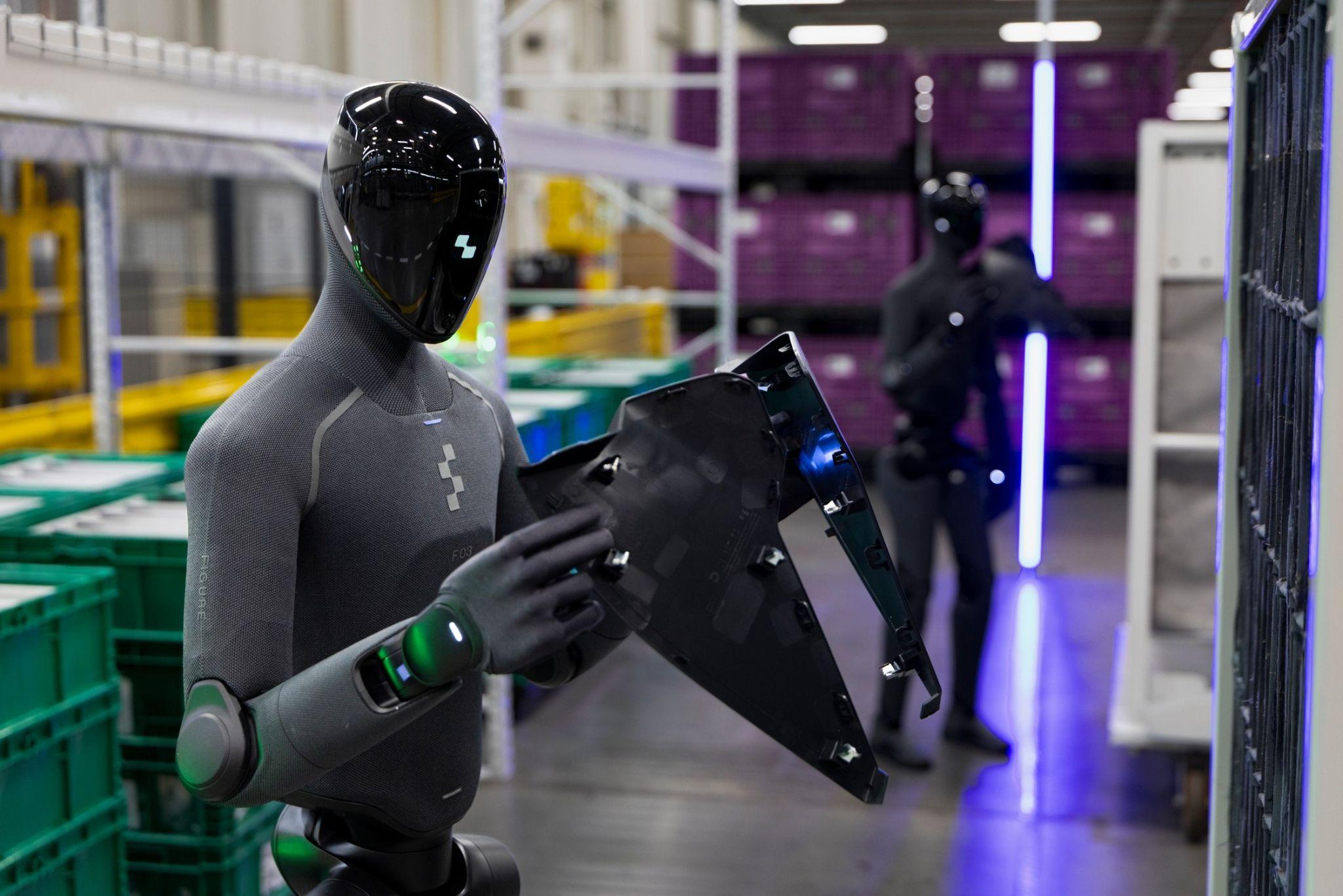
The German automaker has declared an end to the “experimental sandbox” era of manufacturing, fully integrating a fleet of titanium-boned autonomous humanoids directly into the operational grinding machine of their South Carolina plant. This isn’t a cautious pilot program or a sanitized PR stunt. It is a systematic corporate execution of “Physical AI”—the cold, corporate marriage of neural network datasets with real-world pneumatic actuators and articulating limbs.
[ Unsorted Freight Containers ]
│
▼ (Figure 03 Tactile Scanning)
[ Real-Time Bin Kitting ]
│
▼
[ Automated Tugger Train ] ──► [ Assembly Line Floor ]
1. The Proving Grounds: 30,000 Defiant X3 ChassesTo understand why BMW is aggressively expanding this synthetic workforce, you have to look at the brutal metric sheet left behind by the obsolete Figure 02 model. Over a grueling 11-month tour of duty in the punishing environment of the Spartanburg body shop, a pair of these faceless androids pulled full-time, 10-hour shifts right alongside standard assembly employees.Their assignment? A monotonous, joint-destroying task requiring the machine to lift sharp, stamped sheet-metal components from storage racks, orient them precisely in mid-air, and seat them directly into the welding fixtures at a unrelenting 84-second cycle pace.

The Operational Proof: By the time the trial concluded, the autonomous platform had logged over 1,250 operational hours, validated a staggering 98.7% task success rate, and assisted in the physical fabrication of more than 30,000 BMW X3 vehicles.According to Brett Adcock, the tech-evangelist founder of Figure AI, the deployment definitively proved that humanoid machines are no longer expensive laboratory novelties. They are robust, fully scalable industrial assets designed to supplement a volatile human labor pool.
2. Enter Figure 03: The Upgrade MatrixWith the body shop metrics thoroughly analyzed, BMW is moving directly to the next phase of deployment with Figure AI’s next-generation successor: the Figure 03.Built entirely upon the structural failure points of its predecessor—most notably a complete mechanical overhaul of the complex, high-wear forearm and wrist joints—the new unit is engineered for far more chaotic, non-linear environments.
[ Figure 02 Baseline Spec ] [ Figure 03 Upgraded Spec ]
• 12-Degree-of-Freedom Hands • 16-Degree-of-Freedom Hands
• 16 kg Maximum Payload Capacity • 20 kg Maximum Payload Capacity
• Wired Tethered Power Cycles • Inductive Wireless Charging
• Reactive Visual Positioning • Tactile Fingertips & Palm Cameras
The addition of soft-skinned external impact dampeners means the robot can safely move outside of hard-fenced safety cages. More importantly, the system now features real-time, OpenAI-backed speech-to-speech capabilities, allowing human operators on the floor to verbally issue operational commands and receive instant audio status updates.3. The Intralogistics Sorting GrindWhile the older model spent its lifetime staring at a singular welding rig, the Figure 03 has been unleashed into the logistical wilderness of Hall 52. The robot’s new assignment is a classic, high-friction automotive bottleneck: Just-In-Sequence (JIS) sorting.Bulk, unsorted components arrive at the bay in massive, chaotic freight containers. Using its palm-mounted vision arrays and high-sensitivity tactile fingertips, the Figure 03 must autonomously identify the parts, extract them from the clutter, and arrange them perfectly into a mobile sequencing trolley.Once full, the cart is latched onto an autonomous smart transport vehicle, which rockets the parts down to the main line, delivering them to the human assembly crews at the exact millisecond they are scheduled for installation on passing X3 and electrified iX5 chasses.4. The All-Seeing Eye of the iFACTORY.
This android deployment is just one tentacle of BMW’s comprehensive digital panopticon, known internally as the iFACTORY framework. Long before a single physical component is stamped out, the entire assembly environment is mapped, simulated, and stress-tested within a virtual 3D digital twin ecosystem.
[ Virtual 3D Factory Twin ] ──► [ Ergonomic AI Simulation ] ──► [ Physical Shop Floor ]
This virtual space doesn’t just layout machinery; it simulates human biomechanical stress to optimize ergonomics before real workers ever touch a wrench.Once the physical assembly lines are running, a proprietary machine-learning software matrix called AIQX (Artificial Intelligence Quality Next) takes over monitoring duties. Utilizing a network of high-speed optical cameras and acoustic sensors tracking the cadence of the line, AIQX evaluates every weld, bolt, and panel placement in real time. If a variance is detected, the system immediately fires an alert to the smart devices of nearby line workers, creating an unblinking, machine-driven quality insurance loop that BMW is already preparing to mandate across its entire global tier-1 supplier network.