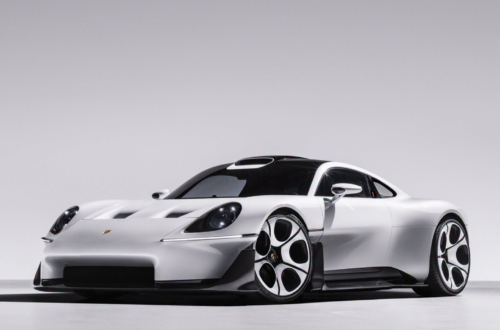
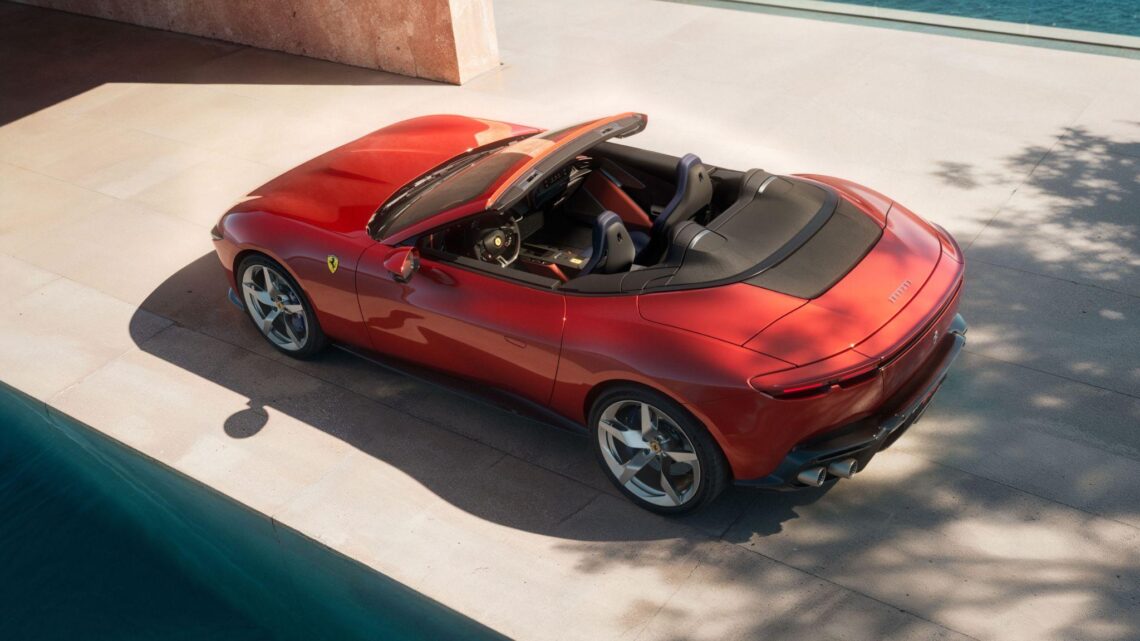
Maranello is currently running two entirely parallel masterclasses in open-top motoring, and they couldn’t be more ideologically opposed. In one corner, you have the 296 GTS—a mid-engined, plug-in hybrid weapon born from the wind tunnel and the telemetry data of Scuderia Ferrari. In the other, you have the Amalfi Spider, a front-mid-engined, pure-combustion V8 grand tourer that looks like it was sketched into existence on a cocktail napkin in Portofino.
You’re not alone in finding the Amalfi sexier. In fact, that’s exactly what Ferrari intended. Where the 296 GTS is a clinical exercise in high-performance physics, the Amalfi is pure visual romance.
The Design Philosophy: Monolithic Form vs. Functional Flow
The aesthetic divide between these two comes down to what the designers prioritized first.
- The Amalfi Spider (The Sculptor): When Flavio Manzoni’s team penned the Amalfi to succeed the Roma, they started by carving a “speed form”—a solid, raw sculpture completely devoid of grilles, vents, or lights. The functional elements were cut into that monolithic shape as subtly as possible. It relies on minimalist surfaces and muscular, unbroken lines. It’s classically elegant, prioritizing tactile beauty and proportion over aggressive aero-graphics.

- The 296 GTS (The Scientist): The 296 is a visual representation of thermodynamic management. Every curve is dictating air to an intercooler, a brake duct, or the active rear spoiler nestled between the teardrop buttresses. It’s short, wide, and aggressive—a modern homage to the 250 LM, but unmistakably digitized.
While the 296 GTS looks like it wants to break a lap record, the Amalfi Spider looks like it belongs draped across a coastal cliffside road, reflecting the sunset off its long, sculpted hood.
Raw V8 Engineering vs. Hybrid Complexity
Under the skin, the mechanical contrast is just as stark.
Feature | Ferrari Amalfi Spider | Ferrari 296 GTS |
|---|---|---|
Engine Layout | Front-mid-mounted | Rear-mid-mounted |
Powertrain | 3.9L Twin-Turbo Pure V8 (F154 BH) | 3.0L Twin-Turbo V6 + Electric Motor (PHEV) |
Peak Power | 631 hp (640 cv) @ 7,500 rpm | 819 hp (830 cv) combined |
Redline | 7,600 rpm | 8,500 rpm |
0–100 km/h | 3.3 seconds | 2.9 seconds |
Top Speed | 320 km/h (199 mph) | >330 km/h (205 mph) |
The 296 GTS is a packaging marvel, mating a wide-angle V6 to an axial-flux electric motor to deliver an astonishing 819 horsepower. It features instant electric torque fill and a screaming 8,500 rpm redline that earned its engine the nickname “piccolo V12.”
The Amalfi Spider, meanwhile, is a glorious tribute to unadulterated, old-school internal combustion. It utilizes the latest, highly optimized evolution of Ferrari’s award-winning twin-turbo V8. It gives up nearly 200 horsepower to the hybrid 296, but it rewards you with the linear power delivery of a flat-plane crank, a visceral mechanical growl amplified by the open air, and a beautifully balanced 48:52 front-to-rear weight distribution.
The Cockpit Experience: A Welcome Return to Tactility
Ferrari also used the Amalfi generation to address one of the modern era’s biggest gripes: the interior interface.
The 296 GTS utilizes the hyper-futuristic, completely digital capacitive touch layout. It’s striking, but can feel sterile. The Amalfi Spider introduces a revised Human-Machine Interface (HMI) that brings back physical buttons on the steering wheel, including a beautifully tactile, red anodized aluminum engine start button.
The Amalfi also heightens the “dual cockpit” experience, treating the passenger to an independent 8-inch screen showing a real-time G-meter and engine stats, emphasizing that this is a shared grand touring journey rather than a solitary track assault.
The Verdict
If your metric of a sports car is purely mathematical—lateral Gs, lap times, and raw horsepower—the 296 GTS takes the crown. It’s an absolute masterpiece of modern engineering.
But if luxury is measured by how a car makes you feel before you even turn the key, the Amalfi Spider wins handily. It trades the clinical, hyper-focused edge of a mid-engined supercar for the effortless, muscular grace of a classic Italian GT. It doesn’t need to try too hard, and that nonchalant confidence is exactly what makes it the sexier machine.