Conceived as a revolution in endurance racing, the Peugeot 9X8 arrived with an unconventional philosophy, only to discover that the regulations governing its future had moved on. From its wingless debut in 2022 to its redesigned silhouette and second-place finish at Fuji in 2025, Peugeot’s journey was one of engineering ambition, compromise and persistence.
There is a particular irony in Peugeot’s departure from the World Endurance Championship. After spending years trying to make its Hypercar competitive, the French manufacturer was finally beginning to see the results of its investment. Yet the story of the 9X8 is not simply one of a racing car that struggled to find its pace. It is a story about homologation, changing regulations and the difficult relationship between engineering ambition and the rules that govern competition.
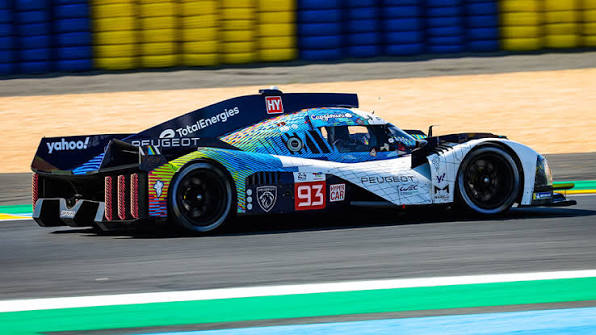
When Peugeot first presented the 9X8, its design immediately stood apart from the competition. There was no conventional rear wing, no familiar silhouette borrowed from the established endurance racing formula. Instead, Peugeot believed it had found another way to generate the aerodynamic performance necessary to compete at the highest level.
It was an ambitious idea, and one that would ultimately require the company to rethink almost everything.
2022: A car designed for a different set of circumstances
Peugeot’s return to top-level endurance racing had been anticipated for several years. The manufacturer had announced its Hypercar programme in 2019, with the intention of returning to the 24 Hours of Le Mans and competing in the new FIA World Endurance Championship Hypercar category.
The resulting 9X8 was developed around the original Le Mans Hypercar regulations, which provided manufacturers with considerable freedom in how they generated aerodynamic downforce within prescribed performance limits.
Peugeot’s engineers pursued an unusual solution.
The car used a ground-effect-focused aerodynamic philosophy, allowing the underfloor to generate downforce without the conventional rear wing seen on its competitors.
The mechanical package consisted of a 2.6-litre twin-turbocharged V6 petrol engine driving the rear wheels, supported by a front-mounted electric motor-generator unit powering the front axle.
The hybrid system was designed to deliver an all-wheel-drive configuration when operating conditions permitted.
However, there was a complication.
Between the initial design phase and the car’s competitive debut, the technical regulations evolved. The convergence between the Le Mans Hypercar and IMSA’s LMDh categories changed the competitive landscape, including the options available to manufacturers regarding tyre dimensions and vehicle configuration.
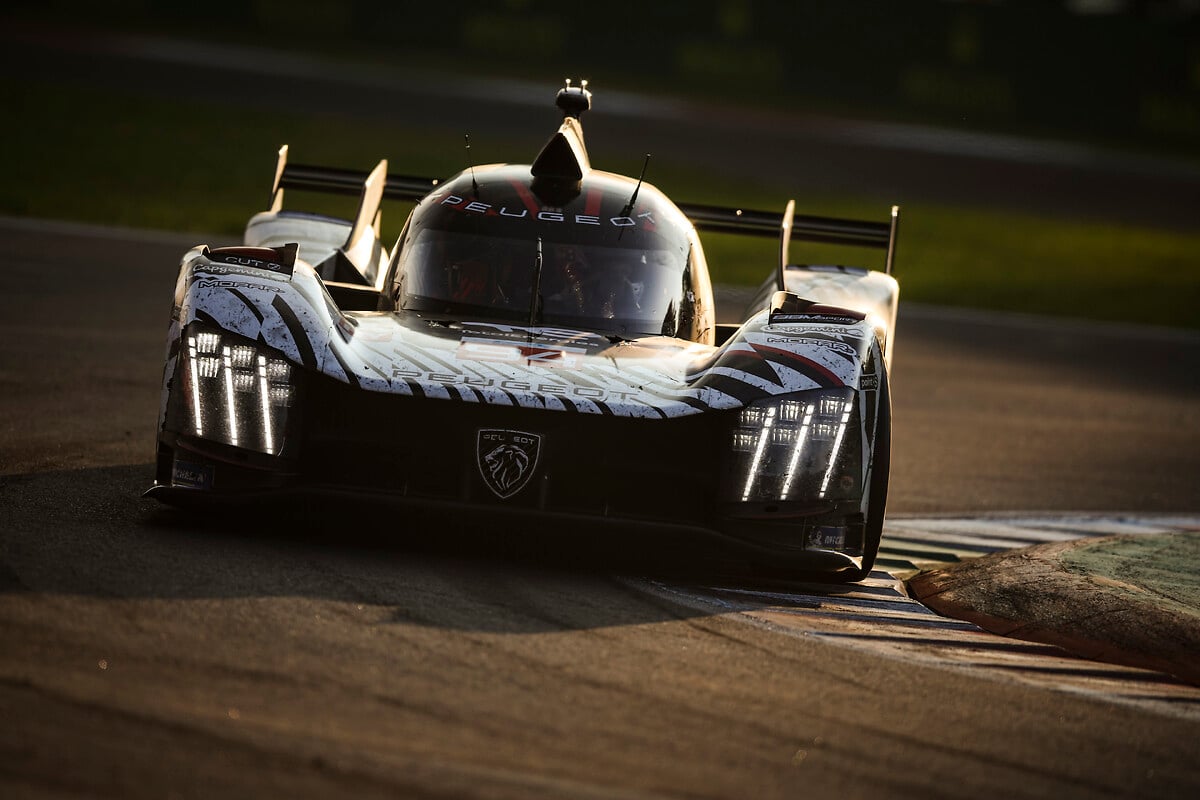
Peugeot had committed to its original concept, including identical 31-centimetre tyre widths at the front and rear.
That decision would become one of the defining limitations of the original car.
The FIA homologation process made the situation even more complicated. Once approved, major changes to the car were restricted. Manufacturers were allocated a limited number of Evolution Jokers, allowing specific technical developments within the homologation cycle.
In February 2022, Peugeot explained that its technical characteristics would be frozen following homologation, with five Evolution Jokers available across the initial 2021–2025 regulatory period.
The challenge was therefore not simply to build a fast car. It was to build one that could remain competitive within a tightly controlled development window.
The 9X8 made its competitive debut at Monza in July 2022, arriving after the Le Mans 24 Hours rather than attempting to enter the championship before the team considered itself ready.
Its first season was effectively an introduction to a category that was already becoming increasingly competitive.
2023: The cost of being different
The 2023 season exposed the weaknesses of Peugeot’s original approach.
The wingless design was visually distinctive, but the aerodynamic philosophy and tyre configuration presented challenges that were becoming increasingly difficult to overcome.
Ferrari, Toyota and other manufacturers were developing cars around different aerodynamic and mechanical philosophies. The difference was not merely cosmetic. It affected how effectively the cars generated downforce, managed their tyres and distributed performance across different circuits.
Peugeot had hoped that the championship’s Balance of Performance system would compensate for some of these differences.
It did not sufficiently do so.
Olivier Jansonnie, Peugeot Sport’s technical director, subsequently acknowledged that the original design decisions were no longer appropriate following the regulatory changes and that the performance difference had not been sufficiently offset by the 2023 Balance of Performance adjustments.
The decision was made in March 2023 to begin a substantial redesign for the following season.
What followed was a project within a project.
Peugeot continued competing with its existing cars while simultaneously developing a significantly revised version of the 9X8. Engineers had to manage two separate development programmes, incorporating lessons from the racing operation into the new design.
It was an enormous undertaking, particularly given the limitations imposed by homologation.
2024: The wing returns
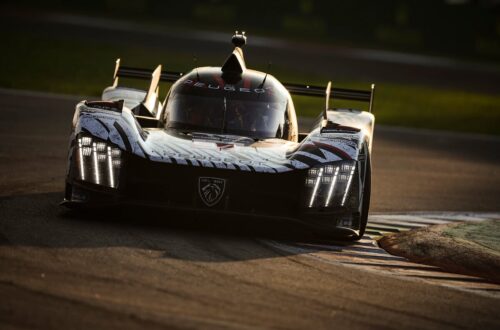
On 25 March 2024, Peugeot unveiled the revised 9X8.
The most obvious change was the return of the rear wing.
The original car had relied on its underfloor aerodynamics to produce the required downforce. The revised version adopted a more conventional aerodynamic arrangement, bringing it closer to the design philosophy employed by its competitors.
But the rear wing was only part of the story.
Peugeot abandoned its original 31/31-centimetre tyre configuration, moving to 29-centimetre front tyres and 34-centimetre rear tyres.
That required a substantial reassessment of the car’s weight distribution and aerodynamic balance.
Components were relocated, others were made lighter, and approximately 90% of the bodywork was redesigned.
The chassis remained fundamentally the same, but the car’s engineering philosophy had changed considerably.
There was also a reliability and performance development programme incorporated into the revised homologation.
The 2024 car made its competitive debut at Imola in April, rather than the opening Qatar round, giving Peugeot additional time to complete development and homologation.
It was a significant admission that the original concept had not delivered the performance required to compete consistently.
The redesign was an attempt to correct that without abandoning the entire programme.
However, the results were still mixed. Peugeot managed to demonstrate greater competitiveness at certain events, but consistency remained elusive.
At the Bahrain season finale, the team secured a third-place finish, offering a glimpse of what the revised package might eventually achieve.
2025: The breakthrough
If 2022 was about ambition, 2023 about correction and 2024 about reconstruction, 2025 became the season in which Peugeot finally began to see the rewards.
The team entered the campaign with revised driver line-ups and a more developed understanding of the 9X8.
Paul Di Resta joined Jean-Éric Vergne and Mikkel Jensen in the number 93 car, while Loïc Duval, Malthe Jakobsen and Stoffel Vandoorne formed the number 94 crew.
The competition remained fierce, with Ferrari, Toyota, Porsche, Cadillac and Alpine all fighting within a category that continued to attract manufacturers.
Peugeot’s progress was not immediate.
Le Mans remained particularly difficult, with the car unable to translate its development into a result representative of the team’s ambitions.
But the later rounds provided a different picture.
At the 6 Hours of Austin, Peugeot secured its first podium of the 2025 campaign, finishing third.
Then came Fuji.
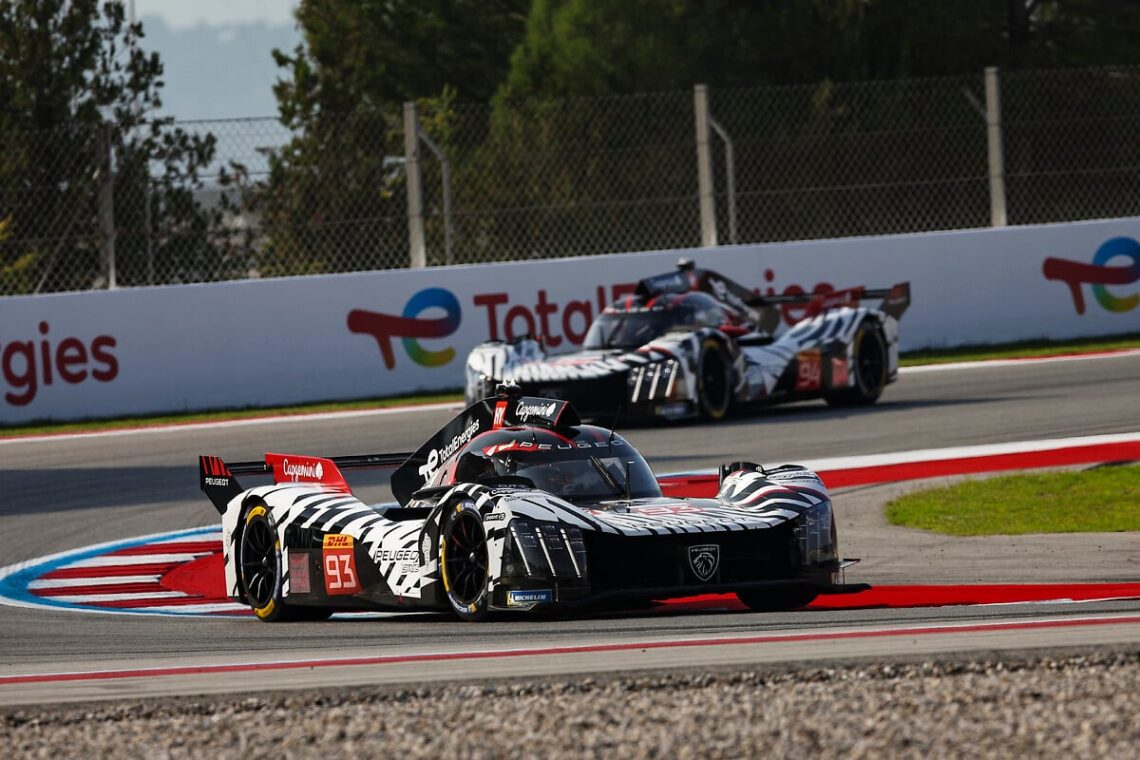
At the 6 Hours of Fuji on 28 September 2025, the number 93 Peugeot 9X8 delivered what was arguably the most significant performance of the programme to that point.
Qualified fourth, the car quickly moved into contention. Paul Di Resta, Jean-Éric Vergne and Mikkel Jensen combined an aggressive race strategy with consistent pace, eventually leading 61 of the race’s 202 laps.
The Peugeot was in contention for victory until the closing stages, when Alpine’s strategic decisions allowed the number 35 A424 to take the lead.
The number 93 Peugeot crossed the finish line second, just 7.682 seconds behind the winning Alpine.
The sister number 94 car also delivered a strong performance, finishing fifth.
It was Peugeot’s best result since returning to the Hypercar category.
The significance extended beyond the result itself. After years of trying to correct the limitations of its original design, the team had finally demonstrated that the 9X8 could compete at the front.
Peugeot CEO Alain Favey described the result as a source of tremendous pride, crediting the determination of the team and its steady progress over the preceding races.
For a manufacturer that had spent much of its return to endurance racing defending an unconventional engineering concept, Fuji represented something more valuable than a trophy.
It demonstrated that the programme had not been without purpose.
The homologation question: Could Peugeot have done more?
There is another part of this story that deserves attention.
Homologation is not simply a formality that allows a racing car to enter a championship. In the Hypercar category, it establishes the technical identity of a vehicle and restricts how far manufacturers can develop it.
Peugeot’s original homologation was built around a concept that subsequently became difficult to reconcile with the evolving competitive environment.
The 2024 redesign was substantial, but it did not erase every limitation of the original platform.
By 2025, the manufacturer was already considering whether a completely new car might be necessary to compete consistently.
Discussions with the FIA and the Automobile Club de l’Ouest explored the possibility of developing a new Hypercar for 2027.
The manufacturer eventually chose to continue developing the existing platform, rather than immediately abandoning the 9X8.
That decision would become increasingly important as the company approached the next development cycle.
The final chapter
The 2025 season demonstrated that Peugeot could still produce competitive performances. But the wider question of whether the 9X8 had reached its development ceiling remained.
The manufacturer had already spent considerable resources correcting the original concept, and further development was becoming increasingly dependent on the opportunities available within the homologation framework.
The planned 2027 evolution was intended to address those limitations.
However, with Stellantis now ending its factory-backed WEC programme, the development of that next-generation 9X8 has been abandoned.
It leaves behind a rather unusual motorsport legacy.
Peugeot returned to endurance racing with an idea that challenged conventional thinking, discovered that the regulations and competitive landscape had moved against some of its original decisions, and spent four years attempting to correct them.
The second-place finish at Fuji showed what the programme could achieve when the pieces finally came together.
It also leaves us with a question that extends beyond Peugeot: how much freedom should manufacturers have to correct a car when the regulations that shaped its original design have changed?
For Peugeot, the answer came at considerable cost.
The 9X8 was not a failure of ambition. It was a reminder that in modern endurance racing, an innovative design must be as adaptable to the rules as it is to the demands of the circuit.
And sometimes, the most expensive part of building a racing car is discovering that the car you started with is no longer the car you need.