
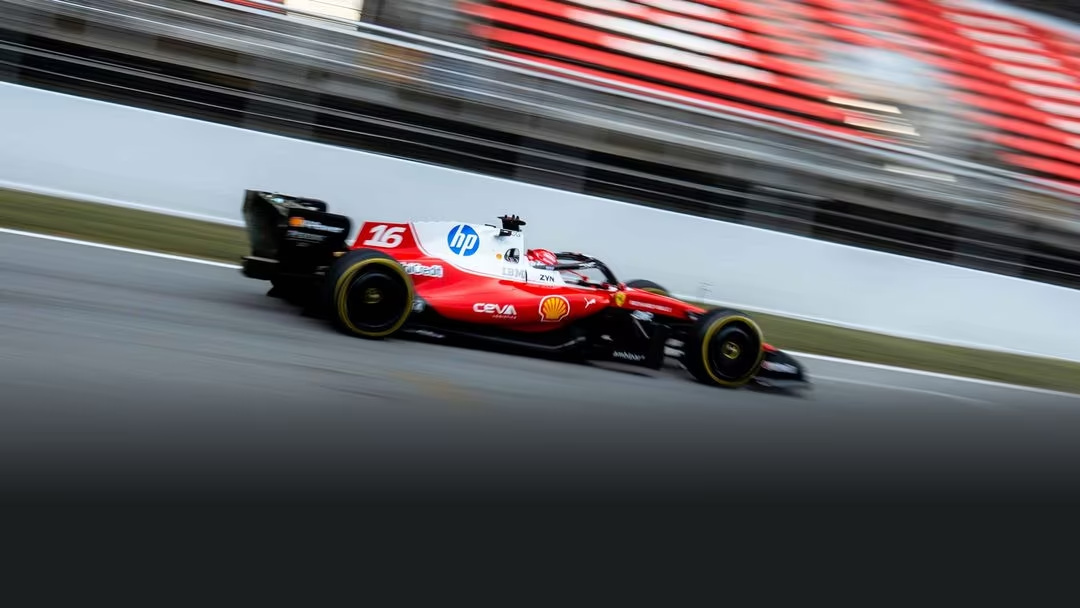
From a more than 4% engine deficit to a much closer fight on track, Ferrari’s 2026 recovery has become one of the most interesting technical stories of the Formula 1 season. But how much ground has the SF-26 actually recovered against Mercedes and Red Bull?
When the 2026 Formula 1 season began, Ferrari had a problem.
It wasn’t necessarily obvious from the outside.
The SF-26 could qualify near the front. It could produce strong cornering performance. It could occasionally challenge for podiums.
But the car was fighting with one hand tied behind its back.
The power unit was not where Ferrari wanted it to be.
The FIA’s first ADUO assessment subsequently confirmed just how significant the problem was. Red Bull-Ford was identified as the benchmark internal-combustion engine, while Ferrari was classified as more than 4% behind that benchmark. Mercedes was closer, sitting in the 2–4% deficit band.
That distinction is crucial because it determined how much development freedom each manufacturer received.
Ferrari was granted two additional homologations for 2026 and two for 2027, along with corresponding increases in cost-cap allowance and dyno testing. Mercedes received one additional homologation for each season. No additional homologations were awarded following the second 2026 review period.
The FIA deliberately does not publish the underlying manufacturer-by-manufacturer performance figures, so precise horsepower claims circulating around the paddock should be treated as estimates rather than official numbers.
But Ferrari’s response is visible on the racetrack.
The SF-26 had to become more than an engine project
Ferrari didn’t wait for the power unit to solve everything.
The SF-26’s development programme became one of the most aggressive on the grid.
At Barcelona, Maranello introduced a substantial aerodynamic package centred around a new front wing and nose, together with extensive floor revisions.
The front wing featured a revised geometry, altered footplate and additional aerodynamic elements, while Ferrari also redesigned sections of the floor to improve downforce generation.
The floor changes included revisions to the leading edge, keel volume, floorboard elements, rear-corner winglets and diffuser integration.
The sidepod bodywork was modified to work with the revised floor.
This was important because Ferrari wasn’t simply trying to create more downforce.
It was attempting to create a more efficient aerodynamic platform.
That distinction matters enormously under the 2026 regulations.
The complete Barcelona package can be studied through Formula 1’s technical coverage of the SF-26 upgrades.
Barcelona was the first major turning point
The improvement was measurable.
Ferrari’s average qualifying deficit to pole position had been approximately 0.442 seconds through Monaco.
From Barcelona onward, that average dropped to approximately 0.204 seconds through the first 11 rounds.
That is a substantial reduction.
And it wasn’t achieved in isolation.
Red Bull’s corresponding qualifying deficit also improved, from approximately 0.577 seconds to 0.466 seconds, while McLaren moved from roughly 0.469 seconds to 0.383 seconds.
Ferrari therefore wasn’t simply sitting still while everyone else stopped developing.
Maranello was closing the gap while the benchmark teams continued to develop their own cars.
Then came ADUO 1
The chassis improvement was only part of the recovery.
Ferrari’s first ADUO-related power-unit development arrived at the Austrian Grand Prix.
This was the first major opportunity created by the new FIA system specifically designed to help manufacturers whose combustion engines had fallen significantly behind the benchmark.
The first Ferrari package was focused on the internal-combustion side of the power unit and was accompanied by a new Shell fuel formulation.
Reports at the time suggested the upgrade could recover a meaningful portion of Ferrari’s power deficit, although the exact gain was never officially published.
That is important.
We can confidently say Ferrari gained performance.
We cannot responsibly turn unofficial horsepower estimates into FIA-certified numbers.
The important evidence came from the car itself.
Ferrari became increasingly competitive on circuits where its early-season straight-line weakness had been particularly visible.
But Red Bull remained the benchmark
This is where the story becomes more complicated.
Ferrari was closing the gap to Mercedes on track.
But the FIA’s ADUO assessment showed that the underlying ICE hierarchy had not been transformed.
After the second review period, Red Bull-Ford remained the benchmark.
Ferrari was still officially classified as more than 4% behind the leading ICE.
Mercedes remained in the 2–4% window.
That does not mean the SF-26 was necessarily four percent slower than a Mercedes or Red Bull car around a lap.
ADUO’s measurement concerns the internal-combustion engine performance index, not the complete car.
The FIA’s calculation incorporates factors including input shaft torque, engine speed, MGU-K power and weighting for the effect of power-unit performance on lap time.
So we need to separate three things:
Engine deficit.
Chassis deficit.
Overall lap-time deficit.
They are not interchangeable.
And Ferrari’s chassis was telling a different story
This is perhaps the most interesting part of the 2026 Ferrari story.
Early in the season, Ferrari’s overall performance suggested the SF-26 was being held back by its power unit.
The chassis itself was not necessarily the problem.
In fact, analysis of early-season qualifying performance suggested Ferrari’s chassis performance could be considerably stronger than its raw overall result indicated.
That became increasingly apparent as the aerodynamic updates arrived.
The SF-26 began to close the gap to Mercedes even before Ferrari had fully resolved its engine deficit.
That means Maranello’s engineers were effectively extracting more performance from the car around the power-unit weakness.
And that is why the Barcelona upgrade mattered so much.
Ferrari’s development philosophy changed
Ferrari also chose a different development strategy from Mercedes.
Rather than waiting for enormous packages several times during the season, Ferrari adopted a more continuous approach.
Small mechanical changes.
Small aerodynamic changes.
Floor refinements.
Front-wing changes.
Cooling adjustments.
Suspension developments.
Then the power-unit developments.
Ferrari team principal Fred Vasseur said the team intended to continue pushing until the end of the 2026 season.
That approach has produced a steady stream of performance rather than relying entirely on one enormous upgrade.
By early September, Ferrari had already brought enough incremental development to remain second in the constructors’ championship while both Charles Leclerc and Lewis Hamilton had taken Grand Prix victories.
Mercedes, meanwhile, stopped developing at the same rate
This has created an unusual situation.
Mercedes began 2026 as the dominant force.
The Silver Arrows took the first six Grands Prix and established a substantial early championship advantage.
But Mercedes subsequently reduced its development rate.
By September, the team had gone several races without a major upgrade package, relying instead on smaller circuit-specific changes.
Ferrari and McLaren continued to bring more substantial developments.
The result?
The gap narrowed.
Mercedes remains comfortably ahead in the constructors’ championship, but the performance gap between the leading cars has become dramatically smaller at several circuits.
At Zandvoort, for example, Ferrari, Mercedes and McLaren were separated by only around a tenth in sprint qualifying.
That is a very different Formula 1 from the opening rounds.
ADUO 2: Ferrari’s second bullet
Then came the second ADUO opportunity.
Ferrari’s second 2026 power-unit upgrade arrived at Monza.
On paper, this was exactly the circuit where the upgrade needed to work.
Monza is brutally honest.
Long straights.
Heavy acceleration.
Large periods at full throttle.
There are relatively few places to hide a power deficit.
Ferrari therefore had the perfect laboratory for its second engine development.
The package included a new turbocharger, following the earlier commitment to Ferrari’s high-temperature combustion concept.
The expectation was that ADUO 2 would further reduce Ferrari’s power deficit.
But Monza delivered an important reality check.
Ferrari had improved.
It had not erased the problem.
Mercedes was still faster on the straights
At Monza, Ferrari’s remaining power deficit became obvious again.
Ferrari team principal Fred Vasseur acknowledged that the SF-26 was losing significant speed to Mercedes on the straights.
Reports from the weekend put the difference at around 10 km/h in some areas of the lap.
Lewis Hamilton described Mercedes’ straight-line performance as extraordinary.
So while Ferrari had clearly gained ground, the second ADUO upgrade did not suddenly transform the Ferrari engine into the benchmark.
And that is arguably the most important finding of the entire exercise.
So how much ground has Ferrari actually gained?
There are several ways to answer that.
Against Mercedes
This is where Ferrari’s progress is easiest to see.
At the beginning of the season, Mercedes had an enormous performance advantage.
Its qualifying advantage over the field was around half a second in the early rounds.
Ferrari’s qualifying deficit was approximately 0.442 seconds through Monaco.
After Barcelona, that fell to approximately 0.204 seconds through Hungary.
The overall gap therefore roughly halved.
Ferrari also began winning races.
Hamilton won in Barcelona.
Leclerc won at Silverstone.
And Ferrari remained the consistent second-placed constructor.
By September, Mercedes still had a huge championship advantage, but Ferrari was no longer operating in a different performance category.
That is a significant recovery.
Against Red Bull
This is different.
Red Bull-Ford remains the FIA’s reference point for the ICE.
Ferrari’s ADUO classification tells us that Maranello has not eliminated its underlying engine deficit to the benchmark.
But the complete Red Bull car is not simply an engine.
Red Bull’s chassis, aerodynamics, suspension and energy management all contribute to its performance.
And Ferrari has been improving its own chassis rapidly.
Therefore, the gap between Ferrari and Red Bull on an individual circuit cannot be reduced to the engine figures published through ADUO.
This is where the SF-26’s aerodynamic development becomes so important.
Ferrari has been compensating for some of its power-unit weakness with chassis performance.
The fascinating part: Ferrari has gained ground without fixing everything
This may be the most encouraging element of Ferrari’s 2026 season.
The SF-26 is not suddenly operating with the best power unit.
It is not officially the benchmark ICE.
Yet Ferrari has still moved closer to the front.
That suggests Maranello has discovered significant performance within the chassis and aerodynamic package.
And that information will be invaluable for 2027.
The engineers now know which parts of the SF-26 work.
They know which parts don’t.
They know where the power unit costs lap time.
They know how much downforce can be generated without creating excessive drag.
They know how the active aerodynamic system interacts with the chassis.
And they know how the tyres respond to the package.
That knowledge is arguably worth more than any single 2026 upgrade.
The uncomfortable question for Ferrari
There is, however, one question Maranello cannot ignore.
If Ferrari can get this close while still carrying an officially recognised engine deficit, what happens if Red Bull and Mercedes continue developing their own power units?
The answer is impossible to know today.
But it explains why Ferrari’s 2027 engine programme is so important.
The 2026 SF-26 has effectively become a rolling laboratory.
Every kilometre is feeding information into the next generation.
The benchmark has changed — but not disappeared
At the beginning of the season, the story looked simple.
Mercedes was the benchmark on track.
Red Bull was developing an extremely competitive power unit.
Ferrari was chasing both.
Now the picture is much more complicated.
Red Bull-Ford remains the FIA’s ICE benchmark.
Mercedes remains the championship benchmark.
Ferrari has become the development benchmark in one important respect: the rate at which it has continued bringing performance to the SF-26.
That distinction is important.
Ferrari has not necessarily overtaken its rivals technically.
But it has demonstrated that the gap can be attacked.
The SF-26’s 2026 legacy
When Ferrari eventually turns its attention completely toward the 2027 car, the SF-26 will provide Maranello with an enormous amount of information.
The early-season deficit identified the weaknesses.
The Barcelona package showed how much performance could be extracted from the chassis.
ADUO 1 provided the first major power-unit correction.
The later aerodynamic developments continued closing the overall performance gap.
ADUO 2 attacked the remaining engine weakness.
And Monza showed that the deficit was smaller than before — but still there.
That is the real story.
Ferrari hasn’t magically gone from the back foot to having the best engine.
It has done something more technically interesting.
It has gained ground while still carrying a measurable disadvantage.
And that makes the SF-26 one of the most important development programmes in Ferrari’s recent Formula 1 history.
Because when the 2027 car arrives, Maranello won’t be starting from the Ferrari that opened 2026.
It will be starting from the Ferrari that spent an entire season learning how to close the gap.
And that could be the most valuable upgrade of all.



