
Formula 1’s 2026 regulations created one of the biggest technical resets the championship has seen in years.
But the interesting part is that the 2026 cars may only be the beginning.
For Scuderia Ferrari and Mercedes-AMG Petronas, the work already underway for 2027 is about taking what the teams have learned from the first year of the new regulations and turning it into something considerably more refined.
The 2027 Ferrari and Mercedes will not simply be evolutionary versions of today’s cars. They will be products of a year spent understanding a completely different power unit, active aerodynamics, energy management and a new generation of chassis regulations.
And the biggest battleground may once again be underneath the bodywork.
The 2027 engine isn’t a completely new engine
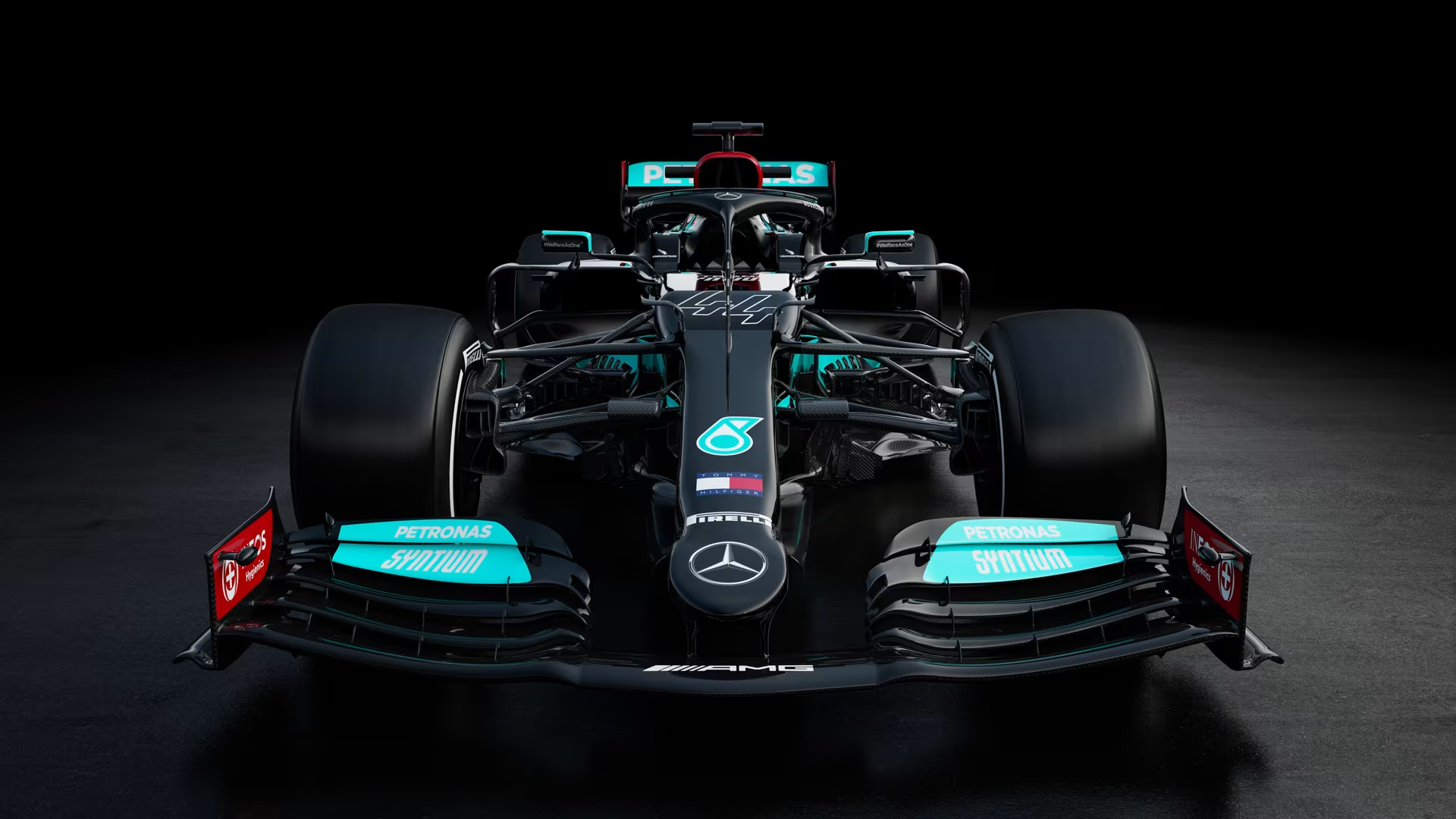
There has been considerable discussion around the future of the Formula 1 power unit, but the 2027 package is better understood as an evolution of the 2026 hybrid formula rather than a return to the previous generation.
The 2026 regulations removed the MGU-H and dramatically increased the contribution of the MGU-K.
The original 2026 formula allowed the internal-combustion engine to produce a maximum of 400kW, while the MGU-K could provide up to 350kW.
For 2027, that balance changes.
The FIA-approved package raises maximum ICE output to 420kW, while the maximum MGU-K output is reduced to 300kW.
The result is a shift in the balance from approximately 53:47 ICE-to-electric contribution in 2026 toward 58:42 in 2027.
The MGU-K’s maximum harvesting capability, however, increases from 350kW to 375kW.
That is an important change.
Formula 1 is effectively asking the manufacturers to find more performance from the combustion engine while simultaneously making energy recovery and deployment smarter.
You can read the FIA’s latest technical framework through its “official 2027 Formula 1 regulations archive” (https://reference-url-citation.invalid/2).
Ferrari: the engine becomes even more important
For Ferrari, this is particularly interesting.
The Scuderia has spent years developing its hybrid power-unit technology, and the 2026 regulations forced every manufacturer to rethink how electrical energy interacts with the combustion engine.
The 2027 changes now give the ICE a larger share of the overall power equation.
That means Ferrari’s combustion-engine development becomes even more important.
There is also another fascinating element.
The FIA’s Additional Development and Upgrade Opportunities, or ADUO, system is already influencing the current power-unit development race.
After the first 2026 review period, Mercedes was placed in the 2–4% performance-gap window and received one additional homologation for 2026 and one for 2027. Ferrari, along with Audi and Honda, was placed in the larger-than-4% category and received two additional homologations for each of those seasons.
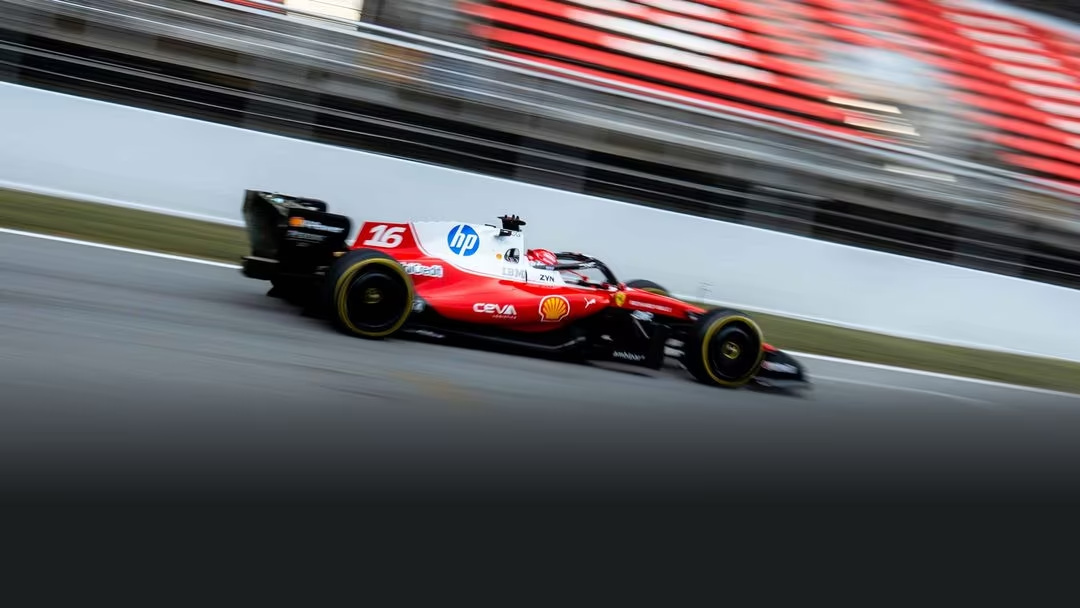
The FIA has deliberately kept the underlying performance measurements confidential.
That means we should be careful about claiming that one manufacturer has a particular horsepower advantage.
But the existence of the additional development allowance tells us something important:
the 2027 power-unit battle is already being shaped by what happened in 2026.
For Ferrari, the objective will be to turn its available development opportunities into a power unit that works across the entire lap rather than simply producing an impressive peak figure.
Mercedes has a different opportunity
Mercedes enters 2027 with its own enormous technical challenge.
The Mercedes power unit has already been placed inside the FIA’s ADUO framework, giving the manufacturer additional development opportunities for 2027 following the first review period.
The German manufacturer therefore has an opportunity to use what it has learned from the first year of the new regulations.
And that could be particularly important because the 2027 regulations change the way the power unit’s energy is distributed.
The MGU-K will produce less maximum power in its normal operation, but the harvesting ceiling increases.
That creates a potentially fascinating engineering problem:
How efficiently can Mercedes recover energy, store it and deploy it at precisely the right moment?
In other words, the fastest power unit may not necessarily be the one with the largest headline output.
It could be the one that manages its energy most effectively from the start of a lap to the finish.
The Ferrari and Mercedes chassis
Then we get to the cars themselves.
This is where things become harder to predict.
The FIA has already approved the first version of the 2027 technical regulations, but the changes to the chassis and aerodynamic package are much less revolutionary than the original 2026 reset.
The FIA’s June 2026 Formula 1 Commission meeting confirmed that minor changes to aerodynamic and bodywork components had been agreed for 2027.
That means Ferrari and Mercedes will be developing from a known foundation.
The 2026 generation introduced smaller and lighter cars, active front and rear aerodynamics and a radically different relationship between aerodynamic drag and electrical power.
The FIA’s original concept reduced vehicle weight by around 30kg and introduced movable aerodynamic surfaces, while substantially increasing the electrical contribution of the power unit.
The 2027 car therefore becomes an engineering refinement exercise.
And this is where the differences between Ferrari and Mercedes could become fascinating.
Ferrari’s biggest question: integration
The most important part of the 2027 Ferrari may not be the engine or the chassis individually.
It could be how well Ferrari integrates the two.
The 2026 power unit changed the requirements placed on the chassis.
More electrical energy means batteries, cooling, packaging and energy management all become part of the aerodynamic equation.
A compact power unit installation can allow greater freedom around the sidepods, floor and rear bodywork.
Cooling requirements can influence the size and shape of the sidepods.
Battery placement influences weight distribution.
The gearbox, rear suspension and floor then have to work around everything else.
The fastest 2027 car will therefore be the product of hundreds of compromises.
Ferrari’s challenge is to make those compromises work together.
Mercedes faces exactly the same puzzle
Mercedes has the same fundamental problem.
The power unit cannot be designed in isolation.
Nor can the aerodynamic department simply design the fastest possible bodywork.
Everything is connected.
A change in cooling can affect drag.
A change in battery packaging can affect weight distribution.
A change in rear suspension geometry can affect the floor.
A change in the floor can alter how the active aerodynamic system behaves.
And a change in energy deployment can influence how the car needs to be balanced through different corners.
That is why the 2027 regulations could produce an intriguing second-generation interpretation of the 2026 concept.
The teams now know what actually happens on track.
The energy-management war
This may ultimately become one of the biggest stories of 2027.
The FIA changed the regulations specifically because the first year of the new power-unit formula exposed issues around energy management.
The June agreement introduced a staged rebalancing of the ICE and Energy Recovery System contributions, together with changes to fuel-energy flow and greater flexibility in energy management.
For Ferrari and Mercedes, this means the engineers aren’t simply chasing horsepower.
They are chasing usable horsepower.
Imagine two cars arriving at the final sector.
One has slightly more theoretical engine performance.
The other has managed its battery, harvesting and deployment better throughout the lap.
The second car could still be faster.
That is the nature of this new generation of Formula 1.
The chassis battle could become just as important
The 2027 Ferrari and Mercedes will also inherit another important characteristic from the 2026 regulations: active aerodynamics.
The FIA introduced movable front and rear aerodynamic systems to allow the cars to run high-downforce configurations in corners and low-drag configurations on straights.
That creates a new aerodynamic design challenge.
The engineers are no longer designing one aerodynamic state.
They are designing a car that effectively has multiple aerodynamic behaviours.
The transition between those states matters.
The stability of the platform matters.
The interaction with the floor matters.
And, crucially, the driver has to trust the car.
That could become one of the areas where Ferrari and Mercedes take noticeably different approaches.
Don’t expect the 2027 Ferrari to look completely alien
There is a temptation whenever Formula 1 enters a new technical cycle to expect dramatically different-looking cars.
But 2027 isn’t another 2026.
The first major reset happened this year.
The next stage is refinement.
Ferrari’s 2027 car should therefore retain the fundamental architecture dictated by the regulations while attempting to improve every area around it.
Mercedes will be doing precisely the same.
And because the 2027 technical regulations are already published in the FIA’s regulatory archive, the teams are working inside an increasingly defined technical box.
The real secrets will therefore be hidden in the details.
Floor geometry.
Cooling.
Suspension.
Weight distribution.
Power-unit packaging.
Battery efficiency.
Energy deployment.
Active-aero behaviour.
And how aggressively each team exploits the permitted aerodynamic surfaces.
Ferrari vs Mercedes: where could the difference come from?
There may be no single answer.
Ferrari could gain through its power-unit development.
Mercedes could find efficiency in energy recovery.
Ferrari could produce a superior aerodynamic platform.
Mercedes could create a chassis that is easier to operate across different circuits.
One team could have the better qualifying package while another has the more efficient race car.
And because the regulations are still relatively young, the development curve could be extremely steep.
The biggest lesson from previous regulation changes is that the first interpretation is rarely the final interpretation.
2027 could be Ferrari’s opportunity to put everything together
For Ferrari, the significance of 2027 extends beyond the engineering department.
The Scuderia has been trying to build a complete championship-winning structure rather than simply producing a fast car.
The 2026 season is therefore providing something Ferrari desperately needs:
information.
Every problem encountered this year becomes data.
Every overheating issue becomes data.
Every battery limitation becomes data.
Every aerodynamic weakness becomes data.
Every mistake in energy deployment becomes data.
And every successful upgrade becomes a starting point for 2027.
That makes the 2027 Ferrari potentially much more interesting than a simple new car.
It is the first Ferrari designed after the team has experienced the realities of the new regulations.
And Mercedes won’t be standing still
The same applies to Mercedes.
The manufacturer has the advantage of enormous experience with hybrid Formula 1 power units, but the 2026 regulations fundamentally altered the technology.
The team now has a year of real-world information.
The 2027 rules give it more ICE power, a revised electrical contribution and greater harvesting potential.
That combination could allow Mercedes to rethink the relationship between its engine, battery and chassis.
And because Mercedes is already receiving additional development allowances for its 2027 power unit under the ADUO framework, there is a clearly defined opportunity to evolve the engine further.
The real question
The fascinating question heading into 2027 isn’t simply:
Who will have the most powerful engine?
It is:
Who will understand the entire car better?
Ferrari and Mercedes are both facing the same fundamental equation.
Power.
Energy.
Drag.
Downforce.
Weight.
Cooling.
Tyres.
Suspension.
And the driver.
The 2026 regulations changed the ingredients.
The 2027 cars will show us what the teams have learned from cooking with them.
For Ferrari, it could be the year when its power-unit development, chassis philosophy and aerodynamic programme finally converge into one package.
For Mercedes, it could be the year when its understanding of the new hybrid era begins translating into a second-generation interpretation of the rules.
And with the FIA already increasing the 2027 pre-season testing allocation from three days to four, the governing body itself recognises how technically demanding this generation of cars has become.
The cars we eventually see roll out of Maranello and Brackley may look like evolutions of their 2026 predecessors.
Underneath them, however, the battle will be considerably more sophisticated.
2026 created the new Formula 1.
2027 could reveal who understood it first.



