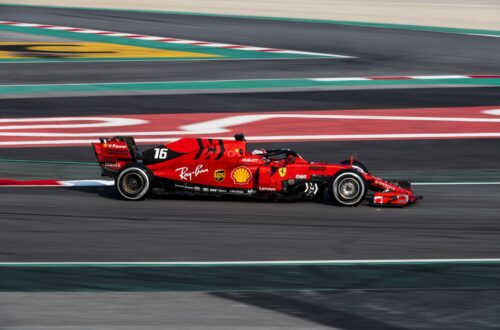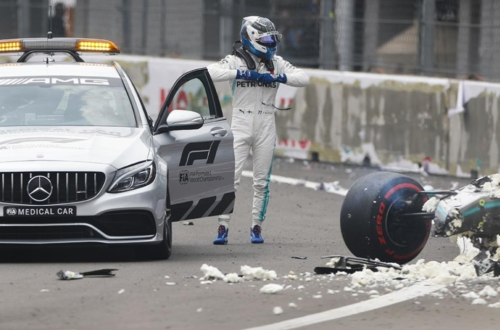
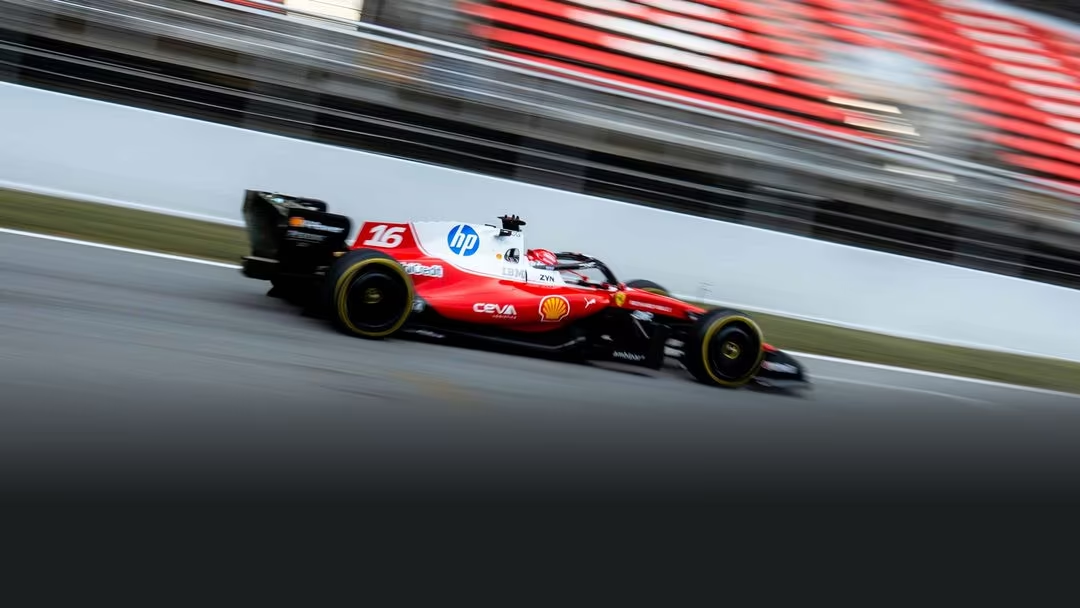
The Unwritten Number One: Charles Leclerc and the Balance of Power at Ferrari
DLifestyle Magazine | Formula 1 | Investigation
There is a difference between being Ferrari’s number-one driver and becoming the driver around whom the team increasingly operates. The former can be established through a contractual arrangement or an explicit sporting decision. The latter is considerably more difficult to identify, particularly when the team insists that both drivers receive equal treatment.
Charles Leclerc’s career at Scuderia Ferrari offers an interesting case study.
Since arriving in Maranello in 2019, the Monegasque has shared the garage with Sebastian Vettel, Carlos Sainz and, most recently, Lewis Hamilton. Each partnership has presented a different set of circumstances, different management decisions and, on several occasions, disagreements over how Ferrari should manage its two cars.
Ferrari has repeatedly maintained that its drivers are entitled to equal opportunities. Yet the team’s decisions have not always produced equal outcomes.
That does not establish favouritism, nor does it demonstrate that Leclerc has negotiated an unofficial position of authority. It does, however, raise a legitimate question: how has Leclerc’s position within Ferrari evolved, and how consistently has the team applied its rules when his interests conflict with those of his teammate?
To understand that question, it is necessary to return to the beginning.
### 2019: Sebastian Vettel and the arrival of Charles Leclerc
When Leclerc joined Ferrari for the 2019 season, he was not arriving as an established team leader. Vettel was a four-time world champion, had been with Ferrari since 2015 and was the more experienced driver within the organisation.
Ferrari team principal Mattia Binotto was relatively explicit about the arrangement.
In April 2019, he confirmed that Vettel would receive priority in a 50/50 strategic situation because of his experience with the team.
It was an important admission. Ferrari was effectively acknowledging that equal machinery did not necessarily mean identical treatment in every strategic circumstance. Formula 1®
The opening rounds also demonstrated that Leclerc’s position was not entirely straightforward.
At the Australian Grand Prix, Ferrari instructed him to remain behind Vettel during the closing stages. Leclerc questioned the decision over the radio but ultimately complied.
At the following Bahrain Grand Prix, however, the situation was different.
After losing positions at the start, Leclerc recovered and found himself considerably quicker than Vettel. Ferrari instructed him to stay behind his teammate for two laps.
Leclerc eventually overtook Vettel.
His explanation was that he had demonstrated his willingness to follow the team’s interests in Australia, but in Bahrain he believed the pace advantage was sufficiently large to justify taking the opportunity.
This was an early example of Leclerc challenging an instruction rather than automatically accepting it. Sky Sports +1
### Russia: An agreement between teammates
The Russian Grand Prix provided another revealing moment.
Leclerc started from pole position and provided Vettel with a slipstream at the start. The understanding was that Vettel would subsequently return the position.
Vettel took the lead but did not immediately surrender it.
Leclerc became frustrated over the radio, while Ferrari attempted to manage the situation.
Afterwards, Leclerc described the situation as a misunderstanding. The episode demonstrated that private agreements between Ferrari teammates could influence race-day expectations without necessarily being formal contractual provisions. Formula 1® +1
### Singapore: Ferrari makes a decision against Leclerc
It is equally important to consider incidents in which Leclerc did not benefit from Ferrari’s decisions.
At the 2019 Singapore Grand Prix, Leclerc was leading when Ferrari pitted Vettel first.
The undercut allowed Vettel to emerge ahead and eventually win the race.
Leclerc was unhappy with the outcome, questioning the strategy over the radio. Ferrari nevertheless stood by its decision.
This is an important counterexample to the suggestion that Ferrari consistently prioritised Leclerc’s interests from the beginning of his career.
In 2019, Vettel still had the strategic priority Ferrari had publicly acknowledged.
### 2020–2024: Carlos Sainz and the question of equal status
When Vettel departed, Carlos Sainz joined Ferrari for the 2021 season.
The circumstances had changed. Leclerc was no longer the newcomer, and Ferrari had an established driver whose relationship with the engineering department and management had developed over two seasons.
Binotto addressed the question of hierarchy directly.
In January 2021, he stated:
> “There is nothing written in the contract of Charles being the \[team\] leader.”
He also confirmed that both drivers would have equal opportunities, with the team’s interests taking priority when decisions became necessary.
Binotto acknowledged that Leclerc had a longer-term contract but specifically rejected the idea that this entitled him to preferential treatment. Formula 1®
That statement is particularly relevant to this investigation. Ferrari was aware of Leclerc’s established position but publicly committed itself to an equal-status arrangement.
### Silverstone 2022: Ferrari gives Leclerc priority
The British Grand Prix provides one of the clearest examples of Ferrari issuing a direct instruction in Leclerc’s favour.
Sainz was leading, with Leclerc behind him, when Ferrari instructed the Spaniard to allow his teammate through.
The intention was to give Leclerc the opportunity to maintain his advantage and fight for victory.
Sainz complied.
However, the subsequent Safety Car changed the situation dramatically.
Ferrari pitted Sainz for fresh soft tyres but left Leclerc on the circuit. Binotto explained that the team did not believe there was sufficient time to double-stack both cars without losing valuable track position.
The decision left Leclerc vulnerable on older tyres. Sainz, Hamilton and Pérez eventually passed him, and Sainz secured his first Formula 1 victory while Leclerc finished fourth. Formula 1® – The Official F1® Website +1
There are two separate decisions here:
* Ferrari instructed Sainz to surrender the lead to Leclerc.
* Ferrari subsequently chose to protect Sainz’s opportunity for fresh tyres rather than pit both cars.
The first benefited Leclerc. The second ultimately benefited Sainz.
Neither decision, taken individually, establishes a permanent hierarchy.
### Sainz refuses another instruction
There was another development at Silverstone that deserves attention.
Ferrari asked Sainz to create a gap behind the Safety Car, effectively helping Leclerc defend his position.
Sainz argued against the instruction.
He subsequently explained that he believed passing Leclerc on fresh tyres was the correct decision for the team, given the circumstances.
He won the race and maintained that he would make the same decision again. Formula 1®
This episode illustrates an important feature of the Sainz partnership: Ferrari could issue instructions favouring Leclerc, but Sainz was not always prepared to accept a decision he believed compromised his own race.
### 2023: Vasseur inherits the partnership
When Fred Vasseur became team principal, he continued to publicly reject a number-one and number-two driver structure.
He stated that Ferrari would provide both drivers with the same car, structure and support.
He also said that he would intervene for either driver if the team’s interests required it.
This was a continuation of the policy announced by Binotto rather than a declaration that Leclerc would receive priority. RaceFans
### Barcelona 2024: A disagreement over racing room
The 2024 Spanish Grand Prix produced another disagreement between the teammates.
Sainz and Leclerc made contact during their early battle, with Leclerc unhappy about the Spaniard’s move into Turn 1.
Both drivers subsequently expressed different interpretations of the incident.
Leclerc questioned Sainz’s approach, while Sainz defended his actions.
The two finished fifth and sixth respectively, with Leclerc ahead. Formula 1®
The incident was not a team-order controversy in the conventional sense, but it demonstrated that Ferrari’s equal-status policy did not eliminate disagreements over how its drivers should race each other.
### 2025–2026: Lewis Hamilton enters the picture
Hamilton’s arrival introduced a different dynamic.
Unlike Sainz, Hamilton arrived with seven world championships, extensive experience managing competitive teammates and a history of operating under formal team rules at Mercedes.
Leclerc, meanwhile, was already deeply familiar with Ferrari’s internal organisation.
The two drivers were therefore entering the partnership with different forms of experience: Hamilton brought a championship record, while Leclerc brought years of experience within Maranello.
The question of how Ferrari would balance those positions became particularly visible during the 2025 season.
### Miami 2025: Hamilton asks to pass Leclerc
At the Miami Grand Prix, Hamilton was running behind Leclerc and believed he had sufficient pace on his medium tyres to attack Mercedes driver Kimi Antonelli.
He asked Ferrari to allow him through.
The team took approximately one and a half laps to assess whether Hamilton’s apparent pace advantage was genuine or partly attributable to the DRS effect.
Ferrari eventually instructed Leclerc to surrender the position.
Hamilton could not reach Antonelli, and Ferrari subsequently instructed him to return the position to Leclerc.
Leclerc initially suggested that the matter should be discussed later.
Vasseur defended the decision, explaining that Ferrari had to establish whether Hamilton was genuinely faster before ordering the swap. He acknowledged Hamilton’s frustration and accepted that the team could have acted earlier. Formula 1® +1
This is a particularly useful incident because Ferrari’s instructions ultimately benefited Leclerc.
Hamilton was asked to surrender the position he had received, while Leclerc recovered his original place.
However, the team’s explanation was that the position swap was conditional: Hamilton was being given an opportunity to attack, not permanent priority.
### Baku 2025: The instruction goes the other way
At the Azerbaijan Grand Prix, Ferrari instructed Leclerc to make way for Hamilton.
Hamilton was running on a different tyre strategy and Ferrari believed he had a better opportunity to challenge Lando Norris.
Leclerc complied.
Hamilton ultimately finished eighth, ahead of Leclerc, but did not manage to pass Norris. Formula 1® – The Official F1® Website
This is another important counterexample.
Ferrari did not consistently require Hamilton to accommodate Leclerc. It issued an instruction that benefited Hamilton, and Leclerc followed it.
Taken together, Miami and Baku show Ferrari applying team orders in both directions.
### Monza 2026: Hamilton demands written rules
The Italian Grand Prix in September 2026 brought the question of racing rules into sharper focus.
Hamilton and Leclerc went side-by-side through the opening chicane. Hamilton was forced onto the gravel, losing several positions.
Hamilton subsequently called for written rules of engagement, drawing on his experience at Mercedes.
Leclerc reviewed the incident and accepted responsibility, saying:
> “It’s pretty clear that I could have done a better job.”
He also explained that the two drivers had spoken privately and agreed on what they should avoid in future.
Vasseur rejected the suggestion that Ferrari had no rules governing its drivers. He explained that the team operated according to established principles rather than a written code attempting to anticipate every possible racing situation.
He also reiterated Ferrari’s philosophy of two number-one drivers and equal treatment. Reuters +2
This episode is significant because it reveals a difference in approach.
Hamilton wanted more explicit written rules. Leclerc was comfortable with the existing understanding, provided the drivers knew their responsibilities.
It does not demonstrate that Leclerc was exempt from those responsibilities. In fact, his public acceptance of responsibility suggests otherwise.
### Mexico City 2026: The latest disagreement
The Mexican Grand Prix on November 1 produced another incident involving both Ferrari drivers.
Hamilton started from pole position. During the opening-lap battle, both Ferraris went off track at Turn 4.
Leclerc rejoined ahead and retained his position. Verstappen subsequently moved between the two Ferraris.
Leclerc received a five-second penalty for gaining an advantage by leaving the track.
Hamilton subsequently criticised the situation, arguing that Ferrari had lost an opportunity to secure a one-two finish.
He also questioned the lack of clearly established rules governing how the two drivers should race one another.
Leclerc acknowledged that communication from the team had not been sufficiently clear, while Vasseur said the matter would be addressed with both drivers. Reuters
The distinction here is important.
Leclerc was penalised by the stewards. That was an external sporting decision, not a Ferrari disciplinary action.
The wider question concerns Ferrari’s response during the race: whether the pit wall should have intervened earlier and whether its expectations were sufficiently clear to both drivers.
### What does the evidence actually show?
Looking across Leclerc’s Ferrari career, the decisions do not form a simple pattern of one driver consistently receiving preferential treatment.
They show something more complicated.
| Season | Incident | Who benefited from the decision? |
| ————————— | ———————————————————————— | ————————————– |
| 2019 Australia | Leclerc instructed to hold position behind Vettel | Vettel |
| 2019 Bahrain | Leclerc overtook Vettel despite an instruction to wait | Leclerc |
| 2019 Singapore | Vettel received the strategic undercut | Vettel |
| 2021 | Ferrari publicly established equal opportunity with Sainz | Both |
| 2022 Silverstone | Sainz instructed to give Leclerc the lead | Leclerc |
| 2022 Silverstone Safety Car | Sainz pitted, Leclerc remained out | Sainz’s strategy, ultimately |
| 2025 Miami | Hamilton allowed through, then instructed to return position | Both at different stages |
| 2025 Baku | Leclerc instructed to let Hamilton through | Hamilton |
| 2026 Monza | Leclerc accepted responsibility after Hamilton was forced onto gravel | Neither |
| 2026 Mexico | Leclerc retained position after running off track and received a penalty | Leclerc initially; no ultimate benefit |
The table demonstrates why it would be premature to declare that Ferrari has consistently prioritised Leclerc.
There are instances where he benefited from team decisions, instances where he was disadvantaged, and instances where Ferrari instructed him to accommodate his teammate.
But there is another issue that the table cannot measure: how quickly Ferrari responds to each driver’s requests, how much discretion each receives and whose interpretation carries greater weight when the two disagree.
That requires a different level of investigation.
### The contract question: What has Ferrari actually disclosed?
On June 3, 2026, Ferrari announced a multi-year renewal of Leclerc’s agreement.
The announcement described him as a driver who had become deeply connected with the organisation, with Vasseur referring to him as part of the Ferrari family.
However, Ferrari did not disclose the contractual provisions governing team orders, sporting priority or decision-making authority. SEC +1
That distinction matters.
There is no publicly verified evidence that Leclerc’s contract gives him the right to:
* Override instructions from the pit wall.
* Receive priority over a newly appointed teammate.
* Determine which driver receives a particular strategy.
* Influence disciplinary decisions involving his teammate.
* Receive preferential treatment in the development programme.
Nor is there publicly verified evidence of a standing verbal agreement granting him those privileges.
His longevity, relationships and familiarity with Ferrari are observable. The extent to which those translate into additional authority is not.
### The question Ferrari still needs to answer
There is a recurring theme throughout Leclerc’s career: Ferrari has repeatedly declared its intention to give both drivers equal opportunities, while retaining the authority to make decisions in the interests of the team.
That is not unusual in Formula 1.
What makes Ferrari’s situation worth examining is the frequency with which disagreements over those decisions have become public.
With Vettel, there were disputes over pre-race agreements and strategic priority.
With Sainz, there were disagreements over racing positions, instructions and strategic decisions.
With Hamilton, there have been questions about the speed of team orders, the interpretation of racing incidents and the absence of a detailed written racing code.
These are documented events, not proof of a deliberate hierarchy.
There is also an important distinction between the driver who has the most influence and the driver who receives the most favourable decisions. They are not necessarily the same person.
Ferrari’s responsibility is to ensure that its principles are applied consistently, regardless of which driver is involved.
The question is not whether Charles Leclerc deserves his position at Ferrari. His results, experience and contribution to the team are matters of record.
The question is whether Ferrari has developed a sufficiently transparent management structure to ensure that his established position does not inadvertently become an advantage over his teammates.
For now, the public evidence establishes a long-standing relationship, significant sporting influence and several instances of Ferrari making decisions both in Leclerc’s favour and against him. It does not establish an unofficial number-one designation.
That distinction should remain at the centre of any assessment of his career at Maranello.
Editorial note: This article distinguishes documented decisions and public statements from questions about internal influence. The latter remain unproven without access to Ferrari’s internal instructions, contractual provisions or testimony from those involved.
### Sources and further reading
* [Formula 1 – Ferrari: Vettel still has priority over Leclerc in 50-50 situations (2019)](https://www.formula1.com/en/latest/article/ferrari-vettel-still-has-priority-over-leclerc-in-50-50-situations.7sT81KyYPAexyTbMBy6ncp?utm_source=chatgpt.com).
* [Formula 1 – Leclerc and Sainz free to fight, says Binotto (2021)](https://www.formula1.com/en/latest/article/they-will-have-equal-opportunity-ferrari-duo-leclerc-and-sainz-free-to-fight.RHrNDVku3bNc5PvvAFZCQ?utm_source=chatgpt.com).
* [Formula 1 – Binotto explains Ferrari’s British GP Safety Car decision (2022)](https://www.formula1.com/en/latest/article/binotto-explains-why-ferrari-didnt-pit-british-grand-prix-leader-leclerc.7Hdc5nisRThXUVDmMAlt3O?utm_source=chatgpt.com).
* [Formula 1 – Vasseur defends Ferrari’s Miami team orders (2025)](https://www.formula1.com/en/latest/article/we-took-the-tough-decision-vasseur-defends-ferrari-team-orders-situation-in.4ejF8x5boJaBm4ixbzZ59S?utm_source=chatgpt.com).
* [Formula 1 – Vasseur explains Ferrari’s Baku team orders (2025)](https://www.formula1.com/en/latest/article/the-situation-was-clear-for-us-vassuer-explains-why-ferrari-issued-team.1mQPO1z35rX6nKFQMwqPKA.1mQPO1z35rX6nKFQMwqPKA?utm_source=chatgpt.com).
* [Autosport – Vasseur addresses Ferrari’s rules of engagement (2026)](https://www.autosport.com/f1/news/vasseur-rejects-ferrari-internal-crisis-claims-as-he-defends-team/10854216/?utm_source=chatgpt.com).
* [Reuters – Hamilton criticises Ferrari after Mexico City Grand Prix (November 2, 2026)](https://www.reuters.com/sports/formula1/hamilton-laments-ferraris-missed-one-two-after-leclerc-clash-mexico-2026-11-02/?utm_source=chatgpt.com).
Suggested featured image: Charles Leclerc standing in the Ferrari garage, with the two Ferrari cars behind him. A restrained editorial treatment with the headline The Unwritten Number One.