
The Little White Bells: Mitzah Bricard, Lily of the Valley and the Language of Dior
Some flowers announce themselves with colour. Others are remembered for their fragrance, their delicacy and the emotions they awaken. For Mitzah Bricard, the woman whose extravagant elegance helped shape Christian Dior’s world, lily of the valley offers a fascinating thread connecting pre-war Parisian couture to one of fashion’s most enduring floral signatures.
There is something almost secretive about lily of the valley.
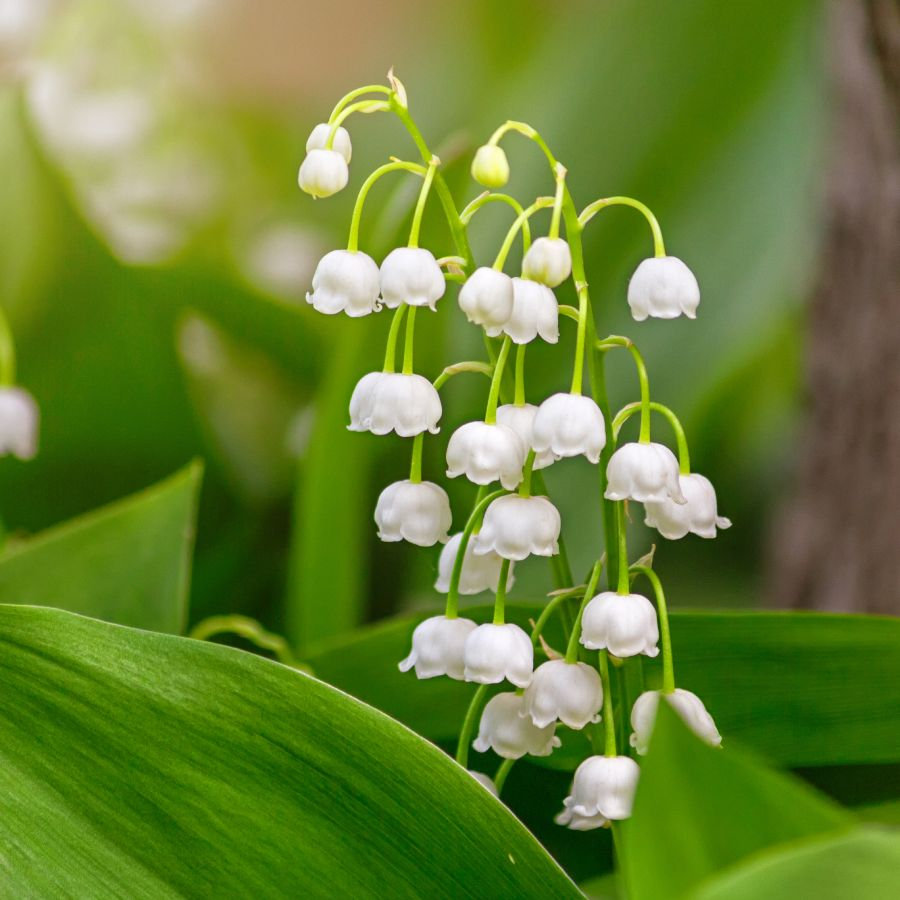
Its flowers do not open towards the sun like great theatrical blooms. Instead, tiny white bells hang beneath slender green stems, partially concealed by broad leaves. You often notice the fragrance before you notice the flowers themselves. Delicate, sweet and unmistakably fresh, the scent seems to belong to a quiet woodland rather than a Parisian couture salon.
Yet these little bells found their way into some of fashion’s most memorable stories.
They appeared in Edward Molyneux’s spring 1938 collection, where the stylist and designer Mitzah Bricard is credited with decorating dresses and hats with clusters of the flowers. Years later, lily of the valley would become one of Christian Dior’s most cherished personal symbols, influencing his couture collections and inspiring a perfume that remains part of the house’s heritage.
Was the flower a personal favourite of Bricard’s? The surviving evidence cannot establish that definitively. But her association with it, and the possibility that her earlier work helped bring it into Dior’s creative orbit, make the story worth examining.
Because sometimes fashion history is not written in a single dramatic gesture. Sometimes it begins with a flower.
Mitzah Bricard: An eye for the extraordinary
Before she became one of the most intriguing figures in Christian Dior’s circle, Bricard had already developed a career within the Parisian fashion establishment.
She worked at several couture houses, including those associated with Jacques Doucet and Edward Molyneux. Research into her early career suggests that she contributed to the design of garments before becoming closely associated with Dior. She was not simply a fashionable woman who happened to inspire a couturier; she had experience inside the business of creating fashion.
Molyneux is particularly important to this story.
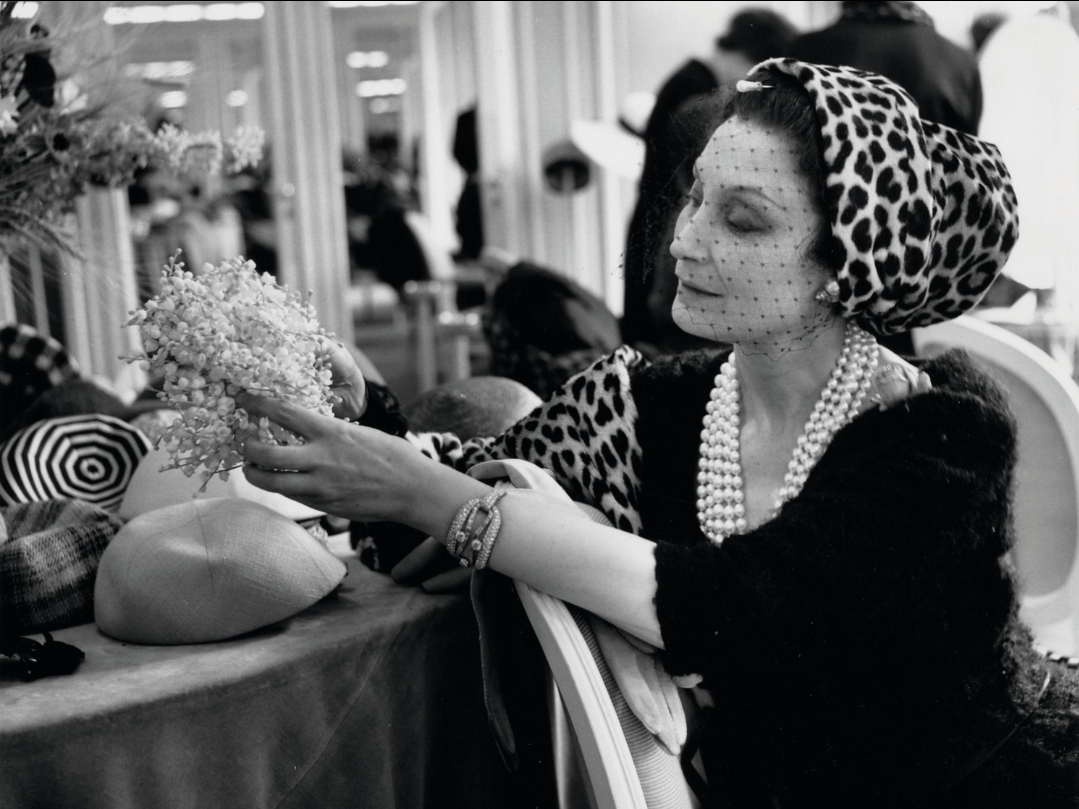
For his spring 1938 collection, Bricard is credited in fashion-historical research with decorating dresses and hats with lily of the valley. Small clusters of the flowers appeared on garments and millinery, introducing a natural, romantic detail into the collection. Contemporary reporting also described Molyneux hats adorned with the blossoms. The precise authorship of individual surviving pieces remains difficult to establish, but the association between the collection and the flower is documented.
It is easy to imagine why such a detail might have appealed to Bricard’s sensibility.
Her personal style was anything but timid. She was known for extravagant elegance, elaborate jewellery, veiled hats and leopard print. She understood how a single element could transform an ensemble — how a scarf, a hat or an unexpected texture could give clothing a distinct personality.
Lily of the valley offered a different kind of statement. It was not bold because it was large or colourful. Its strength lay in restraint.
Placed along a dress or arranged on a hat, the little white bells could soften a silhouette, introduce movement and lend a sense of freshness. Their delicacy contrasted beautifully with the structure of couture.
Whether Bricard regarded the flower as a personal talisman, a seasonal inspiration or simply the right decorative element for Molyneux’s collection remains unknown. No reliable personal statement has surfaced establishing her private feelings about it.
Nevertheless, the 1938 collection provides a compelling starting point for understanding how the flower entered the creative story surrounding her.
Where did lily of the valley originate?
Botanically known as Convallaria majalis, lily of the valley is a perennial flowering plant with a long history in temperate regions.
The Royal Botanic Gardens, Kew, records its native range as extending from Europe to the Caucasus. Botanical references also document related populations and cultivated forms across parts of northern Asia. The plant is associated with temperate climates, particularly shaded woodland environments where moisture and rich soil allow it to spread.
Its appearance is deceptively simple. The plant produces broad green leaves from which slender flowering stems emerge, carrying rows of small, downward-facing, bell-shaped flowers. After flowering, red berries may develop.
The flowers usually appear in spring, commonly around April, May and June depending on the climate. The name majalis is associated with May, the month traditionally linked to its flowering season.
Although it is often associated with France because of its cultural importance there, lily of the valley did not originate exclusively in France. Its natural distribution is broader, and its place in French culture developed through centuries of custom, symbolism and horticulture.
The distinction is important. France gave the flower a particularly powerful cultural identity, but the plant itself belongs to a much wider botanical world.
Today, lily of the valley grows naturally in parts of Europe and the Caucasus, while cultivation and naturalisation have extended its presence into other regions, including parts of North America. It is also grown in gardens and commercial horticulture, although it generally prefers cool conditions and partial or full shade.
For those who encounter it in the wild, the flower is often a sign of spring woodland. For florists and perfumers, it offers something more elusive: a recognisable fragrance and a form that has become synonymous with delicacy.
A flower with a language of its own
Flowers have carried symbolic meanings across cultures for centuries. Lily of the valley has accumulated several, among them humility, purity, renewal and the return of happiness.
Its downward-facing white bells have also given it religious associations. In Christian traditions, it is sometimes connected with the tears of the Virgin Mary, while other folklore links its appearance to the tears of Eve after her expulsion from the Garden of Eden. These are traditions and legends rather than botanical explanations, but they have helped shape the flower’s cultural meaning.
In European floral symbolism, lily of the valley has long been associated with happiness returning after sorrow. Its spring flowering reinforces that interpretation: after winter, the small white blossoms emerge again, bringing fragrance and fresh growth to the woodland floor.
The flower also became associated with good fortune in France.
A tradition commonly linked to the sixteenth century tells how King Charles IX received lily of the valley as a token of good luck in 1561. He subsequently adopted the custom of offering the flower to women at court. Over time, the giving of muguet, the French name for lily of the valley, became particularly associated with 1 May.
Today, the French tradition remains recognisable: small bunches of lily of the valley are exchanged with friends and loved ones as wishes for happiness and good fortune. The custom is closely associated with May Day, which is also Labour Day in France.
For a fashion house concerned with elegance, symbolism and the emotional power of objects, it is easy to understand why such a flower would prove irresistible.
It is delicate, but not insignificant. It carries history without appearing old-fashioned. And its meaning can be expressed through a single sprig rather than an elaborate bouquet.
Dior’s flower: From a personal superstition to a couture signature
Christian Dior’s relationship with lily of the valley is better documented than Bricard’s.
Dior was a superstitious man who believed in signs, lucky objects and rituals. Lily of the valley became his favourite flower, and he reportedly kept it close during his professional life. The House of Dior explains that he considered it a lucky charm and that the tradition of giving the flower to the house on 1 May continues today.
Its importance extended beyond personal sentiment.
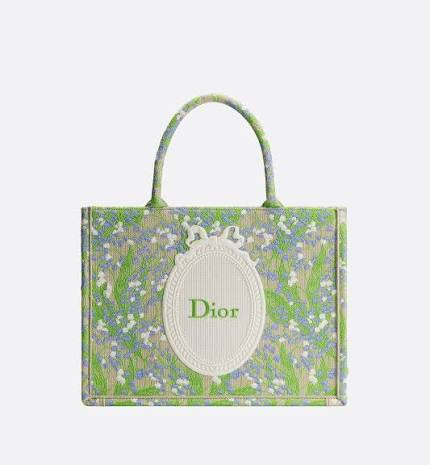
Dior incorporated the flower into his designs, allowing its small bells and delicate structure to inspire embroidery, decoration and silhouette. In the spring–summer 1954 collection, he dedicated an entire line to lily of the valley. The Muguet dress, presented for spring–summer 1957 in the Libre line, later became another celebrated expression of the flower’s place in the house’s history.
This was not simply floral decoration. The flower offered Dior a way to express femininity through delicacy rather than volume alone.
The New Look had established his reputation through defined waists, rounded hips and full skirts. But Dior’s imagination extended far beyond those famous proportions. Flowers provided a vocabulary through which he could explore lightness, texture and movement, creating garments that suggested nature without attempting to reproduce it literally.
Lily of the valley was particularly suited to this approach. Its tiny bells could become embroidered motifs; its green stems could inspire linear details; its clustered arrangement could influence the rhythm of a garment’s surface.
The result was a visual language that could be recognised without requiring the flower to appear in its literal form.
And then there was perfume.
Diorissimo: Capturing a flower that resists capture
Lily of the valley presented a particular challenge to perfumers.
Although its natural scent is distinctive, the flower is difficult to capture directly through conventional extraction. It is often described in perfumery as a mute flower because its fragrance cannot readily be obtained as a traditional natural essential oil. Perfumers therefore recreate its character using combinations of other materials.
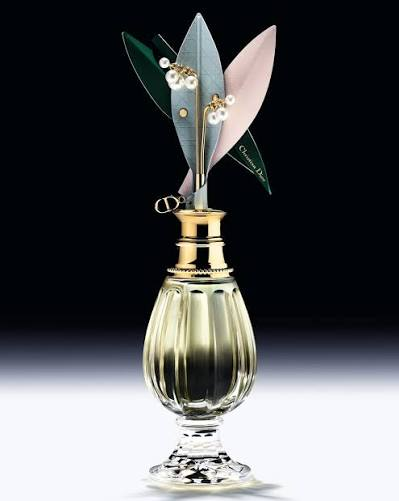
Dior entrusted the creation of Diorissimo to Edmond Roudnitska. Launched in 1956, the fragrance was built around the impression of lily of the valley, translating the freshness of spring into a perfume.
Roudnitska used a carefully composed blend rather than a simple extraction of the flower. The House of Dior identifies ingredients including ylang-ylang, jasmine and Rose de Mai among the materials used to evoke the desired floral character.
The perfume became an extension of Dior’s affection for the flower. What he had once worn or kept close as a symbol of good fortune could now be experienced as scent.
It also illustrates one of perfumery’s most interesting contradictions: the fragrance that seems most faithful to a flower may be the product of considerable invention.
A lily-of-the-valley perfume is not necessarily the flower bottled. It is an interpretation of the impression the flower leaves behind.
That is an idea that sits comfortably beside couture, where a designer can take inspiration from nature and transform it into something that exists independently of its original source.
Did Mitzah Bricard bring the flower to Dior?
This is where the story becomes especially intriguing.
Bricard’s work at Molyneux in 1938 provides a documented connection between her and the flower. Dior’s later affection for lily of the valley is also well established. Researchers have therefore raised the possibility that Bricard’s earlier work influenced the flower’s eventual importance within Dior’s world.
But possibility is not proof.
Dior had his own longstanding love of flowers, and the evidence does not establish that Bricard introduced him to lily of the valley or that she was solely responsible for its later status as a house signature.
What can be said is that Bricard had worked with the flower before Dior founded his couture house. Her experience at Molyneux placed her in a position to understand how it could be used in fashion, and her subsequent role at Dior brought that experience into the same creative environment as his floral imagination.
Perhaps the most interesting interpretation is not that one person gave the flower to the other, but that their sensibilities could meet around it.
Bricard understood ornament and the power of a detail. Dior understood the emotional and symbolic potential of flowers. Together, within the creative world of the house, those instincts could exist in conversation.
We should not turn that possibility into a definitive claim about authorship. Fashion history is already full of stories in which the contribution of a collaborator disappears beneath the name on the label. Bricard’s documented career deserves a more careful treatment than simply assigning her responsibility for every motif she encountered.
Yet her association with the 1938 Molyneux collection remains a fascinating clue — one that invites further research into the movement of ideas between couture houses.
Where can you find lily of the valley today?
The flower has travelled far beyond the woodland environments in which it naturally grows.
In Europe, lily of the valley can be found in suitable woodland habitats across much of its native range, including France, Britain, Germany and other temperate regions. It is also cultivated in gardens, where it is valued for its fragrance and its ability to spread beneath trees and shrubs.
In France, it remains especially visible around 1 May, when bunches of muguet are sold and exchanged as symbols of good fortune. The Nantes region is a major centre of commercial production, benefiting from a mild, relatively humid climate suited to the plant.
In North America, European lily of the valley is cultivated in gardens and has become naturalised in parts of the United States and Canada. It can thrive in shaded gardens, particularly where the soil remains reasonably moist. Because it spreads through underground rhizomes, it can form substantial colonies once established.
In Asia, lily of the valley is associated with a broader botanical region containing related populations and forms. Kew’s account places the accepted species’ native range in Europe to the Caucasus, while other botanical resources document the genus and related distributions across northern Asia. It is important not to confuse the distribution of the familiar European species with every plant that shares the common name.
For those who simply wish to enjoy the flower, cultivated plants are available through specialist nurseries and florists. Fresh stems are often seasonal, though commercial growing can extend availability beyond the natural flowering period.
One caution is essential: lily of the valley is poisonous if eaten. Its leaves, flowers and red berries contain compounds that can affect the heart, so it should be kept away from children and pets who might chew the plant.
Its beauty invites close attention, but it is a flower best admired rather than handled carelessly.
The little bells that remain
Perhaps lily of the valley’s enduring appeal lies in its contradictions.
It is fragile in appearance but persistent in the garden. Its flowers are small, yet its fragrance can fill a room. It carries associations with innocence and good fortune, yet the plant itself is poisonous. And in fashion, it has moved between practical decoration, personal superstition and the language of luxury.
For Mitzah Bricard, its significance remains an open question. We know that she was associated with lily-of-the-valley styling at Molyneux in 1938, but we cannot establish that the flower was her personal favourite or that she deliberately passed it on to Dior.
For Christian Dior, however, its place is unmistakable. It became a lucky charm, a couture inspiration, a perfume and a tradition that continues to connect the house with its founder.
The flower’s story is therefore larger than a single designer or a single collection. It moves from woodland to court, from couture atelier to perfume laboratory, and from the private preferences of a designer to the public identity of a fashion house.
And somewhere within that history is Mitzah Bricard: the woman whose eye for elegance helped shape Dior’s world, and whose earlier encounter with these little white bells may have been one of the quiet connections linking two chapters of Parisian fashion.
We may never know precisely what she saw when she looked at them.
But we can see why the flower endured.
Sometimes the most lasting symbols in fashion are not the loudest. They are the details that return, season after season, carrying a little of their original mystery with them.