The SS United States: From Transatlantic Speed Queen to the World’s Largest Artificial Reef
There is something extraordinary about a ship that once represented the height of American engineering, carried some of the world’s most recognisable names across the Atlantic, and broke a record that has stood for more than seven decades. Now, after years of uncertainty over its future, the SS United States is approaching the final chapter of its life above the water.
In November 2026, the legendary ocean liner is scheduled to be deliberately sunk in the Gulf of Mexico, off Florida’s Emerald Coast, where it is expected to become the world’s largest artificial reef. The planned deployment is set for November 12, weather permitting, approximately 22 nautical miles southwest of Destin and Fort Walton Beach.
For a vessel once celebrated as a symbol of speed, luxury and national ambition, the destination is an unexpected one. Yet the project offers something unusual: an opportunity for a historic ship to continue serving a purpose long after its days carrying passengers have ended.
The SS United States will no longer cross the Atlantic, but its next chapter could bring an entirely new audience to its decks, albeit beneath the sea.
A ship built to make history
Launched in 1951 and entering passenger service in 1952, the SS United States was designed to be more than a transatlantic liner. It was an expression of American technological ambition in the years following the Second World War.
Built by the Newport News Shipbuilding and Drydock Company in Virginia for United States Lines, the vessel combined an imposing profile with advanced engineering. At approximately 990 feet long, it was designed to cross the Atlantic quickly while maintaining the standards expected of a premium passenger ship.
Its most celebrated achievement came on its maiden voyage in July 1952. Travelling from New York to Europe, the liner set the westbound transatlantic speed record, crossing the ocean in three days, 10 hours and 40 minutes. It subsequently established the eastbound record as well.
More than 70 years later, those records remain a defining part of the ship’s legacy.
The achievement was not simply about speed. The SS United States had been designed with national security in mind, too. The US government contributed to its construction because the ship could, in an emergency, be converted into a high-speed troop transport. Its design reflected an era in which commercial shipbuilding and military preparedness could be closely connected.
That dual purpose helped make the liner an engineering achievement unlike an ordinary passenger vessel.
A floating symbol of glamour
During its operating years, the SS United States carried a remarkable collection of passengers, including Hollywood stars, prominent public figures and international travellers.
Its passenger list included names such as Marilyn Monroe, Coco Chanel, Walt Disney and Salvador Dalí. Four US presidents—Harry S. Truman, Dwight D. Eisenhower, John F. Kennedy and Bill Clinton—were also associated with voyages aboard the vessel.
For passengers crossing the Atlantic during the golden age of ocean liners, the journey was part of the experience. Before long-haul commercial aviation transformed international travel, ships offered a way to cross between continents in an atmosphere of ceremony, dining and social occasion.
The SS United States was built for that world, but it also looked towards the future. Its designers prioritised speed, fire safety and innovative construction, giving the vessel a reputation that extended well beyond its passenger service.
Yet the very qualities that made it remarkable could not protect it from changing times.
As commercial aviation became faster, more accessible and increasingly dominant, demand for traditional transatlantic passenger liners declined. The economics of maintaining a ship of this size became harder to justify, and the SS United States eventually left regular passenger service in 1969.
Its record survived. Its working life did not.
Decades of uncertainty
After its retirement, the ship passed through different ownership arrangements and spent years at various locations while plans for its future repeatedly changed.
For a time, there was hope that it might return to service or find a second life as a permanently moored attraction. The SS United States Conservancy, a preservation organisation dedicated to protecting the vessel’s legacy, worked to keep the ship from being scrapped.
The challenge was enormous. Maintaining a nearly 1,000-foot ocean liner requires substantial funding, a suitable berth and a viable long-term business plan. Restoring a ship of this scale is far more complicated than preserving a historic building or displaying a retired vehicle.
The vessel arrived in Philadelphia in 1996 and remained there for almost three decades. But legal and financial pressures eventually forced a decision about its future.
In October 2024, Florida’s Okaloosa County moved forward with its acquisition of the ship and plans to convert it into an artificial reef. The alternative, preservation advocates explained, was that the historic liner could ultimately be dismantled for scrap.
The decision was a compromise rather than the outcome many preservation supporters had originally wanted. The ship would not be restored to its former glory, but neither would its entire structure disappear into a scrapyard.
Instead, it would become something new.
The final voyage: From Philadelphia to the Gulf
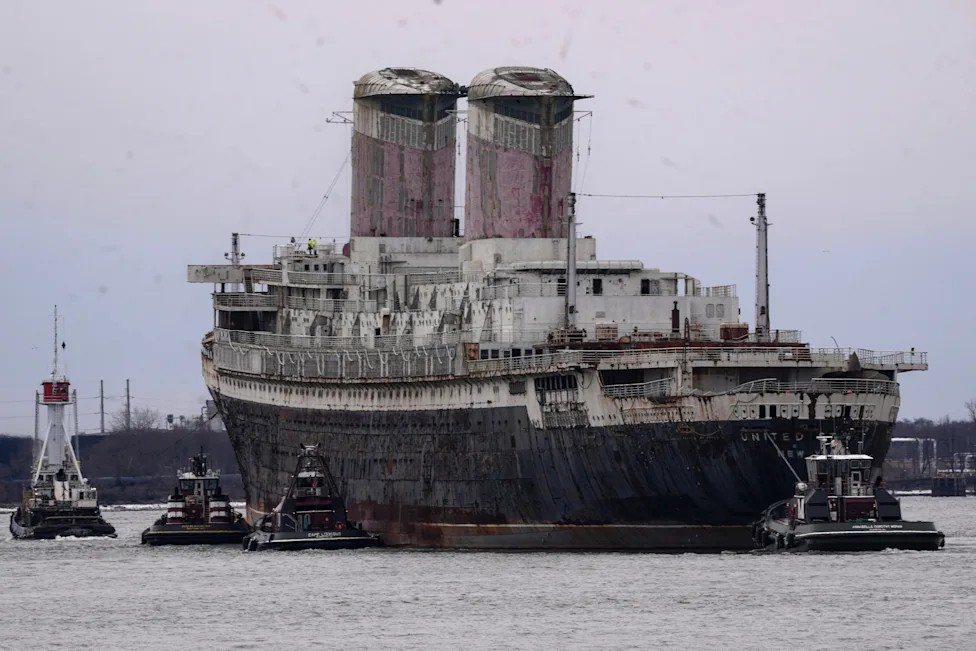
The SS United States began its journey towards an underwater future in February 2025, when it was towed away from Philadelphia towards Mobile, Alabama.
The move marked the end of a long chapter for the ship, which had become a familiar sight along the Delaware River. Crowds gathered to watch its departure, offering a farewell to a vessel whose history extended far beyond the American coastline.
In Mobile, the ship entered an extensive preparation and environmental remediation programme. Before a vessel can be deliberately sunk to create an artificial reef, it must be made suitable for the marine environment. Fuel, hazardous materials and other potential contaminants must be addressed, while the structure must be prepared for its eventual resting place.
The SS United States has also undergone changes that preserve important pieces of its identity on land.
Its two iconic funnels and radar mast have been removed and saved for a planned museum dedicated to the ship’s history. These features once defined its distinctive silhouette, making it recognisable even from a distance.
The removal of these elements is a reminder that the project is not simply about sinking an old ship. It involves separating the vessel’s historical significance from the structure that will ultimately become an underwater habitat.
The plan is to create a controlled sinking using strategically placed openings in the hull, allowing water to enter while helping the ship settle upright on the seabed. Explosives are not intended to be used.
If the operation proceeds as planned, the SS United States will be resting in the Gulf of Mexico by the middle of November 2026.
Why sink a ship to create an artificial reef?
At first, the idea of deliberately sinking a historic ocean liner might sound contradictory to the goals of conservation. But artificial reefs have become an established tool in marine habitat management, provided that vessels are properly prepared and deployed under appropriate environmental controls.
An artificial reef introduces a hard structure into an underwater environment where marine organisms can attach, shelter and feed. Over time, the surface can become colonised by algae, barnacles, sponges and other organisms, creating opportunities for a broader community of marine life.
Fish may use the structure for shelter, feeding or protection from predators. Other species can establish themselves around the wreck, contributing to an increasingly complex underwater ecosystem.
The SS United States offers an unusual opportunity because of its immense size.
Rather than introducing a comparatively small vessel, the project will place a structure measuring approximately 990 feet in length on the Gulf seabed. Its decks, hull and remaining structural features will create an underwater environment unlike most artificial reefs.
However, a distinction matters here: the ship will not become a thriving marine ecosystem overnight. Colonisation takes time, and the ecological outcome will depend on local conditions, water quality, currents, available food and the species living in the surrounding waters.
The project’s success should therefore be measured not simply by the size of the wreck, but by the marine habitat that develops around it over the coming years.
Proper preparation is essential. Removing pollutants and hazardous materials helps reduce environmental risks, while decisions about access and structural safety determine whether the wreck can support responsible diving activities.
The intention is to give the SS United States a new function in the marine environment without overlooking the responsibility involved in deliberately placing a vessel on the seabed.
A new attraction for Florida’s Emerald Coast
The artificial reef is also expected to become a major attraction for Destin and Fort Walton Beach, communities already associated with fishing, boating and coastal tourism.
For divers, the prospect of exploring a nearly 1,000-foot ocean liner beneath the Gulf represents an unusual opportunity. The ship’s scale alone could make it a destination for experienced divers travelling from across the United States and beyond.
The wreck’s eventual accessibility will depend on its final position, depth, safety restrictions and the conditions surrounding the site.
The planned location is approximately 22 nautical miles southwest of Destin. The ship is expected to rest in around 160 feet of water, with the top of its remaining superstructure approximately 75 feet below the surface.
That depth means the site will not be suitable for every recreational diver. While parts of the wreck may be accessible to appropriately qualified divers, deeper exploration will require more advanced training, equipment and planning.
The location also means visitors will need to travel by boat rather than simply arrive at a beachside dive site.
This creates opportunities for local businesses, including dive operators, charter boats, hotels, restaurants and other tourism services. Divers visiting for the wreck may also spend time exploring the surrounding region, extending the economic benefits beyond the underwater attraction itself.
Okaloosa County hopes the project will strengthen the area’s existing artificial reef programme and generate additional tourism spending. The county has described the initiative as an opportunity to benefit both the marine environment and the regional economy.
Those benefits remain projections rather than guaranteed results. The eventual economic impact will depend on how quickly the site becomes accessible, how much demand it attracts and how effectively local businesses incorporate it into their offerings.
What happens to the ship’s history?
Perhaps the most interesting aspect of the project is that the SS United States will have two futures.
One will unfold beneath the Gulf, where marine life gradually colonises its structure and divers encounter what remains of the historic liner.
The other will take shape on land.
The SS United States Conservancy is working towards a museum and visitor experience that will preserve and interpret the vessel’s history. The project is intended to showcase its engineering, design, cultural significance and place in American maritime history.
The preserved funnels, radar mast and other recovered artefacts will help tell that story.
The museum also offers a way to address an important distinction between preserving a ship and preserving its legacy. Although the vessel itself will no longer be available to walk aboard in the traditional sense, its story can continue through objects, photographs, documents and educational displays.
For maritime historians, designers and enthusiasts, that collection will be particularly valuable. The SS United States represented an important moment in post-war industrial design, when engineering, national ambition and the glamour of international travel came together in a single vessel.
Its future museum could also help explain why the decline of the great ocean liners was about more than changing transport technology. It reflected a wider transformation in how people travelled, how ships were financed and what society expected from luxury at sea.
The underwater reef will attract visitors looking forward. The museum will give them a reason to look back.
Is this the end of an era?
In one sense, yes.
Once the SS United States is sunk, the possibility of restoring the original vessel to passenger service will effectively be gone. For those who spent years campaigning to preserve the ship afloat, that is a significant loss.
An artificial reef cannot reproduce the experience of standing on the deck of a functioning ocean liner, examining its design or imagining what an Atlantic crossing might have felt like in 1952.
Nor should the environmental benefits be treated as a replacement for the cultural value of the original ship. Both considerations matter, and the decision reflects the difficult circumstances surrounding the vessel’s survival.
But another perspective is possible.
Instead of ending its story through dismantling, the SS United States is being prepared for a future in which its physical structure could support marine life while attracting a new generation of visitors. Its history will be carried forward through a land-based museum, and its name may become familiar to divers who were not yet born when the ship last carried passengers.
The ship that once crossed the Atlantic at record speed will eventually rest on the Gulf seabed. Its funnels will survive on land, its records will remain in maritime history, and its steel structure will begin a slow transformation into an underwater habitat.
That is an unusual legacy for a vessel built to embody speed, modernity and American engineering.
The verdict: A second life beneath the waves
The SS United States is scheduled to be sunk on November 12, 2026, off Florida’s Emerald Coast, subject to weather and operational conditions. Its final deployment is expected to create the world’s largest artificial reef, opening a new chapter for a ship that has spent years searching for a viable future.
The project brings together three ambitions: protecting the environment through a carefully prepared artificial reef, creating a new attraction for divers and preserving the vessel’s historical significance through a museum.
Whether it ultimately fulfils all three ambitions will take time to establish. Marine ecosystems develop gradually, tourism projections must be tested against actual visitor demand, and a museum’s success depends on how effectively it communicates the ship’s importance.
Still, the idea is compelling.
The SS United States was built to cross an ocean. Now, it is being prepared to become part of one.
Its final voyage will not end with passengers stepping ashore. Instead, it will mark the beginning of a very different journey—one measured not in hours or speed records, but in years of marine growth, exploration and remembrance.
For a ship that once represented the future of ocean travel, perhaps the most remarkable part of its story is that its final chapter is still being written.