The Circuit Gilles Villeneuve is a place where legends are measured in millimeters and milliseconds. As we head toward the 2026 Canadian Grand Prix, the paddock conversation isn’t just about the current standings it’s about a number that has haunted the timing screens for seven years: 1:10.240.


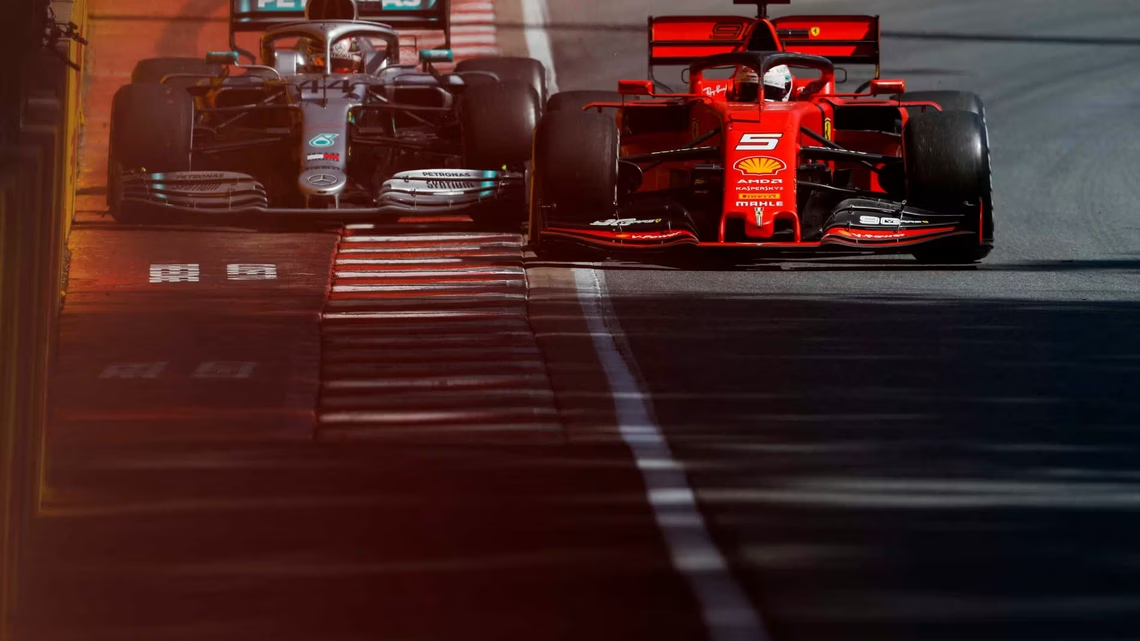
That was Sebastian Vettel’s pole lap in 2019. Since then, cars have grown heavier and aero philosophies have shifted, but the “Vettel Standard” remains the mountain no one has been able to climb.
The Architect: Sebastian Vettel (The 1:10.240 Standard)
Vettel’s 2019 lap was a masterclass in calculated aggression. While most drivers feared the unforgiving curbs of Montreal, Vettel treated them as launchpads.

- The Tactic: His “Point and Squirt” methodology was never more evident than at the 50-yard mark. He would downshift late and hard, using the engine braking to pivot the car on a dime.
- The Exit: By V-shaping the corners, he was back on the throttle while others were still mid-rotation. It was high-risk, mechanical ballet that culminated in a time that survived the entire high-downforce era and the birth of ground-effect.
The Challenger: George Russell (The Nimble Tactician)
If anyone has the momentum to finally crack the 1:10.2s, it’s George Russell. Last year, George secured a blistering 1:10.899 to take pole, but his approach to the limit is a stark contrast to the “all-or-nothing” style of the past.


- The Style: Russell’s Mercedes W17 looks incredibly nimble under his hands, but observers note a distinct hesitancy in his downshifts. While his timing is meticulous, he doesn’t quite “throw” the car into the apex with the same violent rotation Vettel once did. He relies on the car’s agility to navigate the chicanes, often waiting a fraction of a beat longer for the platform to settle before committing to the gear.
- The Goal: George is currently the “King of the Current Era” in Montreal. He’s shaved nearly two seconds off the 2024 pace, but the question remains: Can a “hesitant” downshift strategy ever bridge the gap to Vettel’s raw, aggressive 1:10.240?
The Enforcer: Max Verstappen (The Tactical Threat)
You can never count out Max, especially given his recent dominance. While Max often focuses on race-trim durability, his qualifying sessions in Montreal are a study in precision.

- The Tactic: Verstappen’s strength lies in the “Wall of Champions.” He carries a terrifying amount of speed into the final chicane, using the curbs to rotate the car in a way that mimics that old-school preference for a loose rear end.
- The Rivalry: Max and George are locked in a high-speed chess match. While Russell has the qualifying edge lately, Verstappen’s ability to find grip on a “green” track could be the factor that sees him leapfrog the record.
The 1:10.240 Checklist: What Will It Take?
To beat Vettel’s ghost, the 2026 grid needs three things to align:
- Late Downshifts: Committing to that aggressive 50-yard mark deceleration without the hesitation that currently separates the pack.
- Hybrid Deployment: Using the 2026 ERS boost perfectly out of the Hairpin (Turn 10) to eat up the back straight.
- Brave Curbs: Bullying the chicanes at Turns 3, 4, and 9 without losing the floor’s ground-effect seal.
Vettel’s record has stood for 2,500+ days. In Montreal, the wall is waiting, the curbs are ready, and the clock is ticking. Will 2026 be the year the 1:10.240 finally falls?