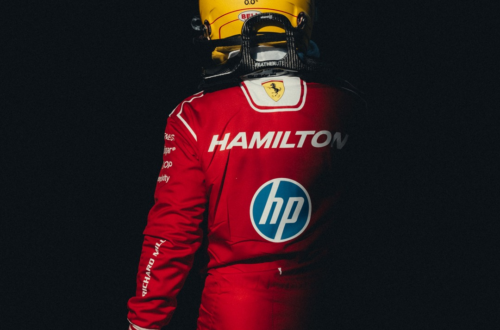

Formula 1 has a funny way of making you believe that everything can change in a single weekend.
Then Madrid comes along and reminds you that sometimes the biggest story is just how far away some teams still are.
So let’s make the rounds.
We’ll start with Aston Martin.
Aston Martin: At This Point, Q2 Would Have Been a Victory

I’ll be honest.
I wanted to see Fernando Alonso on the podium at the Madring.
Maybe that was optimistic.
Maybe it was the Ferrari fan in me looking for another storyline to follow.
But after everything Aston Martin has endured this season, even a strong qualifying performance would have felt like something worth celebrating.
Instead, Alonso was eliminated in Q1, qualifying 17th, and eventually finished 17th in the race.
So yes, perhaps Q2 would have been the best the team could realistically deliver.
And that’s not an insult.
It is an acknowledgement of where Aston Martin actually is. This is a team that has spent much of 2026 fighting its own machinery. Reliability problems, power-unit difficulties and development challenges have turned what was supposed to be the beginning of a new era into something much closer to a survival year. Aston Martin has just three points in the Constructors’ Championship.
Three.
That places it behind every other manufacturer currently competing in F1.
Yet I don’t think the number tells the entire story.
Because Aston Martin isn’t simply trying to save 2026.
It is trying to build 2027.
And that makes the development war more important than the points table.
The Development War Doesn’t Stop
The biggest mistake would be to look at Aston Martin’s position and assume the team has stopped fighting.
It hasn’t.
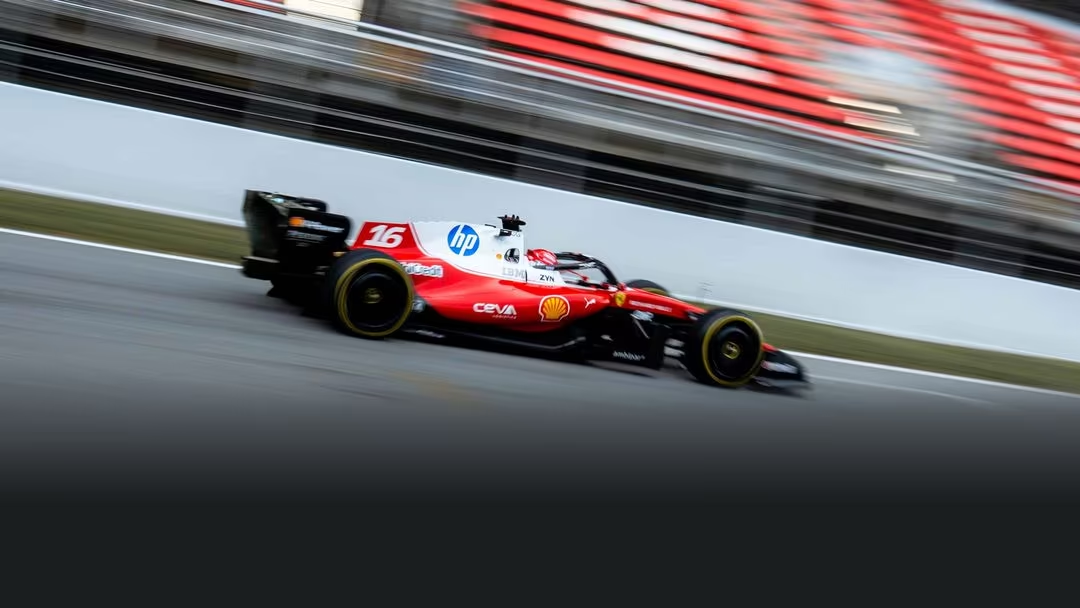
Adrian Newey’s arrival was never really about turning the AMR26 into an overnight championship winner. The 2026 regulations changed the chassis and power unit simultaneously, creating an enormous technical reset for everyone. Newey himself described the first year of those regulations as a situation where the correct philosophy would not immediately be obvious.
That is exactly what we’re seeing.
The team is learning.
Honda is learning.
The aerodynamic department is learning.
Newey is learning.
And somewhere in all of that is supposed to be the foundation for the Aston Martin that can finally fight at the front.
The next major shift in the Honda side of the operation is expected to begin on October 1, as Aston Martin continues reorganising around the future works relationship.
That’s the part I find most interesting.
Aston Martin doesn’t need another cosmetic upgrade.
It needs the entire operation to start behaving like a championship team.
And Then There Is Lance Stroll
Now we get to the ridiculous part.
Forty places.
Lance Stroll was handed a nominal 40-place grid penalty at Madrid after Aston Martin exceeded the permitted allocation of several power-unit components.
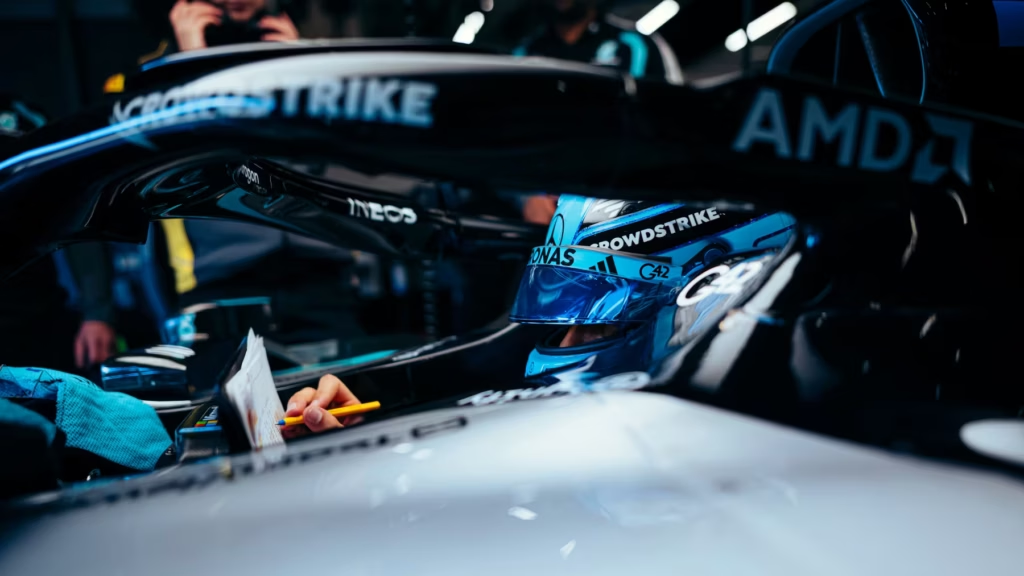
The breakdown was almost comical.
A fifth internal-combustion engine: 10 places.
A fifth turbocharger: another 10.
A seventh PU-ANC: another 10.
A sixth energy store: five.
A fifth MGU-K: five.
Total:
40 places.
Of course, the penalty is largely symbolic because Formula 1 doesn’t have 40 grid positions.
Stroll ultimately started at the back.
But that’s precisely why the penalty deserves discussion.
Mercedes recently absorbed a 20-place penalty while sitting at the front of the championship fight.
Aston Martin is sitting at the bottom. There is a huge difference between penalising a team that can absorb a grid drop and penalising a team that is already fighting just to escape the final rows, And Aston Martin is not merely struggling. It is operating far below the FIA’s 10% benchmark for manufacturers under the new regulations.
Punishment or Consequence?
This is where I struggle with the current system.
I understand why the FIA has power-unit allocation rules.
I understand why teams cannot simply bolt on new components every weekend.
There has to be a sporting consequence.
But there is something uncomfortable about watching a team already struggling for relevance receive the same fundamental type of punishment as a championship-leading team.
Aston Martin needs support.
It needs reliability.
It needs mileage.
It needs data.
And most importantly, it needs to understand its Honda package.
Instead, it is burning through components and collecting grid penalties.
That doesn’t exactly help the development process.
And Then Mohammed Ben Sulayem Talks About Alonso
There was another interesting moment away from the track.
FIA president Mohammed Ben Sulayem publicly praised Fernando Alonso and advocated for the two-time world champion to remain in Formula 1.
Fair enough.
Alonso remains one of the most valuable drivers in the sport.
But I have to ask a slightly uncomfortable question:
Would Alonso still want to stay if he had a 40-place grid penalty hanging over his head?
Would you?
Because there comes a point where even the greatest drivers in the world have to ask themselves whether they’re still competing or simply surviving.
Alonso isn’t fighting for podiums.
He isn’t fighting for wins.
He’s fighting to extract something from a car that has spent much of the year asking him to do the impossible.
And yet, he keeps showing up.
That’s exactly why I understand Ben Sulayem’s comments.
Formula 1 needs Alonso.
But Aston Martin needs to give Alonso a reason to stay.
Now Let’s Talk Ferrari
And this is where I’m probably going to annoy somebody.
But I’ve already made my position pretty clear.
Maybe I Picked the Wrong Ferrari Driver
I didn’t stop believing in my driver.
I didn’t stop believing in Ferrari.
And I certainly don’t believe Ferrari should have been handed a championship.
That’s never been my argument.
What bothered me was the way we fought for it.
Ferrari should be fighting itself to become better.
It should not need to disrupt the internal mechanics of a team that has been together long enough to build championship-winning habits.
And Mercedes has done exactly that.
It has built a machine.
Ferrari is still trying to decide what it wants that machine to be.
The Numbers Are Brutal
After Madrid, Mercedes has 503 points.
Ferrari has 358.
That’s a 145-point gap.
McLaren is now on 306, only 52 points behind Ferrari.
That is the number Ferrari should probably be looking at right now.
Not Mercedes.
McLaren.
Because Mercedes is beginning to disappear.
McLaren is coming.
And that’s a completely different kind of pressure.
Mercedes is sprinting away at the front while McLaren is quietly eating into Ferrari’s second-place advantage.
The Scuderia is caught in the middle.
Too far behind Mercedes to realistically control the championship.
Not far enough ahead of McLaren to relax.
That’s not a comfortable place to be.
And Then There Is Charles
Charles Leclerc finished fifth at the Madring.
Lewis Hamilton?
He retired.
Again, the championship numbers tell the story.
Hamilton sits third with 191 points.
Leclerc sits fifth with 167.
The gap between them is 24 points.
But I’m no longer interested in arguing whether Ferrari should have chosen one driver over the other.
I’m interested in what Ferrari does next.
Because the championship has moved.
The conversation has moved.
And perhaps Ferrari needs to stop trying to rescue 2026 and start protecting what comes after it.
McLaren Is the Interesting One
McLaren has 306 points.
Ferrari has 358.
That’s a 52-point difference.
And suddenly that second-place battle doesn’t feel comfortable anymore.
Oscar Piastri has had a difficult season, but McLaren remains dangerous because of something we’ve talked about all year:
copy, develop, apply.
McLaren has repeatedly shown an ability to identify what works, understand it and turn it into something usable.
That’s not necessarily glamorous.
It doesn’t always make headlines.
But championships aren’t won by having the prettiest concept.
They’re won by understanding what makes the car faster.
And McLaren is still doing that.
Meanwhile, Mercedes Is Doing Something Else Entirely
Mercedes isn’t copying anybody.
It’s setting the benchmark.
Kimi Antonelli has now won eight of the first 14 races and leads the championship by 81 points over George Russell. Mercedes leads Ferrari by 145 points in the Constructors’ Championship.
That is domination.
And perhaps the most frightening part for everyone else is that Antonelli doesn’t appear to be slowing down.
He isn’t simply surviving a championship.
He’s controlling one.
Russell has already admitted that he isn’t realistically in the title fight anymore.
That’s how quickly this championship has shifted.
So Where Does Scuderia Ferrari Go From Here?
Honestly?
It’s hard to say.
And that’s probably the most honest answer I can give.
Ferrari is second.
That’s good.
But second is starting to look less secure.
Mercedes is 145 points ahead.
McLaren is 52 points behind.
Charles is fifth.
Lewis is third.
And the driver Ferrari brought in to help deliver the championship is now watching Antonelli’s lead grow further away.
The 2026 championship may have already escaped Maranello.
But Ferrari doesn’t have the luxury of mourning it.
Because McLaren is coming.
Mercedes is gone.
And 2027 is already waiting.
And That’s Why This Season Still Matters
Maybe that’s the strange beauty of Formula 1.
Aston Martin can finish near the back and still be building something that could matter enormously next year.
Ferrari can lose a championship and still learn enough to win the next one.
McLaren can sit third and suddenly find itself challenging for second.
Red Bull can struggle and still remain the benchmark that everyone studies.
And somewhere at the front, Kimi Antonelli keeps winning.
So yes, it’s tense.
But I wouldn’t call the atmosphere explosive.
I’d call it numb.
Aston Martin is trying to survive.
Ferrari is trying to understand what happened.
McLaren is quietly approaching.
Mercedes is already looking over its shoulder.
And me?
I’m still here.
Still watching.
Still covering Ferrari.
Still hoping.
But perhaps with slightly less expectation than I had at the beginning of the season.
Because sometimes being a Ferrari fan isn’t about believing everything will work.
Sometimes it’s simply about waiting for the moment when it finally does.