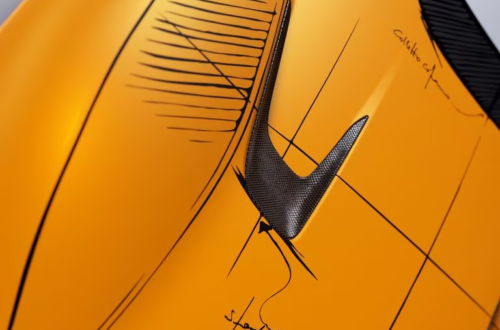

For months, the Genesis Magma GT has existed almost like a secret.
A car you could see, but not really see.
It sat beautifully under showroom lights, surrounded by the polished atmosphere that comes with a concept designed to announce a new chapter for a brand. Genesis showed us the shape, the stance and the ambition, but there was always something missing.
The road.
Now we have finally seen the Magma GT outside.
And there is only one appropriate response:
Absolutely stunning.
The Magma GT doesn’t look like Genesis has simply decided to build a sports car.
It looks like Genesis has decided it wants to enter a completely different conversation.
From Showroom Sculpture to Moving Machine
The first time you see the Magma GT sitting still, its proportions do most of the talking.
Low.
Wide.
Mid-engined.
Aggressive without looking cartoonish.
The front end flows directly into the bodywork, while the headlights and aerodynamic elements are integrated into the design rather than simply attached to it. Genesis describes the car as its first pure sports-car typology, built around what it calls “Athletic Elegance.”
But seeing it outside changes the experience.
The car suddenly has context.
The body moves.
The suspension works.
The engine has to put the power down.
And the enormous difference between a beautiful concept and a convincing sports car becomes very obvious.
The Magma GT is gorgeous.
But now we have to ask:
Can it actually corner?
The Cornering Question
This is where I think the Magma GT needs some help.
That isn’t necessarily a criticism of the concept itself.
It’s an observation from seeing the car finally moving in the real world.
The Magma GT appears to have enormous potential, but the way it carries itself through a corner doesn’t yet inspire the same confidence that its styling does.
Genesis is effectively asking us to believe that this is the beginning of a genuine performance lineage.
If that’s the case, the chassis has to become as convincing as the body.
A car producing serious power is easy to make impressive in a straight line.
Making it change direction beautifully is another matter entirely.
And that’s where the Magma GT has something to prove.
Eight Hundred Horsepower Is Only the Beginning
Genesis has positioned the Magma GT around a mid-rear-mounted engine, with its current concept specification pointing toward a twin-turbocharged V8 producing up to 800 horsepower.
That is serious territory.
But 800 horsepower isn’t the story.
It is the responsibility.
Because once you give a car that much power, every weakness in the chassis becomes more obvious.
The steering has to communicate.
The front axle has to respond.
The rear has to remain predictable.
The brakes have to inspire confidence.
And the suspension has to control all of that mass and power without turning the car into something nervous.
That’s why I’m more interested in what Genesis does with the Magma GT’s chassis than I am in another horsepower announcement.
We’ve reached the point where horsepower alone doesn’t impress me.
How does it drive?
That’s the question.
Genesis Has Already Given Us a Hint
The Magma GT isn’t appearing in isolation.
Genesis has been building an entire performance ecosystem around Magma.
The brand has already introduced the GV60 Magma as its first production Magma model, while the Magma GT3 Concept gives us an even more aggressive interpretation of the GT’s design language for racing.
The GT3 concept is particularly important.
Genesis says it was developed as an exploration of GT3 regulations rather than simply turning an existing road car into a race car. It receives wider tracks, a prominent splitter, larger ducts and additional aerodynamic hardware.
That’s the part that interests me.
Because racing has a funny way of exposing weaknesses.
If Genesis really wants Magma to become a performance identity rather than simply an aggressive design language, motorsport is where that credibility will ultimately be earned.
The Road Car Has to Be More Than a Concept
There is still one major question hanging over all of this.
Will we actually get one?
Genesis has not officially confirmed a production Magma GT. The company continues to identify it as a concept, and recent reports suggest production could potentially arrive later in the decade rather than being an immediate programme.
And perhaps that’s why Genesis has been so careful with it.
The Magma GT isn’t just another concept.
It represents what Genesis wants people to think when they hear the word Magma.
Performance.
Exclusivity.
Motorsport.
Luxury.
And eventually, perhaps, a genuine Genesis supercar.
That is a lot of weight for one car to carry.
But Seeing It Outside Changes Everything
For me, the biggest transformation isn’t technical.
It’s visual.
Inside a showroom, the Magma GT looks like an extraordinary design exercise.
Outside, under natural light, surrounded by real roads and real surroundings, it suddenly looks like something that could actually belong in the world.
And that’s dangerous.
Because now I want one.
I want to hear the V8.
I want to see what that mid-engine layout can actually do.
I want to know what Genesis has done with the steering.
I want to know how hard you can attack a corner before the car starts telling you that you’ve asked too much of it.
And most importantly, I want to know whether Genesis can make the driving experience as memorable as the silhouette.
Because right now, the Magma GT has already won one battle.
It looks incredible.
Absolutely incredible.
But the next battle is harder.
Genesis has to make it corner.
And if it can solve that part of the equation, the Magma GT could become much more than a beautiful concept sitting under showroom lights.
It could be the car that finally tells the established European performance world:
Genesis has arrived.