Before Cartier
became synonymous with the great jewellery houses of the 20th century, before Bulgari turned Rome into one of the capitals of modern luxury, another Roman family was doing something remarkably different.
They were looking backward.
Into Etruscan tombs.
Into ancient Greek and Roman jewellery.
Into Byzantine mosaics.
Into Renaissance goldwork.
And then they were taking what they found and putting it back into the world as jewellery.
The family was Castellani, and at the centre of its rise was Fortunato Pio Castellani, the Roman goldsmith who would help create an entirely new language of 19th-century jewellery.
The firm’s influence would stretch across Europe, attract aristocrats and wealthy travellers, inspire other major jewellers—including Carlo Giuliano—and eventually turn archaeological revival jewellery into one of the defining artistic movements of Victorian-era jewellery.
The Castellani story begins in Rome in 1814.
Fortunato Pio Castellani: A Roman Beginning
Fortunato Pio Castellani was born in Rome in 1794, the son of goldsmith Pasquale Castellani.
His father died when Fortunato was still a young child, but the boy received an unusually strong general education. By the age of 20, he had opened his own jewellery shop in Rome. The British Museum records the firm’s beginning in 1814, when Fortunato Pio was just twenty.
Initially, however, Castellani was not the archaeological jeweller we know today.
His early business produced fashionable jewellery influenced by contemporary French and English styles.
Then something changed.
Fortunato Pio became increasingly fascinated with antiquity.
One of the most important people in that transformation was Michelangelo Caetani, Duke of Sermoneta, an aristocrat, scholar and artist who became a close friend and patron.
Caetani encouraged Castellani to look toward ancient jewellery as a source of inspiration.
It would change the history of the company.
The Etruscan Discovery
The turning point came with the extraordinary archaeological discoveries being made around Rome.
In 1836, the excavation of the Regolini-Galassi tomb at Cerveteri revealed an astonishing collection of Etruscan gold jewellery.
The workmanship was extraordinary.
Tiny gold beads.
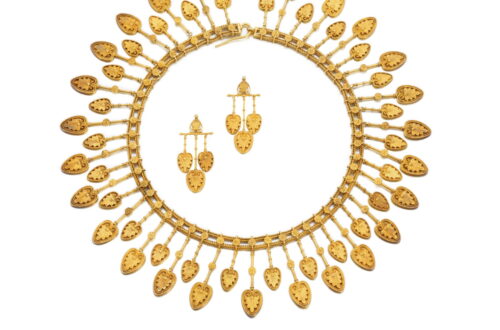
Intricate filigree.
Delicate geometric patterns.
Gold surfaces covered in microscopic granules.
The discoveries demonstrated that ancient Italian goldsmiths had possessed technical abilities that had largely disappeared from European jewellery making.
Fortunato Pio and his sons became obsessed with understanding how it had been done.
The family was given access to archaeological material and collections, allowing them to study ancient jewellery closely. The Bard Graduate Center describes Castellani’s pursuit of the lost Etruscan technique of granulation as one of the family’s greatest contributions to jewellery history.
This was not simply copying.
It was reconstruction.
The Lost Art of Granulation
Granulation became the heart of the Castellani aesthetic.
The technique involves attaching extraordinarily small spheres of gold to a surface to create patterns, borders and images.
The Etruscans had perfected it centuries earlier.
Then the technique largely disappeared.
The Castellanis spent decades attempting to rediscover it.
According to the Getty Museum’s research, the family’s experiments eventually allowed them to reproduce ancient goldsmithing techniques, including the joining of tiny gold spheres to jewellery surfaces.
The result was extraordinary.
From a distance, a Castellani jewel could look almost like an archaeological discovery.
Only when examined closely did its Victorian craftsmanship reveal itself.
And this was precisely the point.
The Castellanis wanted the past to appear alive.
Fortunato’s Sons: Alessandro and Augusto
The family business eventually passed into the hands of Fortunato Pio’s sons:
Alessandro Castellani (1823–1883)
and
Augusto Castellani (1829–1914).
Alessandro would become particularly important.
He was not merely a businessman.
He was a collector, antiquarian, designer and one of the great advocates for archaeological jewellery.
The British Museum records that Alessandro lost his left hand in a hunting accident at thirteen, meaning he could not physically make jewellery himself. Yet he became a powerful artistic force behind the family enterprise.
His fascination with antiquities would eventually become almost as important as the jewellery itself.
Alessandro and the International Castellani Empire
By the 1850s, Alessandro and Augusto were increasingly managing the firm.
The family began selling archaeological jewellery not only to Roman aristocrats but also to international visitors.
Then came expansion.
Alessandro opened subsidiary operations in London and Paris during the 1860s and established a workshop in Naples.
The Castellanis exhibited at international exhibitions in Florence, London and Paris, dramatically increasing the visibility of their work.
Their jewellery became a luxury souvenir for wealthy travellers.
But “souvenir” doesn’t quite capture what these pieces represented.
A Victorian traveller could return from Rome wearing something that appeared to have been pulled directly from an ancient Etruscan tomb.
That was the appeal.
Jewellery That Looked Ancient
The Castellanis became masters of historical illusion.
They produced jewellery inspired by:
– Etruscan goldwork
– Ancient Greek jewellery
– Ancient Roman jewellery
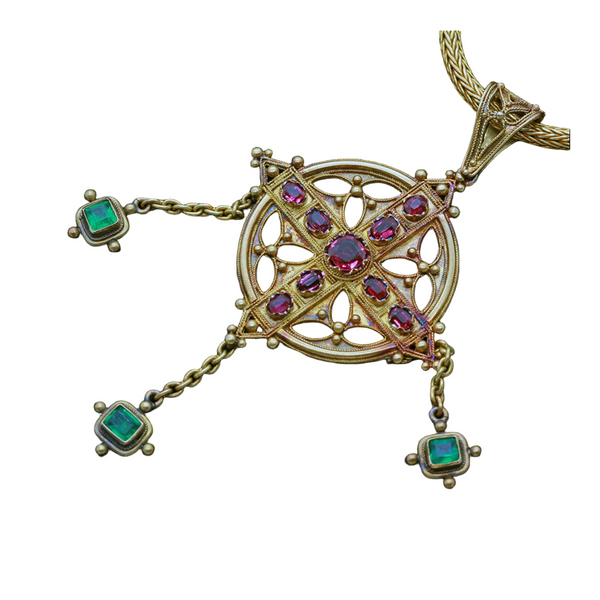
– Early Christian art
– Byzantine traditions
– Medieval jewellery
– Renaissance forms
The Metropolitan Museum describes the firm as having pioneered and dominated archaeological jewellery, with its work covering Etruscan, Roman, early Christian, Byzantine and medieval styles.
But the family didn’t simply reproduce one ancient style.
They combined techniques.
An Etruscan-inspired gold form might contain a Roman cameo.
A Byzantine-inspired jewel could incorporate micromosaic.
An archaeological necklace might carry an ancient gemstone inside a completely new setting.
The past became a vocabulary.
The Castellani Brooch
One of the most important examples of this philosophy is the Castellani Brooch, created around 1858.
The Museum of Fine Arts, Boston identifies it as a copy of an Etruscan original excavated in 1836 at Cerveteri, now associated with the Campana collection at the Louvre.
This is an important distinction.
The Castellanis weren’t merely designing something that looked Etruscan.
They were studying actual archaeological discoveries and creating highly sophisticated interpretations of them.
This approach would become enormously influential.
The Gold Necklace With Ancient Silver Coins
Among the surviving Castellani jewels is an extraordinary necklace combining 19th-century goldwork with ancient silver coins dating to the 4th–3rd centuries BC.
The Museo Nazionale Etrusco describes it as one of the workshop’s most refined achievements, particularly noting the exceptional quality of its granulation.
This is quintessential Castellani.
Ancient objects were not treated merely as museum pieces.
They could become components of a new work.
The necklace therefore occupies an unusual place between archaeology, collecting and jewellery.
It is simultaneously ancient and modern.
The Lion and Two Ducks Brooch
Another remarkable surviving piece is a gold brooch depicting a lion and two ducks.
Its design was inspired by a 6th-century BC Etruscan fibula.
The Museo Nazionale Etrusco notes the use of repoussé, in which thin metal is worked from the reverse to create raised decoration. The Castellanis combined this with granulation and filigree to reproduce the richness of ancient Etruscan goldsmithing.
This is exactly where the Castellanis separated themselves from ordinary revival jewellers.
They didn’t just revive the appearance.
They revived the technology.
The Micromosaic Revolution
Then came another of the family’s great signatures:
micromosaic.
Tiny pieces of coloured glass were arranged into incredibly detailed pictures and patterns.
The technique had ancient Roman roots and was particularly associated with Rome’s churches and decorative traditions.
The Castellanis incorporated micromosaic into their jewellery, sometimes using imagery derived from Christian and Byzantine art and sometimes creating completely new compositions.
One surviving British Museum example is particularly striking.
The Assyrian Winged Bull Pendant
Dating to approximately 1865–1870, the pendant consists of a circular gold setting surrounding a glass micromosaic depicting an Assyrian winged bull.
The gold is decorated with ropework, wirework and beading.
On the reverse are the characteristic crossed-C Castellani monograms.
It is a perfect example of how the family could combine ancient imagery with several different decorative traditions.
Assyria.
Roman micromosaic.
Victorian goldsmithing.
All in one small object.
The “Speaking Jewels”
Perhaps the most charming aspect of Castellani jewellery is that some pieces could actually speak.
The family worked closely with Michelangelo Caetani, who helped develop jewellery incorporating inscriptions and symbolic messages.
The Museo Nazionale Etrusco records bracelets incorporating Latin inscriptions such as:
NON RELINQUAM
“I will not abandon you.”
and
NON RELINQUES
“You will not abandon me.”
Placed on opposite sides, the two inscriptions create a conversation between the wearer and the person who gave the jewel.
These became known as “speaking jewels.”
They transformed jewellery from something decorative into something personal.
The jewel could carry a promise.
A political statement.
A declaration of love.
Or a private message.
The Castellani Crossed-C Mark
The family also developed a recognizable identity.
The double-C or crossed-C mark became associated with Castellani jewellery.
On some surviving pieces, it appears on the reverse, identifying the workshop.
That mark has become incredibly important to collectors today.
Because Castellani jewellery was so influential, imitations became widespread.
A genuine mark, provenance and construction can therefore make a significant difference when determining whether a jewel is an authentic Castellani piece or a later revival.
The Family and Italian Unification
There is another dimension to the Castellani story that makes it much more than a jewellery history.
The family became involved in the politics of Italian unification.
Alessandro was an outspoken supporter of the movement.
His political activities eventually resulted in his banishment from Rome in 1860. He spent years in exile, including periods in Paris and London, while continuing to promote the family business and deal in antiquities.
He eventually returned to Rome after Italian unification and established an arts and antiquities gallery.
By the time of his death in 1883, contemporary obituaries described him as one of the most successful collectors of ancient art of his generation.
For Alessandro, jewellery, archaeology and Italian identity were not separate subjects.
They were interconnected.
The Castellanis and the Birth of a Movement
Perhaps the greatest testament to the family is what happened after their jewellery became successful.
Everyone began copying them.
The archaeological revival spread throughout Europe.
The Castellanis had demonstrated that jewellery could be intellectually sophisticated while remaining fashionable.
Their success influenced jewellers across Europe, including Carlo Giuliano, whose own work would later become one of the great expressions of the Renaissance and archaeological revival in London. The Metropolitan Museum explicitly identifies the Castellanis’ influence on Giuliano and other historicist jewellers.
In other words:
Castellani helped create the environment in which Giuliano could flourish.
The Collection Was Almost as Important as the Jewellery
The Castellanis weren’t simply jewellers.
They were antiquarians.
Alessandro in particular assembled an enormous collection of antiquities.
After his death, much of that collection was dispersed.
The British Museum became an important beneficiary. The museum records major acquisitions from Alessandro in 1865 and an even larger and more varied collection in 1872.
This creates another fascinating aspect of the Castellani legacy.
When you look at a Castellani jewel today, you are sometimes looking at the result of a process that began with the family collecting, studying and documenting ancient objects.
They weren’t working from imagination.
They had the archaeological material in front of them.
What Happened to the Family Firm?
The Castellani enterprise survived for three generations.
The Metropolitan Museum records that the company remained in family hands until it finally closed in 1927.
By then, the jewellery world had changed dramatically.
Art Nouveau had come and gone.
Art Deco was emerging.
Modern luxury houses were beginning to dominate.
But the Castellani contribution had already been made.
They had demonstrated that the ancient world could become modern luxury.
Are Any Important Castellani Jewels Missing?
This is where the story becomes more complicated.
Unlike some jewellery houses where individual stolen jewels are extensively documented in police or auction records, the Castellani story is complicated by the enormous number of pieces produced, copied, modified and dispersed through collections.
The family operated for more than a century.
Their pieces travelled through aristocratic collections, museums, international exhibitions and private hands.
Some survive in major institutions.
Others remain privately owned.
And some pieces described in 19th-century exhibition records are no longer easily traceable.
There is also another problem:
the Castellanis deliberately made archaeological revival pieces that could look extraordinarily close to ancient originals.
Consequently, attribution can be difficult.
A jewel may be:
– an original ancient object;
– a Castellani reproduction;
– an original Castellani design inspired by antiquity;
– a later Castellani-family piece;
– or a later imitation by another jeweller.
That makes the search for “lost Castellani” jewellery particularly interesting.
The disappearance of a piece from a museum record does not necessarily mean it was stolen.
It may have entered a private collection.
It may have been sold at auction under a different description.
Or it may have been attributed simply as “Italian archaeological revival.”
The Greatest Castellani Legacy
The Castellanis ultimately changed the relationship between jewellery and history.
Before them, antiquity could be something studied in a museum.
The Castellanis made it wearable.
A person could put on an Etruscan-inspired brooch and carry thousands of years of artistic history into a Victorian drawing room.
They could wear a Roman-inspired necklace.
A Byzantine micromosaic.
A Greek-style bracelet.
A jewel carrying an ancient coin.
Or a tiny gold object covered in granulation that required its maker to rediscover a technique that had been lost for centuries.
That is why Fortunato Pio Castellani matters.
He did not merely found a successful jewellery business.
He helped reconstruct a forgotten language of goldsmithing.
And his sons, Alessandro and Augusto, transformed that discovery into an international phenomenon.
The Castellani family eventually disappeared from the jewellery trade.
Their influence did not.
The techniques they revived continue to fascinate jewellers today.
Their pieces remain in the world’s great museums.
And somewhere, almost certainly, there are Castellani jewels whose stories have yet to be fully recovered.
Because the family didn’t just make jewellery.
They made the past wearable.