John Brogden: The Victorian Jeweller Who Turned Archaeology Into Art
There was a time in Victorian London when a jewel could be more than an ornament. It could be a fragment of antiquity, a miniature archaeological discovery, or a piece of history recreated in gold.
Few jewellers understood that idea better than John Brogden.
Today, his name is not as immediately recognizable as Cartier, Fabergé or Castellani. Yet during the second half of the 19th century, Brogden was one of Britain’s most important manufacturing jewellers, producing extraordinary pieces influenced by ancient Egypt, Greece, Rome, Assyria, the Renaissance and the archaeological discoveries that fascinated Victorian society.
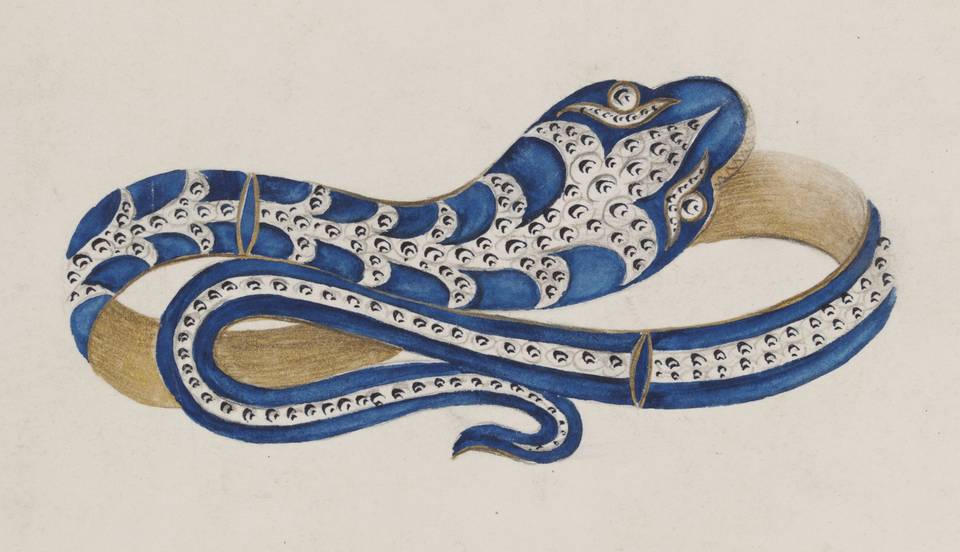
The Victoria and Albert Museum describes the Brogden firm’s surviving design archive as containing 1,593 jewellery designs dating from 1848 to 1884—an extraordinary record of a jewellery house operating during one of the most stylistically adventurous periods in European jewellery.
And behind those designs was a London jeweller who built his reputation by treating the past not as something to copy, but as something to reinterpret.
From Islington to Covent Garden
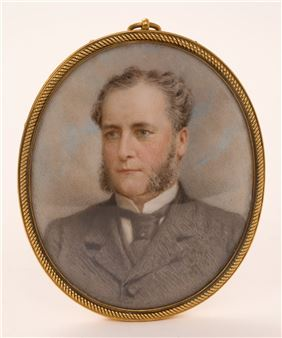
John Brogden was born in Islington, London, in 1819 according to biographical records, although museum and trade references commonly give his dates as 1820–1884.
His route into jewellery began unusually early.
In 1834, Brogden entered a seven-year apprenticeship with James William Garland, a London watch and clockmaker whose workshop was at Bridgewater Square.
That apprenticeship gave him something more important than simply technical training. It placed him inside London’s highly competitive luxury manufacturing world at precisely the moment when the Victorian fascination with history was beginning to transform decorative arts.
After completing his apprenticeship, Brogden became associated with James Watherston. Their firm, Watherston & Brogden, operated from 16 Henrietta Street, Covent Garden, where Brogden developed his reputation as a manufacturer and designer.
In 1864, he took control of the business and continued under his own name.
The address would become closely associated with the Brogden name.
The Jeweller Who Looked Backward
Brogden’s genius was his ability to turn archaeology into luxury.
Victorian Britain was fascinated with the ancient world. Excavations, museums and international exhibitions were bringing Egyptian, Greek, Roman, Assyrian and Renaissance objects before an increasingly wealthy public.
Brogden understood the market.
His jewellery incorporated motifs and techniques derived from ancient civilizations while using the sophisticated craftsmanship demanded by 19th-century luxury consumers.
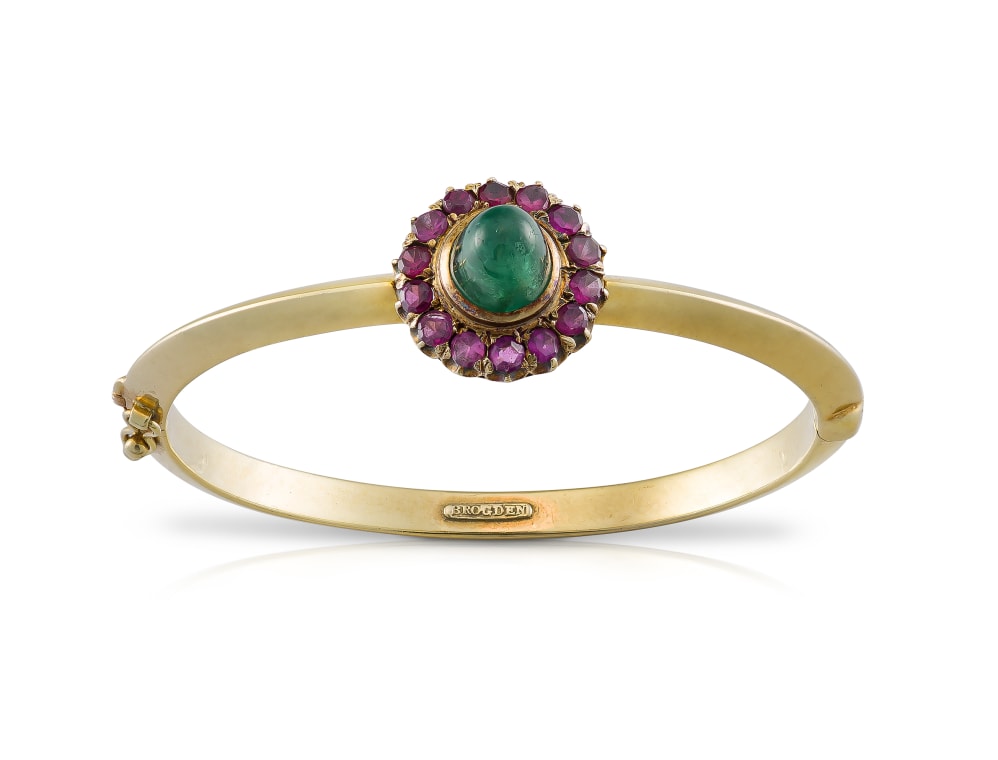
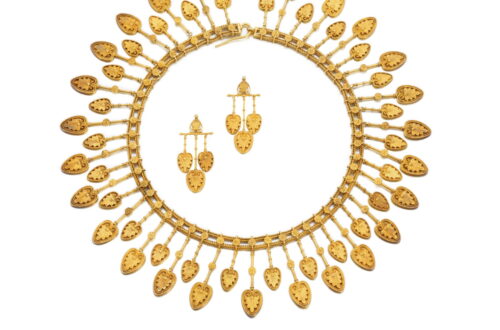
His surviving work includes Egyptian Revival, Greek, Roman, Assyrian, Renaissance and archaeological-revival pieces.
The Victoria and Albert Museum notes that the firm produced jewellery in an exceptionally broad range of fashionable styles and was particularly renowned for its outstanding goldwork.
But the archaeological influence was not superficial.
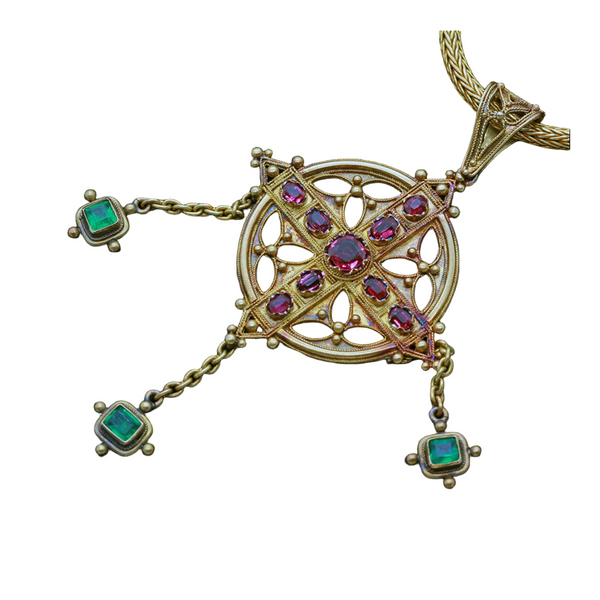
Brogden specialized in difficult techniques including granulation and filigree, creating surfaces that could resemble ancient goldwork while remaining unmistakably Victorian in their execution.
That technical ability helped separate him from ordinary manufacturers.
Nineveh, Egypt and the Ancient World in Gold
One of the most fascinating aspects of Brogden’s work is how directly contemporary archaeology entered his designs.
The British Museum holds a pair of Brogden dress or lapel studs made around 1852–1855, engraved with an Assyrian winged bull and Assyrian soldiers. The museum records that Brogden’s mark had been entered at Goldsmiths’ Hall in 1848.
These aren’t generic Victorian decorations.
They demonstrate the extraordinary appetite of the period for newly excavated civilizations.
The V&A likewise preserves a Brogden design for an Egyptian-inspired brooch dating to around 1860, noting that Victorian enthusiasm for ancient Egypt was being fueled by contemporary archaeological excavations.
Brogden was effectively turning the museum into a jewellery vocabulary.
Ancient symbols became pendants.
Archaeological forms became bracelets.
Classical figures became cameos.
And objects that had once belonged to ancient civilizations were reinterpreted for Victorian wardrobes.
Cameos: One of His Great Specialties
Among Brogden’s most important areas of expertise was cameo jewellery.
He became one of London’s leading purveyors of cameo pieces, working with hardstone and shell cameos produced by specialist Italian carvers. He was also an important collector of antique cameos himself.
One surviving example in the British Museum is particularly beautiful: a gold pendant containing a shell cameo of Cupid and Psyche, mounted by Brogden around 1870.
The Italian cameo depicts the mythological lovers, while Brogden’s gold setting incorporates his characteristic applied ivy-leaf decoration.
It is an excellent example of the Brogden philosophy.
The ancient image was not enough.
The setting had to become part of the artwork.
The 1867 Paris Exhibition
Brogden’s reputation reached well beyond London.
He exhibited internationally and received recognition at major exhibitions, including the Great Exhibition of 1851 and the Paris Exhibition of 1855.
His international reputation continued to grow.
By the later Victorian period, Brogden was producing pieces in a remarkable range of historical styles.
A surviving account of his 1878 Paris exhibition is revealing. His display included a Pompeian bracelet decorated with birds and flowers, a massive Greek-style gold armlet incorporating an antique gem, an Etruscan-style bracelet with antique gems and a large onyx cameo surrounded by precious stones.
One of the pieces—a sapphire and pearl cross inspired by a work attributed to Quintin Matsys—was purchased by Prince Leopold, demonstrating the level of royal attention Brogden’s work could attract.
This was no longer simply a London manufacturing operation.
Brogden had become an international name.
Not Everything Was Ancient
Despite his fascination with archaeology, Brogden’s catalogue was remarkably diverse.
The British Museum preserves a Zulu shield brooch, produced around 1875–1880, made in gold and silver. The shield shape and miniature spears and clubs were inspired by Zulu military objects that had entered British public consciousness following the Zulu Wars.
Another surviving Brogden jewel is a silver necklace incorporating vulture claws, produced around 1870.
There were also sporting jewels, portrait pieces, crosses, cameos, bangles and bracelets.
A Brogden jewel could therefore tell very different stories depending upon its owner.
The Brogden Woman
One of the most interesting figures associated with Brogden’s workshop was Charlotte Isabella Newman.
Newman trained at the South Kensington Art School and worked with Brogden from the mid-1860s until his death in 1884.
Her involvement is important because Brogden’s workshop was not simply a production line.
It brought together designers, craftsmen and specialists capable of translating elaborate drawings into finished jewellery.
The V&A’s Brogden archive gives us an unusually intimate view of that process.
More than 1,500 surviving designs reveal the thinking behind the jewellery—an extraordinary survival rate for a Victorian manufacturing house.
But Were Brogden’s Jewels Ever Stolen?
This is where the story becomes particularly interesting.
There is documented evidence of at least one Brogden-associated jewel being stolen and later recovered.
In 2023, an auction house offered a Victorian gold turquoise “book” bracelet associated with John Brogden.
Known as the Pole Carew bracelet, the jewel consists of pierced and engraved panels spelling “SOUVENIR” and carries the inscription “In memory, Anne Carew.”
Its provenance records something remarkable: it was reportedly taken in lieu of a debt around 1910, subsequently stolen, and then recovered around 1923–24.
The bracelet eventually returned to the market more than a century after it was created.
That story gives us a glimpse into something often forgotten about Victorian jewellery.
These were not merely museum objects.
They were portable fortunes.
They could be inherited, pawned, used to settle debts, sold privately—and stolen.
What About Truly Missing Brogden Jewels?
Here the evidence needs to be treated carefully.
There are certainly Brogden jewels that are no longer publicly accounted for. Given the enormous quantity of jewellery produced by the firm, and the fact that much Victorian jewellery remains in private hands, it would be reasonable to assume that many pieces have disappeared from public view.
But I have not found a reliable museum, police, auction or scholarly record identifying a specific famous Brogden jewel as definitively stolen and still missing.
That distinction matters.
There is a difference between a jewel that has disappeared from the public record and one officially documented as stolen.
The Brogden archive itself makes the search fascinating. With more than 1,500 surviving designs at the V&A, researchers can sometimes identify the intended design even when the finished jewel has not yet resurfaced.
That means the possibility remains that some extraordinary Brogden pieces are sitting anonymously in private collections, family estates or even incorrectly attributed collections.
What Survived?
Fortunately, quite a lot.
The Victoria and Albert Museum and British Museum both hold important examples of Brogden’s work.
Among them are:
– Egyptian-inspired designs
– Assyrian jewellery
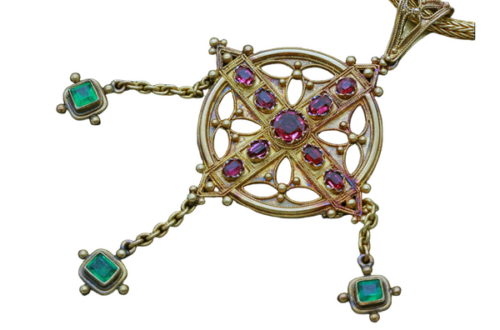
– Russian-inspired crosses
– Cameo pendants
– Sporting jewels
– Archaeological Revival pieces
– Gold and silver brooches
– Renaissance-influenced work
The British Museum’s Russian-style cross, for example, is a cast and chased gold pendant dating to around 1870 and based upon a 16th- or 17th-century Russian form.
Its survival gives us something incredibly valuable: a physical example of how Brogden transformed historical objects into Victorian luxury.
The Legacy of John Brogden
John Brogden died in 1884, leaving behind something more substantial than a collection of beautiful jewels.
He left behind a visual record of Victorian Britain’s obsession with the past.
Egyptian temples, Assyrian sculptures, Greek ornaments, Roman antiquities, Renaissance masterpieces and archaeological discoveries were all being absorbed into the culture of the Victorian elite.
Brogden turned that fascination into jewellery.
And perhaps that is why his work remains so compelling today.
A Brogden jewel is rarely just a Victorian jewel.
It can be an Egyptian fantasy.
An Assyrian relic recreated in gold.
A Renaissance revival.
An archaeological experiment.
A family heirloom.
Or, in the case of the Pole Carew bracelet, even a jewel with its own story of theft and recovery.
And somewhere among the private collections of the world, there may still be Brogden pieces that have not been seen for generations.
That is where the story gets interesting.
Because for a jeweller whose surviving archive contains thousands of designs, the pieces we know about may only represent part of the story.