X-Pod Technologies: Could an Ejectable Passenger Capsule Change the Future of Aviation Safety?
An American aerospace technology company is developing a new approach to aircraft emergency protection, proposing that passengers could be enclosed in protective capsules capable of separating from an aircraft during a catastrophic event. With a published patent application and an evolving engineering programme, Safety-X-Pod raises an intriguing question: could the future of aviation safety involve saving the passengers rather than the aircraft?
Commercial aviation has spent decades refining the technology that makes flying safer. From sophisticated flight-control systems and redundant hydraulics to improved materials, fire suppression and emergency evacuation procedures, aircraft manufacturers have continually worked to reduce the likelihood and consequences of an accident.
Yet one fundamental limitation remains. In a catastrophic aircraft failure, passengers are still largely dependent on the structural integrity of the aircraft carrying them.
An American technology company, X-Pod Tech LLC, is exploring an alternative.
Its proposed Safety-X-Pod system is designed around a relatively radical concept: enclosing passengers inside individual or grouped protective compartments that could seal themselves and, under appropriate emergency conditions, separate from the aircraft.
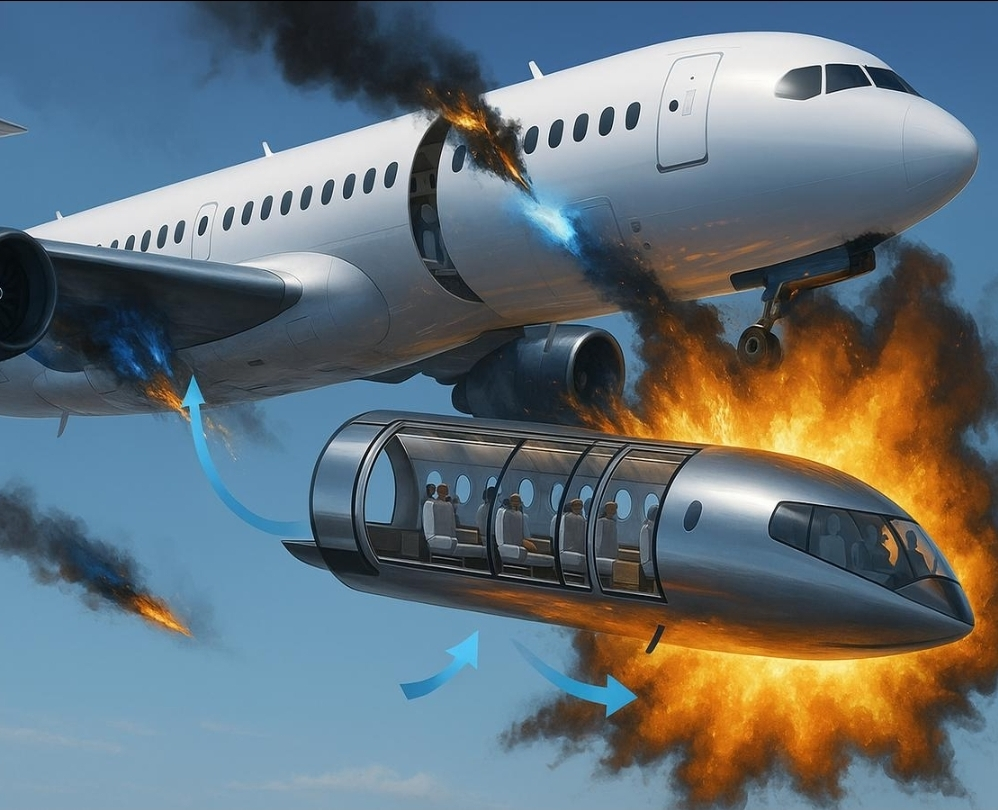
Rather than relying exclusively on the aircraft’s ability to survive an emergency, the concept seeks to provide passengers with an independent protective environment that could remain intact after separation.
It is an ambitious proposition, and one that has moved beyond an initial idea into published patent documentation and early-stage engineering development.
Introducing X-Pod Technologies
X-Pod Tech LLC is a United States-based technology company founded in 2024, with its listed address in Richmond, Virginia.
The company’s primary development project is Safety-X-Pod, a modular passenger protection system intended for potential applications in commercial aviation, private aircraft and defence.
Its founder and inventor, Roy Bey, is identified in the patent documentation. The company’s March 2026 announcement also identifies Bey as its Director of Innovation.
The company’s approach is not to redesign the aircraft’s propulsion or flight-control systems. Instead, it is concentrating on what happens to the people inside an aircraft when the vehicle itself experiences a potentially unsurvivable event.
The proposed system would introduce protective enclosures into the passenger cabin, allowing occupants to travel normally before an emergency activates the containment and separation mechanisms.
It is an interesting departure from conventional aircraft safety architecture, where the fuselage itself provides the primary protective structure.
The Safety-X-Pod concept
At the centre of the proposal is an enclosed passenger compartment, described in the patent as an ovoid-shaped safety pod.
Depending on the aircraft configuration, the system could accommodate individual seats or entire rows of passengers.
During normal flight operations, passengers would enter and exit through electrically operated doors. These doors would remain open when required for normal passenger movement and cabin service.
If a catastrophic event occurred or became imminent, the system would be designed to close and seal the occupied compartments.
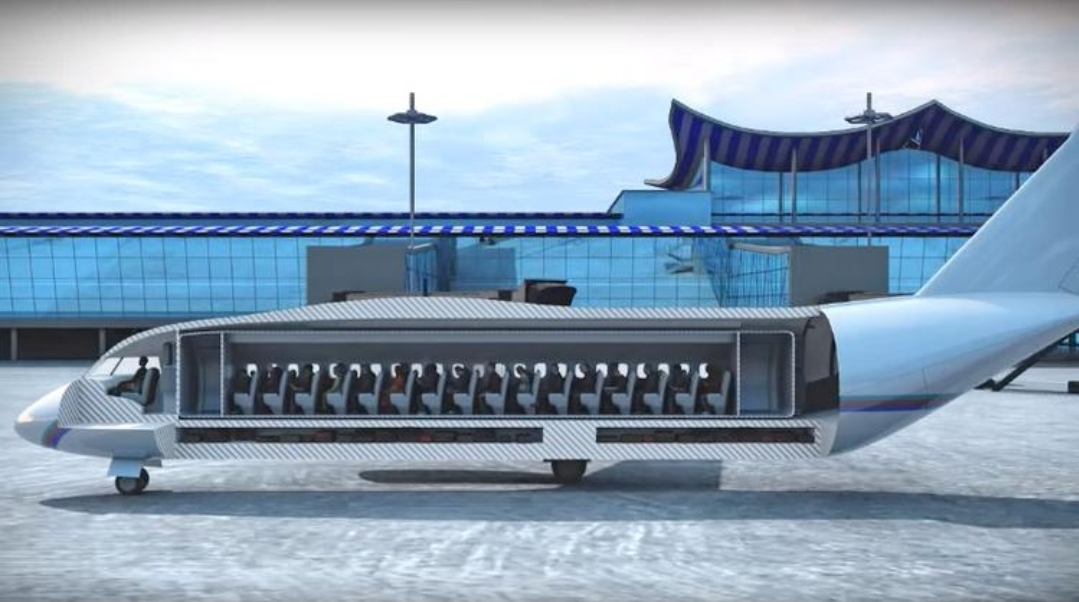
The proposed enclosure incorporates several protective elements:
– Impact-resistant construction and internal cushioning.
– Sealed doors intended to limit exposure to smoke and fire.
– Pressurised compartments and provisions for breathable air.
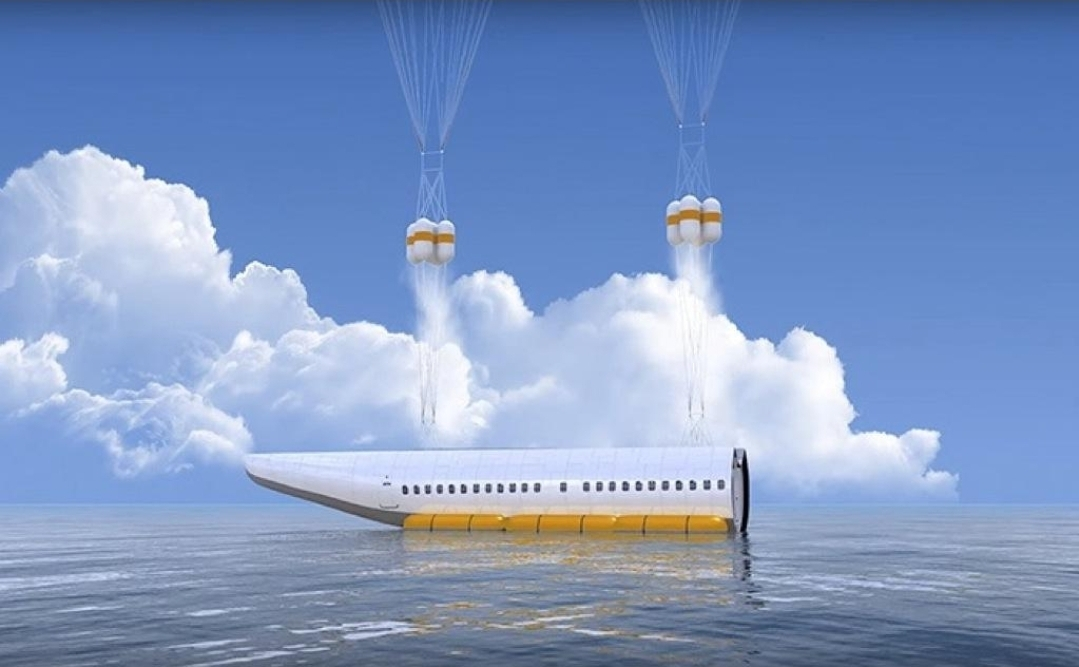
– Water-resistant construction and flotation capability.
– Emergency supplies, independent electrical power and communications equipment.
– A potential parachute system to control descent after separation.
One particularly interesting feature concerns the upper section of the capsule. The patent describes an arrangement in which the top section could separate from the occupied portion and function as a parachute canopy.
The intention is to control the descent of the occupied compartment rather than allowing it to fall freely after leaving the aircraft.
The patent also discusses the possibility of conventional parachute deployment from a compartment within the pod.
These are proposed engineering features, not demonstrated performance specifications. Nevertheless, they establish the technical direction of the project.
Inside the patent: US20250019080A1
The foundation of the Safety-X-Pod concept is United States patent application US20250019080A1, titled:
System Including at Least One Ejectable Safety Pod for Protecting Occupants of a Vehicle During and After a Catastrophic Event.
The application identifies Roy Bey as the inventor and X-Pod Technologies LLC as the current assignee.
The timeline begins on July 12, 2023, when the underlying priority date was established. The US patent application was filed on October 2, 2023, and published on January 16, 2025.
The invention is not restricted exclusively to aircraft. Its patent documentation identifies possible applications in helicopters, automobiles, trucks, buses, trains, ships, military vehicles and spacecraft.
However, its aircraft application is particularly ambitious.
The proposed commercial aircraft configuration could incorporate multiple passenger pods arranged along the cabin, with individual enclosures surrounding seats or groups of seats.
The patent illustrates pods mounted on longitudinal tracks running along the cabin floor.
In an emergency requiring separation, the proposed arrangement would propel the pods towards the rear of the aircraft. A portion of the rear fuselage would then be detachable, providing an opening through which the occupied compartments could leave the aircraft.
This is an important distinction from conventional military ejection seats. Rather than ejecting an individual passenger directly into the surrounding airflow, the concept seeks to preserve an enclosed compartment around the occupant.
The patent also describes a possible minimum deployment altitude, giving 250 feet as an illustrative example for parachute deployment. Below that threshold, the pod would instead need to rely on its impact-resistant construction.
The patent’s illustrations and descriptions therefore outline a complete proposed sequence: containment, sealing, controlled movement, aircraft separation, descent and eventual recovery.
Read the original technical documentation: US Patent Application US20250019080A1.
The international patent question
X-Pod announced on March 19, 2026, that its Safety-X-Pod system had secured international patent protection through the Patent Cooperation Treaty (PCT).
The announcement refers to international application WO2025014546A1.
However, there is an important legal distinction worth making.
A PCT application provides an international filing and examination framework. It does not, by itself, grant a worldwide patent or establish enforceable patent protection in every participating country.
The published international application is evidence that the technology has entered the international patent publication process, not that the invention has received worldwide patent approval.
Furthermore, the patent database currently identifies the international application as ceased. The corresponding US application remains listed as pending.
The US prosecution history also records several final rejections, followed by further responses and examination activity during 2026, including a subsequent non-final action recorded in July.
This means that the intellectual-property position is still developing. The company has published patent applications, but the distinction between an application and a granted patent must be maintained.
How far has development progressed?
Perhaps the most important question is whether Safety-X-Pod has progressed beyond its patent drawings.
According to the company’s own development information, the project remains in a pre-commercial stage.
Its published development programme identifies several areas of ongoing work:
1. Concept refinement and system architecture
The company is continuing to develop the overall design, including the relationship between the passenger enclosure, aircraft cabin and emergency separation mechanisms.
2. Aircraft integration
X-Pod is evaluating how a modular pod arrangement could be incorporated into different aircraft configurations. This includes considering both new aircraft designs and potential retrofit applications.
3. Controlled deployment
The company identifies deployment and containment mechanisms as areas of ongoing investigation. These are central to the concept because a passenger compartment must separate without colliding with the aircraft or exposing its occupants to dangerous forces.
4. Environmental control and survivability
The company is also exploring environmental control and life-support considerations, including maintaining breathable air and protecting occupants from external hazards.
5. Certification and regulatory alignment
Any eventual aircraft installation would require extensive engineering validation and regulatory approval. X-Pod says it is considering certification requirements as part of its development programme.
The company has also identified future testing, industry partnerships and collaboration as potential next stages.
Importantly, its website states that it does not currently manufacture aircraft components. Manufacturing would depend on future partnerships and integration arrangements.
There is, at present, no publicly documented evidence establishing that a full-scale passenger pod has undergone a successful aircraft ejection test, parachute deployment test or certified crash-survival demonstration.
That does not mean development has stopped. It means the publicly verifiable progress remains concentrated on patent documentation, system architecture and pre-commercial engineering work.
The engineering challenge ahead
The underlying idea is compelling, but the practical challenges are considerable.
An aircraft travelling at hundreds of miles per hour generates complex aerodynamic forces. Separating a passenger compartment from a moving aircraft would require careful management of airflow, structural loads and the trajectory of the departing pod.
The proposed rear-fuselage opening is another substantial engineering challenge. The aircraft would need a release arrangement that could create a safe exit path without compromising the separation sequence.
Then there is the question of weight.
An individual or multi-seat passenger capsule would need a strong outer structure, sealing systems, internal cushioning, independent life support, communications equipment and a parachute arrangement. Multiplying those components across an entire commercial aircraft could add considerable weight and affect payload, fuel consumption and aircraft performance.
Certification would be equally demanding. Engineers would need to demonstrate reliable operation across different flight altitudes, speeds, emergency scenarios and environmental conditions.
A system that works at cruising altitude might not have enough time or height to deploy during an emergency close to the ground.
There would also need to be safeguards against accidental deployment, false emergency detection and situations in which ejecting a pod could create greater danger than remaining inside the aircraft.
These are not minor obstacles. They are the engineering questions that will determine whether Safety-X-Pod can progress from an ambitious patent into a practical aviation safety system.
What comes next for X-Pod?
For now, X-Pod Technologies is working towards establishing the engineering foundations of its Safety-X-Pod concept.
The company has identified potential applications across private and commercial aviation, while also expressing interest in partnerships with aircraft manufacturers, operators and other aerospace stakeholders.
The next meaningful milestones would be the publication of a physical prototype, independently verifiable deployment testing, full-scale structural validation and engagement with aviation certification authorities.
Those developments would provide a much clearer indication of how close the technology might be to practical implementation.
There is also an important distinction between protecting passengers and guaranteeing their survival. Even a successfully deployed capsule would have to withstand the forces of separation, descent and landing, while maintaining a survivable internal environment.
The concept is not a solution to every aviation accident, but it represents an alternative direction in passenger safety research.
For decades, aircraft safety has concentrated heavily on preventing catastrophic events and improving the survivability of the aircraft itself. X-Pod is exploring whether the passenger compartment could become an independent safety system.
Whether the technology ultimately reaches commercial aircraft remains uncertain. But with its patent application published and its engineering programme identified, Safety-X-Pod is a development worth following.
The next chapter will not be written by the patent drawings. It will be determined by what the company can physically build, test and demonstrate.