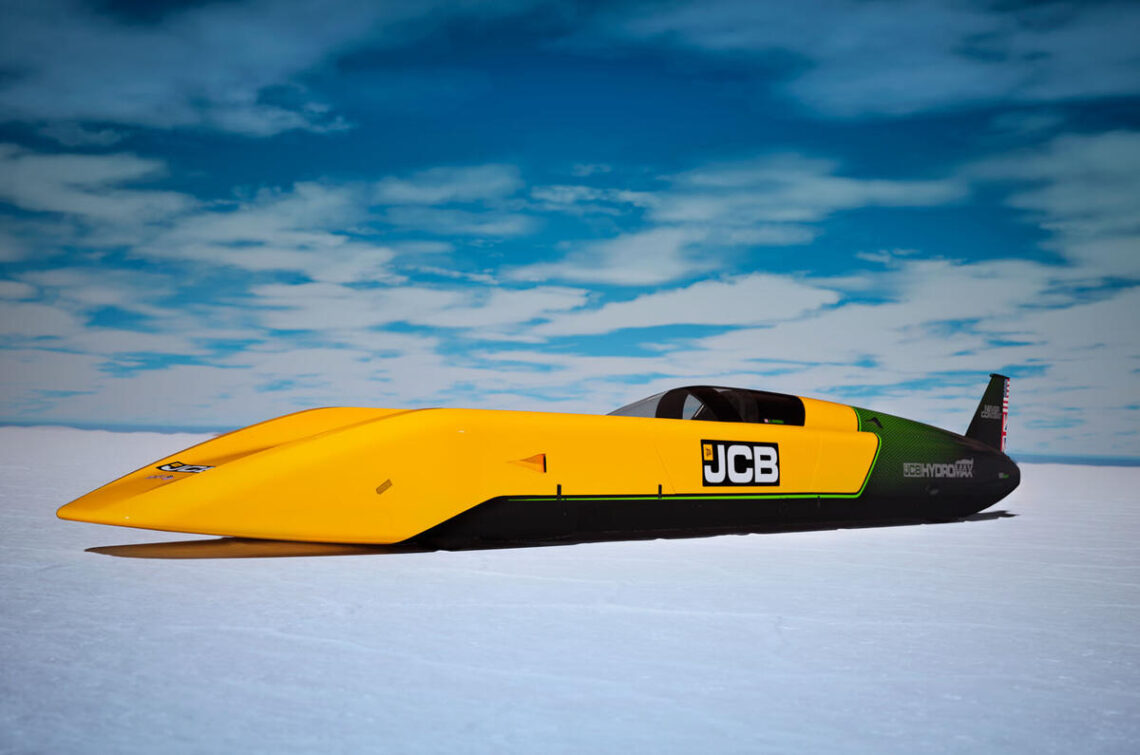
Two decades after British engineering heavyweight JCB stormed the Bonneville Salt Flats with the iconic Dieselmax—establishing a diesel land speed record of 350.092 mph that remains unbroken—the company returned to Utah’s blinding white expanse to settle a new score. This time, the weapon of choice was the JCB Hydromax, a 32-foot twin-engine streamliner powered not by fossil fuels, but by hydrogen combustion.
The Anatomy of a Benchmark
Behind the wheel was none other than Wing Commander Andy Green OBE—the fastest man on Earth and the driver who famously piloted Dieselmax twenty years ago. Under strict FIA World Flying Record Start regulations, Green was tasked with completing two runs in opposite directions across a 10-mile course within a single hour.
- First Run: 400.623 mph
- Return Run: 412.135 mph
- Official FIA Average: 406.320 mph
Before making its official FIA record attempt, the Hydromax laid down its marker during the Southern California Timing Association’s (SCTA) Bonneville Speed Week. Running on engines detuned to 600 bhp each, Green established an SCTA Blown Gas Streamliner class record of 368.347 mph. Following that success, JCB’s engineering team swapped in fresh, fully uncorked 800-bhp engines, unlocking a combined 1,597 bhp for the historic 406+ mph run.

To put this feat into perspective, the Hydromax didn’t just edge out existing records; it obliterated them:
- Previous Hydrogen Combustion Benchmark: 185.5 mph (BMW H2R prototype, 2004)
- Previous Overall Hydrogen Record: 302.877 mph (Buckeye Bullet 2 fuel cell, 2009)
- JCB’s Own Diesel Mark: 350.092 mph (JCB Dieselmax, 2006)
Heavy Equipment Meets High-Speed Engineering
Equally remarkable as the numbers on the radar gun is what lives under the streamliner’s skin. The Hydromax isn’t driven by an esoteric, money-no-object racing prototype motor. Instead, it relies on two production-based 4.8-liter hydrogen internal combustion engines—the exact core architecture currently powering JCB diggers rolling off production lines in Derbyshire as part of the company’s £100 million hydrogen initiative.
Collaborating with Prodrive for the lightweight tubular chassis, carbon-composite safety cell, and multi-link suspension, alongside custom-engineered Goodyear tires built to withstand violent centrifugal forces, JCB effectively proved that heavy-duty commercial technology can dominate at the absolute limits of motorsport.
A Seismic Shift in Propulsion
Much like the cultural evolution explored in The Beautiful Terrifying Shift, the automotive landscape is navigating its own profound pivot point. Where purists once feared that green energy meant sacrificing raw speed and visceral emotion, the Hydromax demonstrates that zero-emission mobility can be unequivocally thrilling.
In a world increasingly distracted by modern digital speed—where human connection often falters, as detailed in The Chat: The Silent Game and Our Disconnect—there remains something deeply grounding about watching mechanical ingenuity conquer nature. It offers a moment of pure focus, echoing the tranquil clarity found in The Saturday Morning Reprieve: A Stroll to the Summit with Mika.in.Paris. Furthermore, as industry leaders embrace clean innovation to usher in new paradigms—a rebirth as joyous as the milestones celebrated in Mazel Tov, She’s Pregnant—JCB Chairman Lord Bamford’s vision proves that internal combustion still has a vibrant, sustainable future.
The JCB Hydromax hasn’t just set a new standard on the salt; it has redefined what green performance looks like at 400 miles per hour.