Ferrari 499P Evo: The Test That Reveals Ferrari’s Next Hypercar
Ferrari didn’t leave Texas after winning the Lone Star Le Mans.
Instead, Maranello stayed at the Circuit of the Americas and put its most important endurance-racing project back onto the track.
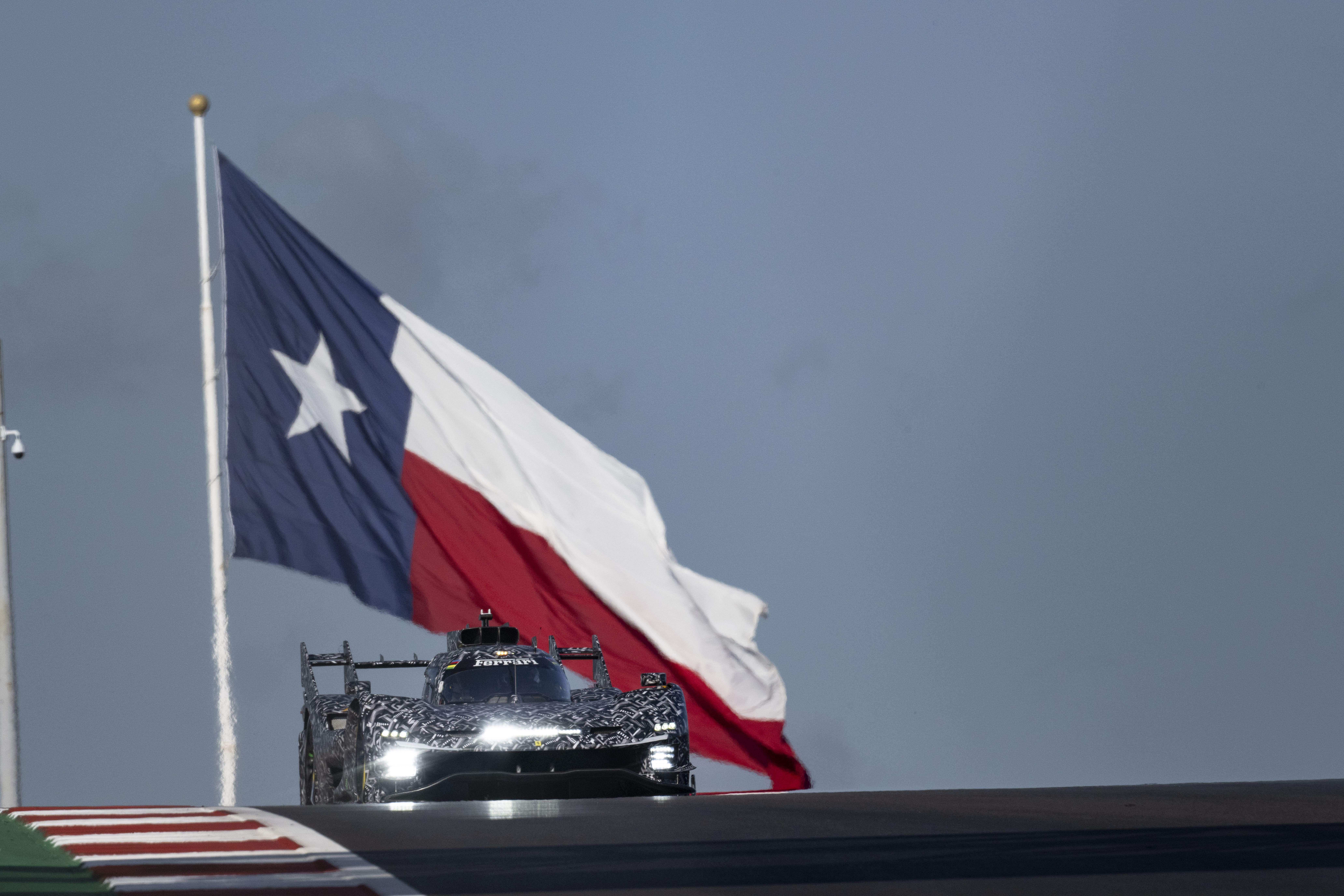
The Ferrari 499P Evo, the heavily revised development version of Ferrari’s Le Mans Hypercar, completed two days of testing at COTA on September 8 and 9 as the manufacturer continues preparing for the 2027 FIA World Endurance Championship.
The camouflage-covered prototype is beginning to reveal what Ferrari has planned for the next chapter of the 499P.
And this is considerably more than a cosmetic update.
From Victory to Development
The timing of the test was almost perfect.
Ferrari had just taken its first WEC victory of the 2026 season at COTA with the #50 499P of Miguel Molina, Antonio Fuoco and Nicklas Nielsen. The result ended a difficult start to Ferrari’s title defence and gave the team an ideal opportunity to remain at the circuit and gather additional data.
The #50 Ferrari won the six-hour race after a dramatic closing phase, while Toyota’s leading #7 suffered a hydraulic failure with less than 15 minutes remaining.
Ferrari therefore left Austin with something it desperately needed: a victory and a huge amount of additional track data.
Then the development programme began.
James Calado, Antonio Fuoco, Nicklas Nielsen and Yifei Ye all participated in the test, with Calado, Nielsen and Ye experiencing the 2027 development car for the first time. Ferrari also ran its current-specification 499P during the programme, allowing the engineers to make direct comparisons between the existing car and the prototype.
Ferrari has not released official lap-time results from the test, so there is no meaningful public ranking of the 499P Evo against the other Hypercars from these sessions.
The objective was different.
This was engineering work.
Four Evo Jokers
The biggest story surrounding the new 499P is what Ferrari is allowed to change.
The 499P is an LMH rather than an LMDh, meaning Ferrari operates within the FIA WEC homologation system that restricts major technical changes during a car’s competitive life.
Ferrari has four remaining Evo Joker allocations available for the next major evolution.
The manufacturer has previously used one Joker, introduced during 2024, which concentrated on brake cooling and associated aerodynamic changes. The upcoming 2027 car could therefore represent the most extensive evolution of the 499P since its introduction.
Ferrari has been careful not to describe the prototype as an entirely new car.
It isn’t.
The underlying 499P remains recognizable, but Ferrari is effectively using the available development allowance to attack areas where the original concept can still be improved.
And the changes visible on the test car are substantial.
The Front End Has Changed
The nose immediately gives away the evolution.
The splitter remains recognizable, but it has been raised and reshaped, with sharper edges around the central section.
The lighting arrangement has also changed.
The previous configuration has been replaced by a slimmer arrangement incorporating a central LED strip, while additional lighting elements remain toward the outside of the nose.
But the headlights aren’t simply a styling exercise.
Ferrari has reworked the airflow around the front of the car.
The previous brake-cooling arrangement, which incorporated openings inside the headlight area, has been redesigned. New openings have appeared around the central lighting section, while additional aerodynamic deflectors help guide airflow underneath the bodywork and toward the side of the car.
There is also a new opening between the front wheel arch and the side bodywork.
That is particularly interesting because airflow management around the wheel arches is critical on a modern Le Mans Hypercar.
Ferrari is clearly attempting to gain more control over the air travelling around the front wheels rather than simply chasing additional downforce.
The Sidepods Are Different
Moving rearward, Ferrari has also reworked the central bodywork.
The vents above the side skirts have been shortened and repositioned, while additional openings have appeared farther back.
The prototype also features a large opening ahead of the rear wheel arch.
This is where the 499P Evo starts to look less like a conventional facelift and more like a carefully re-engineered aerodynamic package.
Every opening has a purpose.
Every surface is being used to control either cooling, pressure or airflow.
The challenge for Ferrari is making all of those changes work together without creating compromises elsewhere.
Ferrari Has Completely Reworked the Rear
The rear of the prototype may be where the biggest visual changes can be found.
The rear wing is substantially different.
Ferrari has introduced a new wing architecture with additional side supports and a revised multi-element profile.
Below it, the previous beam-wing arrangement has also disappeared.
Instead, the prototype features a horizontal red LED element positioned in the central rear section.
The diffuser has been revised as well.
Ferrari has raised the rear bodywork to make room for a substantially different diffuser arrangement, with two larger openings separated by a central section.
The bodywork surrounding the rear wheels has also been redesigned.
Taken together, these changes suggest Ferrari is looking at the entire aerodynamic balance of the 499P rather than simply adding one or two isolated components.
The Real Target: Low-Speed Performance
There is an important reason for that.
The 499P has already demonstrated extraordinary speed.
Ferrari won Le Mans with the car in 2023 and 2024, then went on to take the 2025 WEC manufacturers’ and drivers’ championships.
But endurance racing isn’t won by being spectacular at one type of circuit.
The car has to work at Monza.
It has to work at Spa.
It has to survive Le Mans.
It has to deal with slow corners at Interlagos.
It has to deal with the very different demands of Fuji.
Ferrari’s development philosophy has therefore increasingly focused on making the 499P more versatile, particularly in the areas where low-speed performance and tyre management have presented challenges.
That philosophy is continuing with the Evo.
Monza Was the Beginning. COTA Is the Next Layer.
The COTA test was not Ferrari’s first outing with the new prototype.
The development programme began publicly at Monza in late July.
There, Ferrari ran the camouflage-covered 499P Evo for two days with Fuoco, Antonio Giovinazzi, Alessandro Pier Guidi and Miguel Molina sharing driving duties.
Ferrari described the programme as the evaluation and validation of a range of technical and aerodynamic solutions.
COTA represents the next stage.
Ferrari now has data from two very different circuits.
Monza is dominated by long straights, heavy braking zones and relatively low aerodynamic drag requirements.
COTA is much more varied.
It combines long straights with high-speed direction changes, technical corners and substantial braking zones.
That makes the Texas circuit a useful laboratory for understanding whether the new aerodynamic package actually works across a wider operating window.
Ferrari’s next scheduled development work will continue later in the year, with testing planned at Fuji, Silverstone and Barcelona.
So, What Did Ferrari Actually Learn?
Ferrari has not released the kind of test sheet that would allow us to say the 499P Evo was definitively faster by a specific number of seconds.
That distinction matters.
The COTA test was not a race.
There was no qualifying session.
There was no Balance of Performance comparison.
And Ferrari was not required to show its full performance potential.
Instead, the value comes from the engineering data.
Ferrari can compare the new aerodynamic package against the current 499P, study tyre behaviour, evaluate cooling, examine high- and low-speed balance and determine which of the prototype’s new solutions deserve to survive into final homologation.
Ferrari itself described the earlier Monza test as positive and said the programme was helping engineers understand which of the new elements offered the most promising directions for 2027.
The 499P Isn’t Finished Yet
Perhaps the most important detail is that what we are seeing today is not necessarily the final 2027 Ferrari 499P.
The prototype is still under development.
Some of the visible aerodynamic solutions may change before homologation.
Others may disappear completely.
Ferrari has essentially created a rolling laboratory.
The camouflage isn’t hiding a finished car.
It is hiding a collection of ideas.
And Ferrari has until homologation to decide which ones make the final cut.
That makes the coming months particularly interesting.
The 499P has already become one of Ferrari’s most successful modern racing cars. It has won Le Mans three consecutive times and helped return Ferrari to the top of the World Endurance Championship.
But the competition has changed.
Toyota remains a major force. Cadillac is increasingly competitive. BMW, Alpine, Aston Martin and Genesis are developing their own Hypercar programmes, while the 2027 grid is expected to become even more significant with additional manufacturers entering the category.
Ferrari therefore isn’t developing the Evo because the 499P has failed.
It is developing it because the competition is catching up.
Ferrari’s Next Weapon
The 499P Evo currently looks like evolution in the most literal sense.
The silhouette remains unmistakably Ferrari.
The V6 hybrid architecture remains at the heart of the car.
But underneath the camouflage, Ferrari is changing the way the car breathes, turns, cools itself and generates aerodynamic performance.
The COTA test adds another chapter to that development story.
There are no headline lap times yet.
There doesn’t need to be.
For Ferrari, the important result is the data.
The 2027 499P is being built one test, one aerodynamic surface and one engineering decision at a time.
And if Ferrari gets those decisions right, the next version of the 499P could arrive not as a replacement for the car that conquered Le Mans, but as its most complete evolution yet.