Ferrari’s ocean-going experiment just gained a new technology partner—and this time, the story is about electricity, not horsepower.
Ferrari Hypersail has added ABB as a Premium Partner and Electrification Partner, bringing one of the world’s major electrification and automation companies into Ferrari’s increasingly ambitious sailing project.
Announced on September 14, 2026, the partnership goes considerably deeper than putting another logo around the project.
ABB will contribute expertise in Direct Current technology, marine electrical systems, energy storage, intelligent monitoring and energy management—all areas that become critical when the goal is to create a 100-foot ocean-going yacht capable of operating for weeks using renewable energy.
And this is where Ferrari Hypersail becomes much more than a sailing project.
It becomes an energy-management laboratory.
A Yacht That Has to Make Its Own Energy
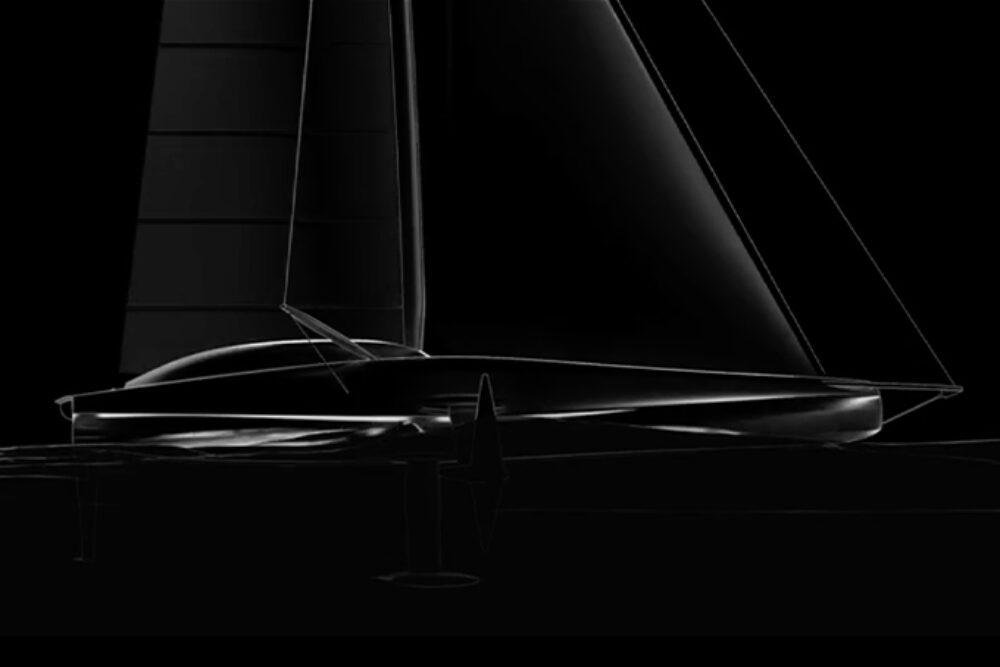
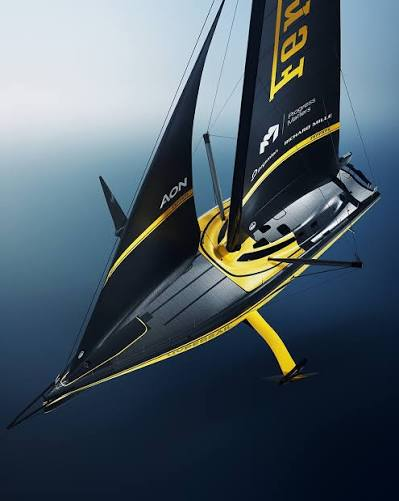
Ferrari Hypersail is being developed as a 100-foot, full-foiling monohull designed to operate using renewable energy.
The concept is extraordinary.
Instead of simply carrying enough conventional energy onboard to complete a voyage, Hypersail is being designed around the idea of generating, storing and managing its own energy while at sea.
Ferrari says the yacht must be capable of remaining self-sufficient for weeks at a time in some of the most hostile environments on Earth.
That changes everything.
Every watt matters.
Every electrical conversion matters.
Every piece of equipment consuming energy has to justify its existence.
And when the yacht is flying above the water on foils at high speed, the electrical system cannot simply be an afterthought. It becomes part of the performance architecture.
Why ABB Matters
ABB brings more than 25 years of experience in Direct Current technology to the project, backed by more than 700 patents in the field.
Its role will cover several critical areas, including DC system integration, energy management, intelligent power distribution, energy storage, monitoring and marine electrical systems.
That might sound industrial rather than exotic.
But look at what Ferrari is asking this system to do.
Hypersail’s electrical architecture will operate as a self-sufficient microgrid, using both 48-volt and 800-volt DC systems.
Those systems will be responsible for supplying energy to critical functions including navigation, foil controls, safety systems and propulsion.
The significance of the 800V architecture should not be overlooked.
High-voltage DC allows substantial electrical power to be moved with lower current for a given power requirement, which can help reduce losses and conductor requirements. In a project where weight, efficiency and available energy are constantly being balanced, that becomes particularly valuable.
The Microgrid at Sea
Think of Hypersail less like a conventional yacht and more like a floating, moving microgrid.
Energy is generated.
Energy is stored.
Energy is distributed.
Energy is consumed.
And all of those processes have to remain synchronized while the boat is moving through an environment that is anything but stable.
The yacht has to deal with salt spray, extreme cold, pressure, constant motion and rapidly changing operating conditions.
ABB’s role is therefore about making the electrical architecture resilient enough to operate under those circumstances while extracting as much useful energy as possible from the renewable sources available onboard.
This is one of the reasons the partnership is so interesting.
Ferrari isn’t simply looking for an electric boat.
It’s looking at how energy should be generated, controlled and distributed when there is no conventional energy infrastructure around you.
Where Ferrari’s Automotive DNA Enters the Water
Ferrari’s involvement makes the project even more intriguing.
The company has already identified Hypersail as a technology-transfer opportunity, with its own development work touching areas including energy management, the e-axle, software dynamic control and human-machine interface technologies.
That means the project sits somewhere between yacht design, motorsport engineering and automotive research.
The vehicle isn’t on four wheels.
But the engineering questions are remarkably familiar.
How do you manage energy?
How do you control a complex machine in real time?
How do you reduce losses?
How do you extract maximum performance from limited resources?
How do you build systems capable of operating at the edge of their performance envelope?
Those questions are just as relevant on the ocean as they are on a racetrack.
The Ocean Becomes the Test Track
There is another reason ABB’s involvement matters.
For ABB, Ferrari Hypersail becomes a demanding real-world test environment for technologies that could eventually have applications far beyond sailing.
The company says the lessons learned from the project could contribute to future power systems for shipping, renewable-energy infrastructure, industrial microgrids and data centers.
That is an important distinction.
Hypersail may be an extreme project, but the engineering problems it is trying to solve aren’t confined to the ocean.
Renewable energy is inherently variable.
Energy storage needs to be intelligently managed.
Power distribution needs to become increasingly efficient.
And industries are searching for ways to reduce conversion losses while handling increasingly large electrical loads.
A 100-foot flying yacht is certainly an unusual place to investigate those problems.
But that is precisely what makes it interesting.
Ferrari Is Building Something Different
The Hypersail project has never really looked like a conventional Ferrari project.
There is no V12 sitting behind the driver.
There is no exhaust note.
There isn’t even a traditional road beneath it.
Instead, Ferrari is applying its engineering philosophy to a machine that has to deal with wind, waves, hydrofoils, renewable energy and ocean endurance.
Now ABB is adding another layer.
Direct Current.
The partnership gives Hypersail an electrical backbone designed around efficiency and self-sufficiency rather than simply supporting conventional onboard systems.
And that could ultimately be one of the most important parts of the entire project.
Because the spectacular images of Hypersail flying above the water will inevitably grab the attention.
But underneath that spectacle is something far less visible:
A complex energy system constantly deciding where power needs to go, how much can be stored and how efficiently the yacht can continue operating.
The Ferrari That Doesn’t Need a Road
Ferrari has spent decades perfecting the relationship between power, weight, aerodynamics and control.
Hypersail takes those principles somewhere completely different.
The road becomes the ocean.
The tires become foils.
The engine becomes an integrated electrical system.
And now, with ABB involved, the energy architecture is becoming just as important as the shape of the yacht itself.
The result could be one of Ferrari’s most unconventional technology experiments yet.
Not because it is trying to build the fastest Ferrari on land.
But because it is asking a much broader question:
How far can a high-performance machine go when it has to create and manage the energy that keeps itself moving?
For Ferrari Hypersail, ABB may have just become one of the most important pieces of that answer.