
There is something almost impossible to explain about the first line drawn when designing a Ferrari.
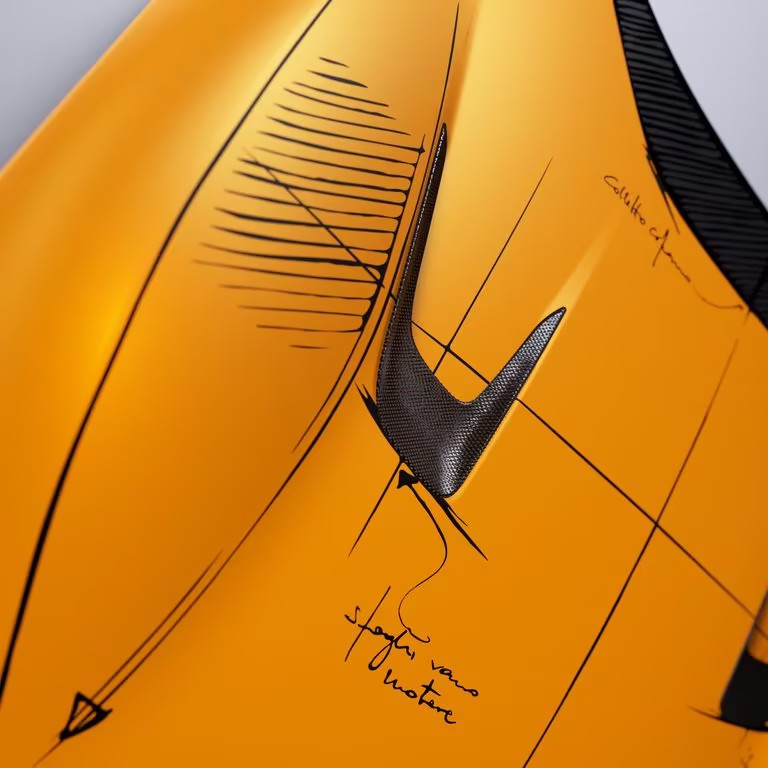
Before the engine runs, before the carbon fibre is shaped, before wind tunnels begin measuring airflow and engineers start turning an idea into thousands of individual components, there is simply a line.
Ferrari’s new Sketch Body project takes that moment and gives it a physical life.
Part of Ferrari’s evolving Collectibles project, Sketch Body brings together two normally separate ends of the automotive creative process: intuition and execution. The first is the designer’s instinctive gesture on paper. The second is the engineering, manufacturing and craftsmanship required to turn that idea into something real.

And Ferrari has found a rather unusual way to bring the two together.
From Sketchbook to Bodywork
The project is closely connected to Ferrari’s design philosophy and the work of Flavio Manzoni, Ferrari’s Chief Design Officer.
A sketch is normally the beginning of a car’s journey. It is eventually covered by clay, digital models, engineering drawings and production components. Once the vehicle is finished, the original sketch becomes a historical record of what came first.
Sketch Body reverses that relationship.
Instead of placing the drawing beside the finished automobile, Ferrari places the designer’s creative gesture onto the physical bodywork itself.
Inspired by the Ferrari 812 Competizione Tailor Made, selected bonnets and rear decks are freed from their original automotive function and transformed into three-dimensional canvases. The surface becomes the place where the sketch returns.
That changes the object completely.
It is no longer simply a piece of Ferrari bodywork. It becomes a physical record of the transition from an empty sheet of paper to an automobile.
The Surface Becomes the Story
This is where Sketch Body becomes particularly interesting.

Manzoni describes the surface as a narrative space—a canvas where the line follows the curves of the body, responds to the tension of the volumes and interacts with light and material.
That distinction matters.
A conventional automotive sketch is two-dimensional. A car is not.
The designer’s line might suggest a shoulder, a fender, an air intake or the way light should travel across a panel. Once that line is transferred onto the actual three-dimensional surface, the viewer can experience the original idea in the same physical language as the finished automobile.
The sketch is no longer merely an illustration of the Ferrari.
It becomes part of the Ferrari’s form.
A New Direction for Ferrari Collectibles
Sketch Body also represents an evolution of Ferrari’s Collectibles philosophy.
Ferrari has previously explored collectibles through components, racing-related pieces and objects connected to its drivers. The company has described the broader project as a way of expanding collectability through limited-edition and one-off objects that reflect the craftsmanship and innovation behind its cars.
Sketch Body moves that concept further toward art and design.
Rather than simply preserving a physical fragment of a Ferrari, it preserves the creative thought behind the fragment.
That is an important difference.
A removed component can tell you what a Ferrari was made from. A Sketch Body piece attempts to tell you how Ferrari designers thought about creating it.
The 812 Competizione Connection
The choice of the 812 Competizione Tailor Made is also significant.
The 812 Competizione represents one of Ferrari’s most extreme interpretations of its front-engined V12 philosophy, while the Tailor Made programme allows individual cars to become highly personalised expressions of Ferrari’s design and craftsmanship.
Sketch Body takes that philosophy beyond the finished automobile.
The bonnet or rear deck becomes an object in its own right—large enough to retain the proportions and tension of real Ferrari bodywork, but removed from the practical requirements of being attached to a road car.
The result occupies an unusual space between automotive component, sculpture and designer’s artwork.
When Engineering Becomes Art
Perhaps the most compelling part of Sketch Body is the contradiction at its centre.
Ferrari begins with something incredibly spontaneous: a pencil stroke.
That stroke then has to survive one of the most demanding creative processes in the automotive industry.
Design becomes modelling.
Modelling becomes engineering.
Engineering becomes manufacturing.
Manufacturing becomes a finished Ferrari.
Sketch Body takes that journey and effectively folds it back onto itself.
The finished object carries both ends of the process: the spontaneity of the first drawing and the precision of the manufactured surface.
That makes it less about memorabilia and more about provenance of an idea.
The Ferrari You Normally Never See
Most Ferrari collectors ultimately acquire the finished product.
They see the body, the interior, the engine and the finished details. What they rarely get to experience is the moment before any of those things existed.
Sketch Body attempts to capture precisely that missing moment.
It is Ferrari showing the beginning and the end of the design process at the same time.
The result is a collectible that does not simply commemorate a Ferrari. It commemorates the act of creating one.
And perhaps that is where this new chapter of Ferrari’s Collectibles project becomes most fascinating.
A Ferrari can be admired for its speed, its sound, its engineering or its history.
But before any of those things exist, there is a line.
With Sketch Body, Ferrari has found a way to preserve that line—and give it a body of its own.