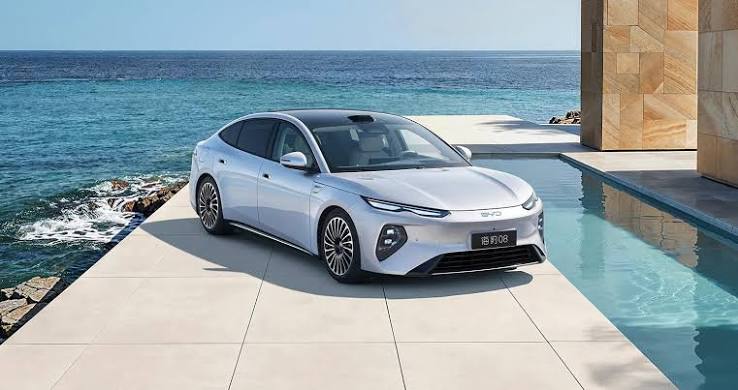
The domestic automotive market has just witnessed an unprecedented shift in velocity. When BYD pulled the silk off its new flagship sedan the Seal 08 it triggered a massive market response. Within just over 30 hours of opening the books, the company secured roughly 65,000 locked-in orders. For context, 25,000 of those flooded the servers immediately following the final price announcement.
With assembly lines initially capped at 8,000 units per month to handle the early manufacturing ramp-up of its new battery hardware, BYD essentially sold out its first eight months of production overnight.
What Makes It Better Than the Competition?
The sheer volume of orders comes down to a staggering distortion of the price-to-performance ratio. Priced between $29,000 and $35,300 in China, the Seal 08 delivers a level of mechanical and digital engineering typically walled off behind a $100,000 premium by European legacy marques. It aggressively undercuts and outperforms its primary benchmark, the Tesla Model 3, across several critical parameters:
- The Power and Dynamics: The top-tier all-wheel-drive variant puts down an astonishing 680 to 694 horsepower from its dual-motor configuration. It flashes from 0 to 100 km/h in a brutal 3.3 seconds. To handle that output, BYD didn’t just stiffen the springs; they fitted the chassis with dual-chamber air suspension and a rear-wheel steering system capable of up to $\pm 7^\circ$ of articulation, ensuring high-speed stability and razor-sharp agility that leaves standard premium sedans feeling unwieldy.
- Next-Gen Battery Architecture: The Seal 08 serves as the launch platform for BYD’s highly anticipated Blade Battery 2.0. Utilizing a massive flash-charge capability (up to a 10C rating), the vehicle can pull down juice at an unprecedented rate, while achieving a maximum range of 785 km under CLTC metrics (roughly 645 km on the stricter WLTP cycle).
- Uncompromising Cabin Substance: True to a philosophy that prioritizes actual physical substance over barren, cost-cut minimalism, the interior features dual zero-gravity seats, heating, ventilation, and massage functions for all occupants, an electric frunk, a built-in 6.8-liter refrigerator, and a comprehensive LiDAR-driven advanced driver assistance system (ADAS).
Where is BYD Moving Next Outside of China?
The domestic success of the Seal 08 arrives at a pivotal moment for BYD’s aggressive, multi-billion-dollar global expansion. As Western markets pivot toward protective tariffs, BYD is playing a highly sophisticated logistical chess game, moving away from simple shipping exports and transitioning into localized industrial manufacturing.
1. Anchoring in the European Perimeter
To bypass steep EU import duties, the company is focused heavily on finishing its new manufacturing hubs in Szeged, Hungary, and its production site in Turkey. These facilities will serve as the localized launchpads to introduce premium, high-margin platforms like the Seal 08 directly to European retail networks without tariff penalties.

2. Southeast Asian Dominance
BYD has rapidly locked down the right-hand-drive market. With its new manufacturing plant in Thailand now active and rolling out vehicles at scale, BYD is expanding its footprint across Malaysia, Indonesia, and Australia—consistently climbing the sales charts and displacing traditional Japanese automakers who have been slow to deploy compelling electric infrastructure.
3. The Latin American Bridgehead
Brazil has become the crown jewel of BYD’s overseas strategy. By transforming the historic former Ford facility in Camaçari, Bahia, into a massive electric vehicle production hub, BYD is positioning itself to supply the entire South American continent locally.
The strategy is clear: BYD isn’t just trying to export cars from Shenzhen anymore. By embedding factories directly into local economies globally, they are building an ironclad operational footprint that allows vehicles like the Seal 08 to disrupt global markets exactly the same way it just disrupted the domestic market overnight.