The intersection of elite motorsport heritage and mechanical safety is being forced into the spotlight. In a high-profile legal battle in London’s High Court, former Deutsche Bank executive Robert Ebert is pursuing pre-action disclosure against Ferrari. The litigation stems directly from a tragic, fatal 2015 accident in Hong Kong—an event that Ebert claims was caused by sudden, catastrophic brake failure, but which Ferrari historically dismissed as simple driver error.
The legal filing adds a dark chapter to Ferrari’s recent history, explicitly connecting a decade-old fatal crash to the massive, multi-wave braking system recalls that the Italian automaker eventually issued years later.
The 2015 Hong Kong Accident and the Expert Witness
In June 2015, Robert Ebert—then the head of equities for Asia-Pacific at Deutsche Bank—was driving his £400,000 Ferrari 458 Spider through a tunnel leading into a car park near the bank’s offices in the International Commerce Centre tower. Ebert admitted he was traveling roughly 90 km/h in a 30 km/h zone, but maintained that when he hard-braked 84 meters ahead of a sharp corner, the pedal went dead.
CCTV footage captured the 458’s brake lights flashing, but the supercar failed to decelerate. The car veered, colliding with a water barrier and striking 53-year-old security guard Ku Lap-chi, who died instantly from severe injuries.

During Ebert’s subsequent criminal trial in Hong Kong, a Ferrari technical engineer took the stand for the prosecution. The engineer testified that a mechanical failure of that nature was “not possible” given the sophisticated design and quality of the model’s braking system. Based heavily on that manufacturer assurance, Ebert was convicted of causing death by dangerous driving, served 14 months of a 21-month prison sentence, was deported from the territory, and saw his lucrative banking career collapse.
The Connection to the November 2021 Recall
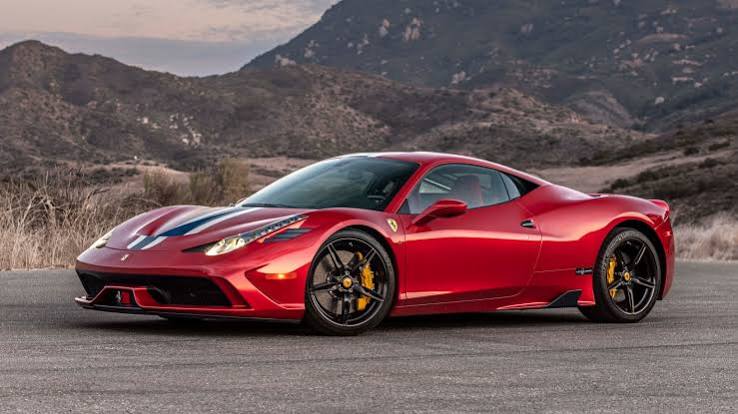
The foundation of Ferrari’s defense began to crack six years later. In November 2021, Ferrari North America issued its first major wave of voluntary recalls to address sudden brake fluid leakage. That initial campaign explicitly targeted **9,985 vehicles** manufactured between 2010 and 2019, explicitly encompassing the **Ferrari 458 Italia, 458 Spider, 458 Speciale, and 488 GTB/Spider** lineups.

The National Highway Traffic Safety Administration (NHTSA) filings revealed a structural flaw: the brake fluid reservoir caps failed to vent pressure properly. This lack of ventilation created a vacuum within the master cylinder reservoir as fluid cycled, causing fluid to migrate past seals and leak into the brake booster assembly ultimately starving the system of hydraulic pressure and causing a partial or total loss of braking capacity.
By August 2022, Ferrari was forced to expand the recall net to a staggering **23,555 vehicles** across almost their entire modern lineup.
Pre-Action Disclosure and the Battle in the High Court
Represented by UK lawyers at Acuity Law, Robert Ebert’s legal team is using these subsequent global recalls to challenge the narrative presented at his criminal trial. The current litigation seeks to force Ferrari to hand over internal documents, engineering logs, and telemetry data to ascertain exactly what the manufacturer knew about these fluid migration and seal defects back in 2015 when they testified that failure was impossible.
Parallel class-action lawsuits in the United States have already alleged that Ferrari and its brake component supplier, Robert Bosch, were aware of these dangerous, latent “leakage-type” failure modes as early as 2015, yet failed to fully disclose the scope of the threat to the public, offering what plaintiffs call an inadequate “interim” hardware fix.
Ferrari continues to robustly defend its position, challenging the High Court’s jurisdiction on the grounds that pre-action disclosure requires documents to be within the local jurisdiction. The manufacturer maintains that there is no technical evidence linking Ebert’s 2015 accident to the mechanism of the later reservoir cap recalls, firmly attributing the fatality to human error and excessive speed. For Ebert, however, the internal corporate timeline of when Ferrari first discovered its supercars could lose stopping power is the key to unlocking whether his prison sentence was the result of reckless driving, or a catastrophic mechanical flaw the manufacturer wasn’t ready to admit.