

Bugatti Restores a Mirror-Finish Veyron With a Very Red Interior: The Story of Chassis 8.100
A one-off commission, polished aluminium bodywork and a Carmine Red leather interior make this Veyron Grand Sport Vitesse one of the most distinctive cars to emerge from Bugatti’s modern era. Now, more than a decade after its creation, chassis 8.100 has returned to Molsheim for a factory restoration and certification.

Some cars are defined by their performance. Others are remembered for their design, their rarity or the circumstances surrounding their creation. Then there are automobiles like chassis 8.100, a Bugatti Veyron Grand Sport Vitesse that makes an extraordinary statement before its engine has even been started.
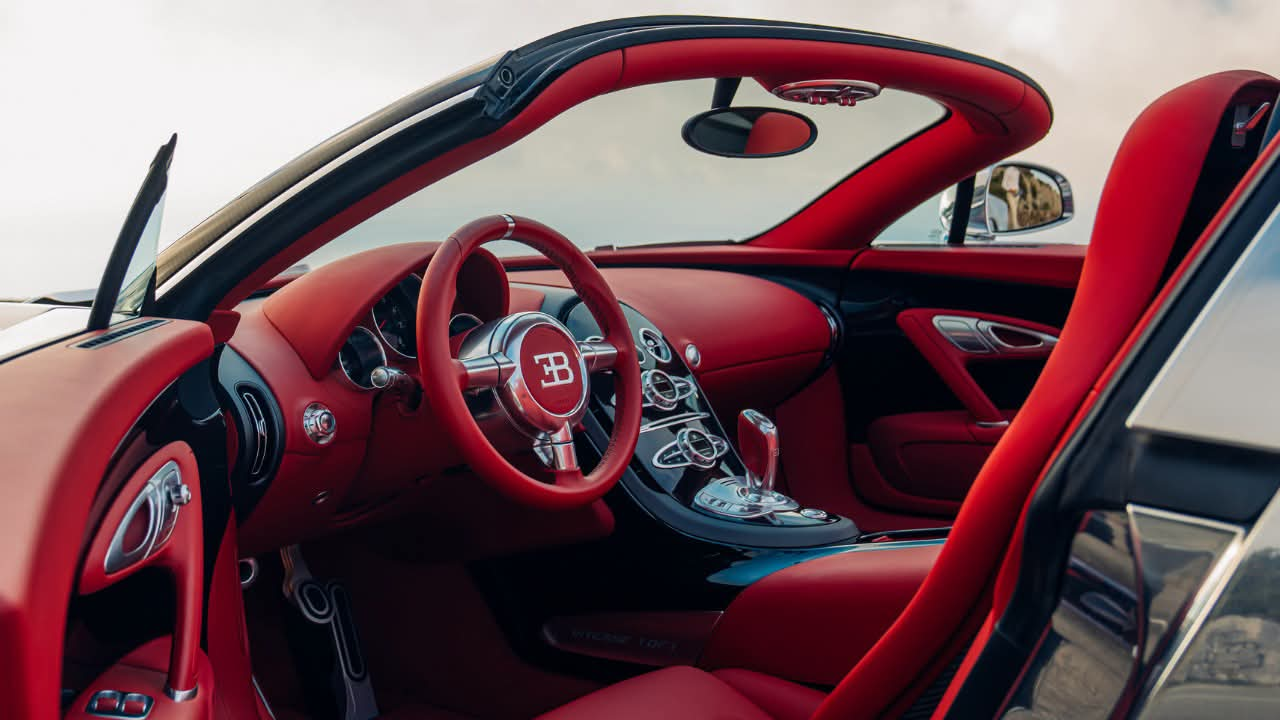
Its bodywork is not finished in conventional automotive paint. Instead, the exposed aluminium has been polished to a mirror-like sheen, transforming the roadster into a moving reflection of its surroundings. Open the door, and the exterior’s cool metallic character gives way to an interior dressed in Carmine Red leather, interrupted by exposed carbon fibre and polished aluminium detailing.
It is a striking combination, but this Bugatti was never intended to be ordinary.
More than a decade after its original construction, the one-off Veyron has returned to Bugatti’s historic headquarters in Molsheim, France, where the marque’s La Maison Pur Sang programme has restored the car to its original specification and certified its authenticity. The result is not a new interpretation of an old masterpiece. It is a return to the vision that made this particular Veyron unique in the first place.
Chassis 8.100: A Veyron Unlike Any Other
To understand what makes chassis 8.100 special, it helps to look at the car that provided its foundation.
The Bugatti Veyron Grand Sport Vitesse represented the ultimate open-top evolution of the original Veyron family. Introduced in 2012, it combined the engineering ambition of the Veyron Super Sport with the experience of driving a high-performance roadster.
But for this particular commission, the customer wanted something beyond an already extraordinary production car.
Built in 2014, chassis 8.100 received a bespoke exterior that placed polished aluminium at the centre of its identity. Rather than hiding the metal beneath layers of paint, Bugatti made the material itself the finish.
The undertaking demanded substantial preparation. According to Bugatti, aluminium blocks weighing as much as 20 tonnes were delivered to Molsheim for the project. These were raw materials for the complex manufacturing process, not the weight of aluminium ultimately used in the finished bodywork. The distinction matters because the achievement lies in transforming the material into the sculpted surfaces of a functioning automobile.
The design team studied proportions, surfaces and the behaviour of light before the project entered the Bugatti Atelier. Every stage of the original construction was documented, creating a record that would later help establish the car’s identity and preserve its history.
That documentation has particular importance for a one-off vehicle. With no second example to serve as a reference, the original build record becomes essential when determining which features belong to the car’s intended specification and which were added later.
Chassis 8.100 was not simply a Veyron with an unusual finish. It was a bespoke commission whose individuality extended into the way its bodywork was conceived and produced.
A Mirror Made of Metal
The most immediately recognisable feature of chassis 8.100 is its exterior.
Polished aluminium reflects the world around it, allowing the car’s appearance to change with its surroundings. Under direct sunlight, the bodywork catches the light across its curves and creases. In darker conditions, the reflections become more subdued, revealing the underlying proportions of the roadster.
Unlike a painted surface, the exposed metal makes the material itself part of the visual experience.
The effect is almost architectural. The Veyron’s familiar shapes remain present, but the changing reflections alter how those shapes are perceived. Its bonnet, flanks and rear bodywork become moving surfaces that respond to the environment.
Achieving that appearance is not merely a matter of polishing metal until it shines. The finish must complement the underlying bodywork, and imperfections become particularly noticeable when a surface reflects its surroundings so clearly.
This is one reason the restoration is significant. Bugatti’s announcement describes a comprehensive refurbishment and certification process intended to return the car to its original vision. The work also involved removing personalisation elements added during the vehicle’s subsequent life.
For a conventional car, reversing later modifications might mean returning a vehicle to its original colour or replacing altered trim. For chassis 8.100, preserving the original specification means protecting one of the most unusual material treatments ever commissioned for a Veyron.
The mirror finish is not an accessory. It is the car’s defining feature.
Carmine Red: The Other Half of the Design
If the exterior is an exercise in metallic restraint, the cabin takes an entirely different approach.
The interior is upholstered in Carmine Red leather, creating a bold contrast against the exposed aluminium and carbon fibre. Rather than allowing the reflective exterior to dictate a subdued interior, Bugatti chose a colour that demands attention in its own right.
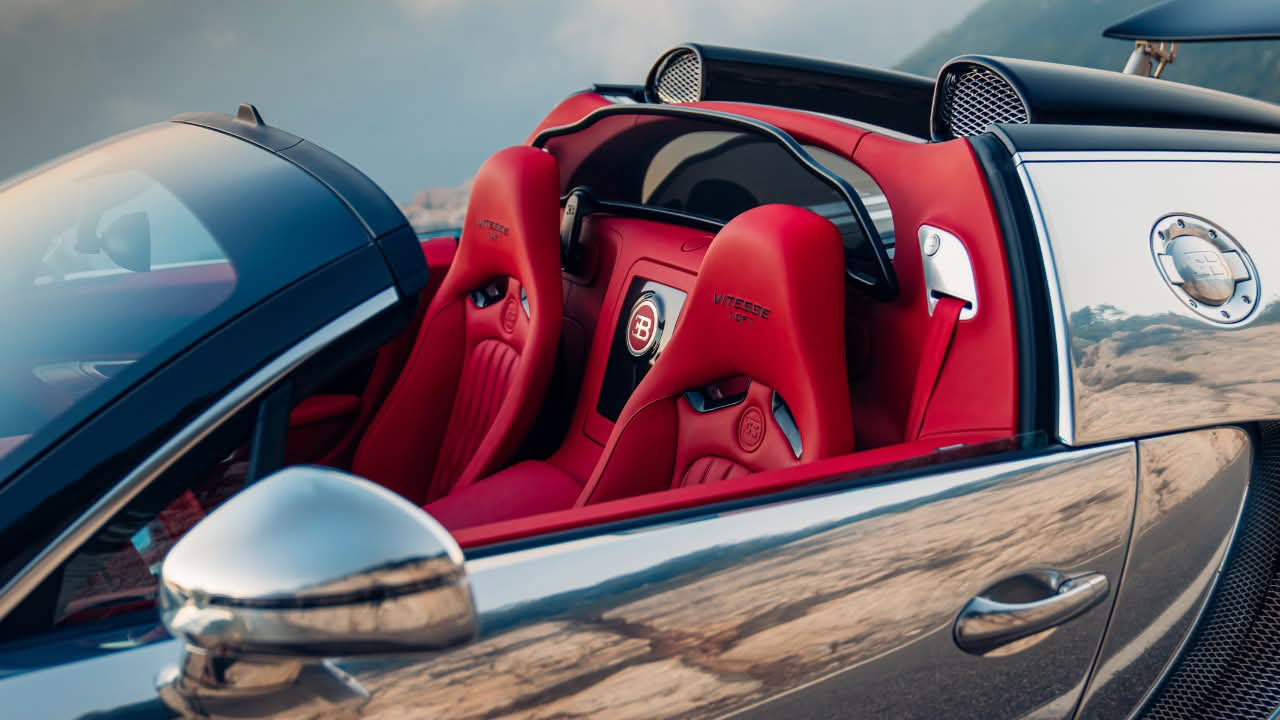
The red leather extends across the cabin, while exposed carbon fibre and polished aluminium provide contrasting textures. Together, these materials establish a visual connection between luxury craftsmanship and the technical character of the Veyron.
The aluminium suggests precision and industrial design. The carbon fibre recalls the use of advanced materials in performance engineering. The leather introduces warmth and richness, making the cabin feel less like a technical instrument and more like a bespoke luxury environment.
It is a particularly effective combination because the materials are allowed to express their differences rather than being blended into a single visual theme.
The result is unmistakably individual: a mirror-finished exterior paired with an interior that refuses to disappear into the background.
Bugatti’s original design process considered the relationship between proportion, surface and light, and that thinking extends beyond the bodywork. The contrast between the bright exterior and the richly coloured cabin gives chassis 8.100 a coherent identity on both sides of the door.
The W16 Beneath the Surface
Of course, the car’s significance would be incomplete without the engineering that made the Veyron a defining machine of the modern hypercar era.
Chassis 8.100 retains the Veyron Grand Sport Vitesse’s 8.0-litre, quad-turbocharged W16 engine.
Bugatti specifies output at 1,200 PS and 1,500 Nm of torque, equivalent to approximately 1,184 bhp and 1,106 lb-ft. Those figures place the car firmly among the most powerful road-going automobiles of its generation.
The Grand Sport Vitesse was developed to deliver the performance of Bugatti’s most powerful Veyron derivatives in an open-top configuration. Its engineering had to reconcile immense power with the structural and aerodynamic demands of a roadster.
The model also established an important place in performance history. In 2013, a Veyron Grand Sport Vitesse driven by Anthony Liu reached 408.84 km/h (254.04 mph) at Volkswagen Group’s Ehra-Lessien test facility, setting a production roadster speed record at the time. That achievement demonstrated that removing the fixed roof did not mean abandoning the performance ambitions that defined the Veyron.
Chassis 8.100 takes that engineering foundation and places it inside a singular design statement.
There is no need for an elaborate aerodynamic package or a conspicuous collection of external additions to make it memorable. Its identity comes from the combination of the established W16-powered platform and the extraordinary material treatment surrounding it.
La Maison Pur Sang: Bringing the Car Home
The restoration took place through Bugatti’s La Maison Pur Sang programme, which supports the marque’s heritage through historical research, authenticity certification, refurbishment and restoration.
The programme is particularly relevant to vehicles whose value depends on more than their mechanical condition. For a rare, individually commissioned Bugatti, originality and documented provenance are central to its identity.
A car can remain mechanically functional while gradually moving away from the specification that made it distinctive. Personalisation, replacement components and changes in finish may reflect an owner’s preferences, but they can also complicate the process of establishing how the vehicle originally left the factory.
For chassis 8.100, Bugatti’s objective was to recover the original design vision. The company undertook certification alongside refurbishment and reconfiguration, removing later personalisation elements and using its knowledge of the original commission to guide the work.
This is an important distinction: the project was not presented merely as a cosmetic refresh. It was a manufacturer-supported process intended to preserve the vehicle’s authenticity and establish its specification for the future.
Bugatti has also confirmed that chassis 8.100 received La Maison Pur Sang certification following the work.
For collectors, such documentation can help establish a clearer record of a car’s history. It does not make every restored vehicle identical to a brand-new example, nor does certification guarantee a particular market value. Instead, it provides a manufacturer-backed account of the vehicle’s identity and the work carried out to preserve it.
In the case of a one-off Veyron, that record is especially valuable because the car has no production counterpart against which its original details can be checked.
A New Chapter on the French Riviera
Following the restoration and certification, chassis 8.100 joined a new owner’s collection on the French Riviera, according to Bugatti. The company has not officially identified the owner or disclosed the cost of the restoration.
Reports and social-media footage have linked the car to Formula 1 world champion Fernando Alonso after he was seen driving a matching polished-aluminium Veyron in Monaco. However, Bugatti’s announcement does not name him as the owner, so that connection should be treated as unconfirmed rather than established fact.
The car’s return to the Riviera places it in a region familiar with extraordinary automobiles, private collections and the luxury lifestyle associated with the Mediterranean coast.
Yet its story is not simply about where it now resides. It is about the continued life of a bespoke machine that was created to a customer’s particular vision, preserved through factory records and subsequently returned to the place where it was built.
The Value of Keeping a One-Off Original
The restoration of chassis 8.100 illustrates a broader principle in the collector-car world: rarity is only part of a vehicle’s significance.
A limited-production car may be valuable because relatively few examples exist. A one-off commission carries a different kind of importance. Its individuality is tied to the specific decisions that shaped its creation, from materials and finishes to the details that distinguish it from every other example of the same model.
Change those details, and the car may still be extraordinary, but its relationship with its original specification becomes less clear.
Bugatti’s decision to restore chassis 8.100 therefore reflects an approach to preservation that extends beyond making an old car look new. It is about retaining the connection between the original commission, the craftsmanship required to build it and the documented history that follows it through successive ownership.
The polished aluminium may be what captures attention first. The Carmine Red leather may be what makes the cabin unforgettable. And the W16 remains the mechanical heart of the car.
But the most important part of this restoration is the effort to preserve the relationship between all three.
A Reflection of Bugatti’s Modern Heritage
The Veyron changed the conversation around what a road-going hypercar could be. It brought extraordinary power, high-speed capability and exceptional levels of luxury into a single production automobile.
Chassis 8.100 took that formula in a more individual direction, using exposed polished aluminium to turn a recognisable Bugatti into a singular piece of automotive design.
Its return to Molsheim demonstrates that the marque’s relationship with a car need not end when the original purchase is completed. Through La Maison Pur Sang, Bugatti can help preserve the identity of exceptional vehicles long after their first delivery.
For DLifestyle Magazine, this is what makes the story worth telling. The car is visually spectacular, but its significance goes deeper than a reflective body and a dramatic interior.
It is a reminder that some automobiles are created not simply to be driven, but to be preserved as expressions of a particular moment, a particular commission and a particular manufacturer’s craft.
Chassis 8.100 has returned to its original specification, received its factory certification and begun another chapter on the French Riviera.
The mirror is back. And beneath its reflection remains one of the most distinctive expressions of the Veyron era.