The Power Unit Dance: Re-Engineering Ferrari’s 2026 Trajectory
The impending 2026 Formula 1 regulatory shift has triggered a quiet war of engineering philosophies in Maranello. While baseline power unit development progresses, a glaring reality is emerging: outright thermal efficiency is no longer the sole guarantor of dominance. True performance in the next era belongs to the chassis that executes the perfect “power dance”—not merely by balancing energy between the Internal Combustion Engine (ICE) and the Energy Recovery System (ISS/MGU-K), but by dynamic, multi-axle torque distribution.

When evaluating Red Bull’s 2026 powertrain progression, it becomes evident they are translating total system output to the tarmac with zero apparent deficit. Ferrari, conversely, faces a subtle but critical efficiency bleed. The solution does not lie in questioning the absolute mechanical prowess of Maranello’s internal combustion engines; their combustion architecture remains a gold standard. Instead, the focus must pivot entirely to the powertrain translation layer—redefining the “dance” away from simple battery-to-engine management and shifting it directly to how power is divided between the front and rear wheels.
Redefining the Dance: Dynamic Front-to-Rear Shifting
Under the 2026 framework, the traditional rear-wheel-drive dependency of F1 enters a highly compromised aerodynamic and electrical state. The “Power Unit Dance” is most lethal when weaponized across both axles. By manipulating how energy is deployed mechanically to the rear and electrically to the front, teams can rewrite the laws of cornering dynamics.
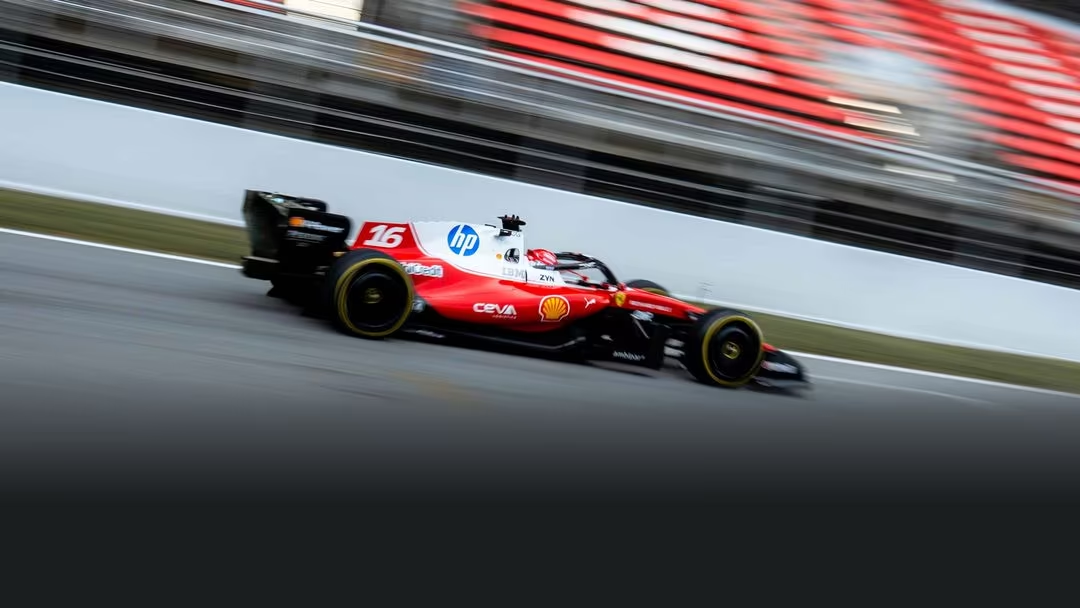
Consider Charles Leclerc’s #16 car. Under current rear-dominant deployment strategies, lower-speed cornering phases subject the rear tires to a brutal dual-demand: handling extreme lateral cornering forces while simultaneously managing the massive, instant torque spikes of the electrical system. The result is a car that requires delicate micro-management on corner exits, forcing a driver to wait for the platform to stabilize before fully unleashing the power.
If the power dance is shifted forward effectively transforming the lower-speed cornering phase into a front-wheel-driven pull configuration the entire entry-to-exit arc changes:
- Aggressive Cornering: By pulling the chassis through the apex via front-axle electrical deployment, the front end bites with immense precision, drastically reducing low-speed understeer.
- Cleaner Exits: Shifting the power burden away from the rear wheels during the initial phase allows the rear tire contact patch to focus entirely on lateral stability. As the car straightens, mechanical rear drive seamlessly blends back in, eliminating the snap-oversteer characteristics that frequently cost Leclerc vital hundredths on exit.
A Theoretical Architecture: The 50/50 Dual-Drive Powertrain
To fully exploit this philosophy, we must move past legacy packaging and hypothesize an entirely new powertrain topology optimized for the 2026 regulations.
[ FRONT AXLE ] ◄─── (Electrical Powertrain / MGU-K Front)
         ▲
         │  [ The Power Unit Dance / Dynamic Torque Splitting ]
         ▼
[ REAR AXLE  ] ◄─── (Mechanical Powertrain / ICE + Rear Drive)
This theoretical architecture establishes a strict 50/50 energy split based on dedicated, independent drivelines:
- The Mechanical Spine (Rear Axle): A pure, highly optimized mechanical powertrain running directly to the rear wheels, driven by the internal combustion engine.
- The Electrical Matrix (Front Axle): A high-voltage, rapid-discharge electrical powertrain operating independently on the front wheels, utilizing advanced torque vectoring.
Weaponizing the “Z Mode” (Cornering Mode)
The true manifestation of this 50/50 split occurs when the car enters its specialized Cornering (Z) Mode. This software and mechanical map dictates the actual dance between the axles based on steering angle, brake pressure, and throttle position.

When a driver activates or triggers Z-Mode on entry into a complex corner sequence, the system overrides traditional uniform deployment:
- Phase 1: Entry & Apex (Front-Load): As the car decelerates and rotates, the rear mechanical drive steps back into a stabilizing, low-torque state. The front electrical powertrain commands the front wheels, utilizing regenerative braking to stabilize the front axle while preparing an immediate, electric “pull” out of the apex.
- Phase 2: Apex to Exit (The Hand-off): At the critical geometric apex, the front electric drive deploys maximum torque instantly. This claws the car forward, straightening the driving line far earlier than a rear-driven car could manage.
- Phase 3: Straightline Transition (The 50/50 Balance): As steering angle decreases, Z-Mode blends the mechanical rear drive back to peak output, matching the electrical front deployment to achieve a perfectly balanced, balanced-torque sprint down the straight.
By decoupling the mechanical and electrical power paths and assigning them their own dedicated axles, the SF-26 would cease battling its own energy recovery deficits. Red Bull’s translation advantage is answered not by building a more powerful engine, but by building a smarter, multi-axle dance that optimizes every square millimeter of the tire contact patch. For a driver of Leclerc’s high-commitment caliber, a front-pulling Z-Mode framework could provide the exact tool needed to turn raw corner entries into untouchable corner exits.