In the mid-1970s, Formula 1 wasn’t just a sport; it was a high-speed flirtation with mortality. Nowhere was this more evident than at the Nürburgring Nordschleife the “Green Hell.”
During the era of James Hunt and Niki Lauda, the track was a 14-mile, 170-turn monster that essentially functioned as a high-speed executioner for those who made the slightest error.

The 1/16 Chance: Racing’s Deadliest Odds
The statistic often cited from that era was that a driver had a 1 in 16 chance of not surviving a full season. To put that in perspective for your interest in technical regulations: while modern 2026 F1 focuses on 50/50 power splits and sustainable fuels, the “regulations” of 1976 were primarily about whether you could keep a flimsy aluminum tub from becoming a coffin.
James Hunt, despite his “playboy” image, was hyper-aware of these odds. He famously vomited before almost every race due to pure adrenaline and fear. He once remarked:
“On a modern circuit, if something breaks, you have a 70/30 chance of being okay. At the Nürburgring, if something breaks, it is 100% death.”
The 63 Who Didn’t Return
While the exact “official” number of fatalities at the Nürburgring is often debated due to the inclusion of private testing and amateur races, historians frequently point to over 60 drivers and riders who lost their lives on the Nordschleife between its opening in 1927 and the late 1970s.

By the time Hunt and Lauda faced off in 1976, the tally of professional competitors who had perished there included legends like:
- Onofre Marimón (1954): The first F1 driver to die during a Grand Prix weekend.
- Peter Collins (1958): A Ferrari superstar and close friend of Mike Hawthorn.
- Carel Godin de Beaufort (1964): An aristocratic privateer who died during practice.
- John Taylor (1966): Burned in a horrific first-lap collision.
1976: The Year the Music Stopped
The danger reached a breaking point in 1976. Niki Lauda, the reigning champion, actually tried to organize a boycott of the race, arguing that the circuit was too long for fire engines to reach a crash in time. He was outvoted by his peers including James Hunt who wanted to race.

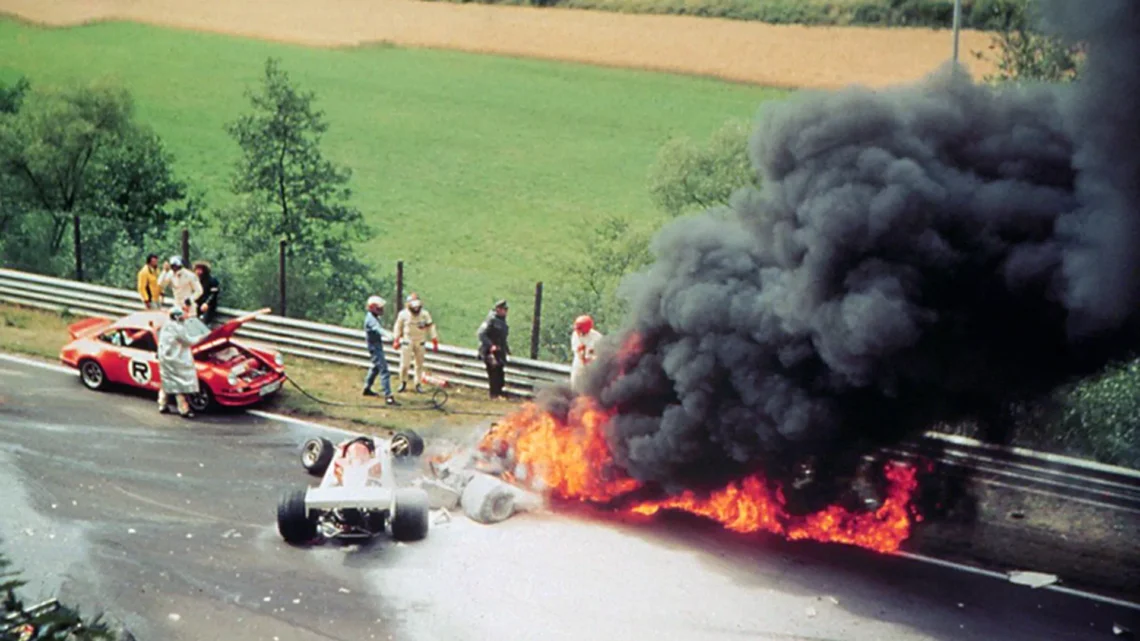
On the second lap, Lauda’s Ferrari suffered a suspected rear suspension failure at Bergwerk. The car slammed into the embankment, burst into flames, and was struck by other cars.
- The Rescue: Because the track was so massive, marshals were nowhere near. It was only the bravery of four fellow drivers (Arturo Merzario, Guy Edwards, Brett Lunger, and Harald Ertl) who stopped and pulled Lauda from the inferno that saved his life.
- The Aftermath: James Hunt went on to win that restarted race, but the horror of Lauda’s accident effectively ended the Nordschleife’s career as an F1 venue. It was deemed “untraceable” by modern standards.
The “Green Hell” vs. Modern F1
| Feature | 1976 Nürburgring | Modern F1 Circuit (2026 Stds) |
| Length | 14.2 Miles (22.8 km) | 3–4 Miles (5–7 km) |
| Turns | 170+ | 15–20 |
| Medical Response | Up to 5–10 minutes | Under 60 seconds |
| Driver Outlook | “1/16 chance of death” | “Push to the limit with safety” |
James Hunt won the 1976 Championship by a single point after Lauda famously withdrew from the final race in Japan, citing the conditions as too dangerous. Hunt’s career was the bridge between this era of “blood and thunder” and the more professional, safety-conscious sport we see today.