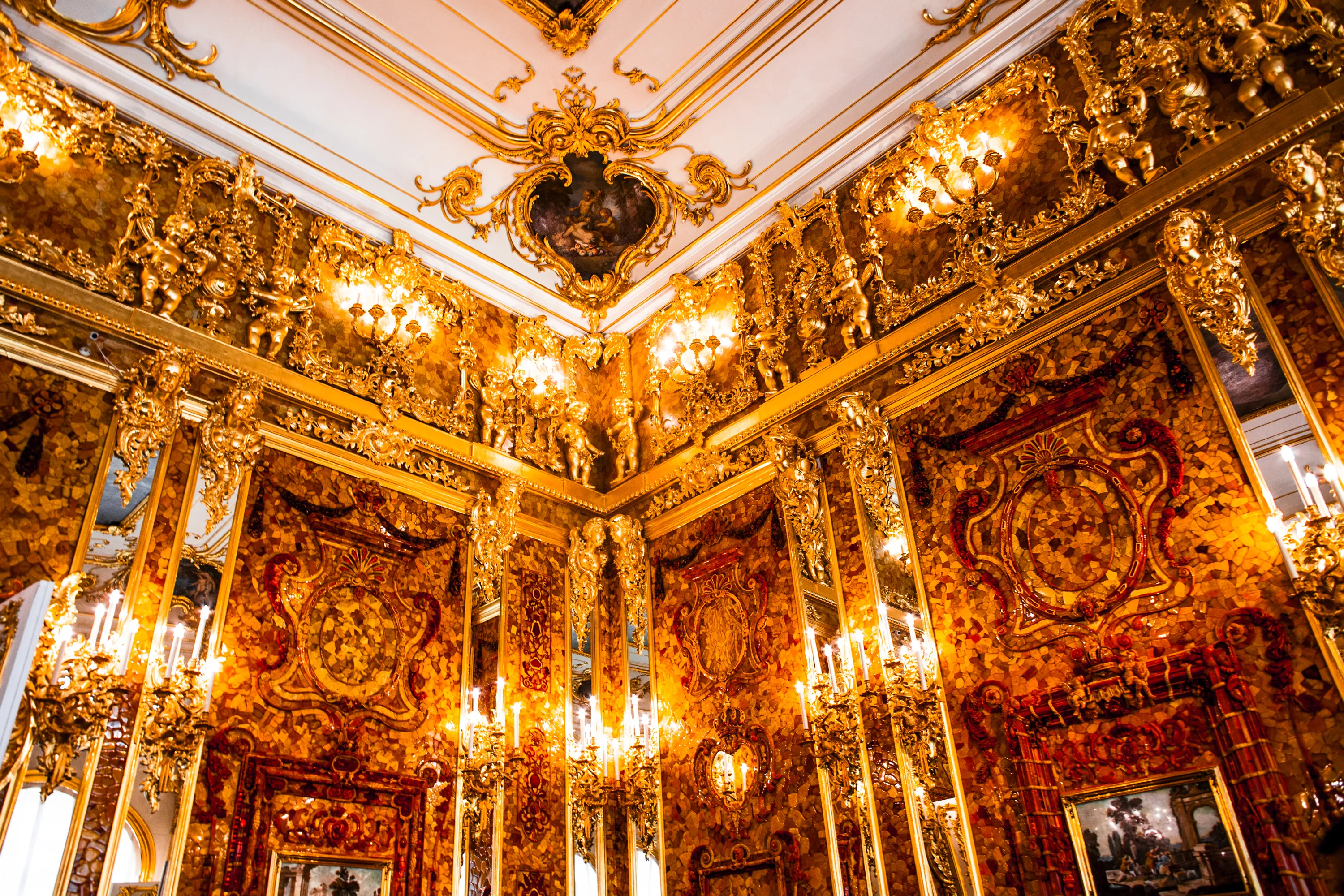
Often described as the “Eighth Wonder of the World,” the Amber Room remains one of history’s most tantalizing mysteries. It was a dazzling feat of Baroque craftsmanship a chamber of glowing gold and honeyed resin that vanished during the chaos of World War II, leaving behind only a trail of legends and a meticulously crafted modern replica.

The Visionaries: Architecture of Light
While the Amber Room is most famously associated with the Russian Tsars, its origins lie in Prussia. It was originally conceptualized in 1701 for Frederick I, the first King of Prussia.

The primary architect was Andreas Schlüter, a master of the German Baroque style. However, the true soul of the room was breathed into it by the Danish amber cutter Gottfried Wolfram, alongside master craftsmen Gottfried Turau and Ernst Schacht. Their task was unprecedented: to treat amber as a brittle, fossilized resin, not as a gemstone for jewelry, but as a structural material for expansive wall paneling.
What Made the Room One of a Kind?
The room was a sensory experience that defied the architectural standards of the 18th century. When Peter the Great visited Prussia, he was so enamored with the chamber that Frederick’s successor, Frederick William I, gifted it to him to solidify a Prusso-Russian alliance.
- Material Alchemy: The room consisted of over six tons of amber. The panels were backed with gold leaf, which caused the translucent resin to glow from within when illuminated by candlelight.
- Intricate Mosaic: It wasn’t merely flat walls; the room featured ornate carvings, busts, and Florentine mosaics made of semi-precious stones illustrating the five senses.
- Thermal Atmosphere: Visitors often remarked on the “warmth” of the room. Unlike the cold marble of most European palaces, the amber held a natural, organic radiance that felt alive.
The Great Disappearance
During the German invasion of the Soviet Union in 1941, Nazi forces dismantled the room in 36 hours, packing it into 27 crates. It was taken to Königsberg Castle, but as Allied bombings intensified in 1945, the trail went cold. Whether it was destroyed in the fire of the castle or hidden in a deep salt mine remains one of the greatest cold cases in art history.
The Replica: A Monument to Persistence

In 1979, the Soviet government began the Herculean task of recreating the room at the Catherine Palace in Tsarskoye Selo. This project took 24 years and cost millions of dollars, relying on black-and-white photographs and a single remaining original fragment.
Today’s replica represents more than just a tourist attraction; it is a symbol of cultural resilience.
- Technological Triumph: Modern artisans had to rediscover lost 18th-century techniques to dye and fit the amber, bridging a two-century gap in craftsmanship.
- Collective Memory: The replica serves as a physical bridge to the pre-war era, acknowledging the scars of history while refusing to let the beauty of the past be completely erased.
- The Ghost of the Original: While the replica is stunning, its presence serves as a haunting reminder of the “Amber, Ember” lost to the archives of war a testament to the fact that while objects can be stolen, the human drive to create (and recreate) is indestructible.