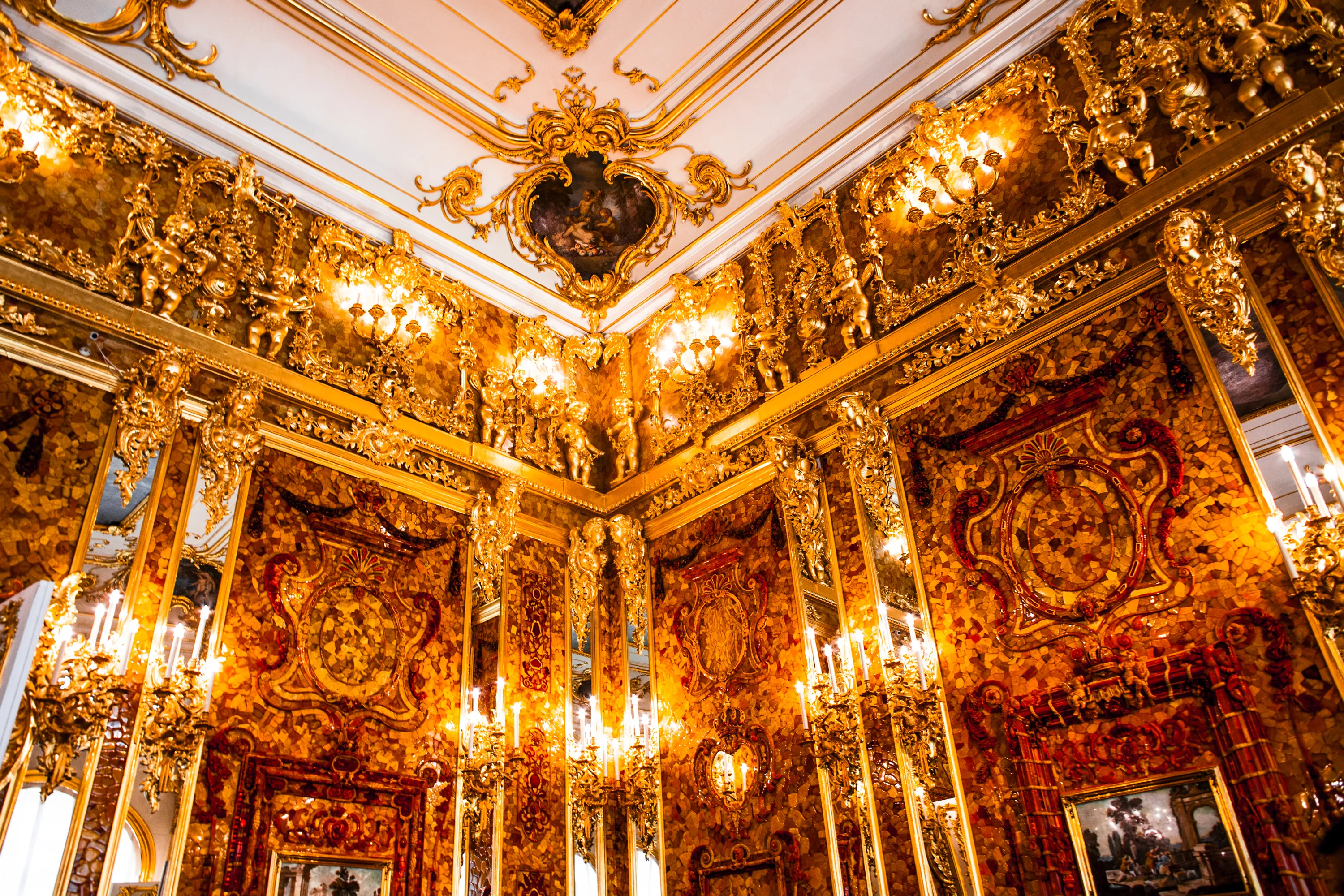
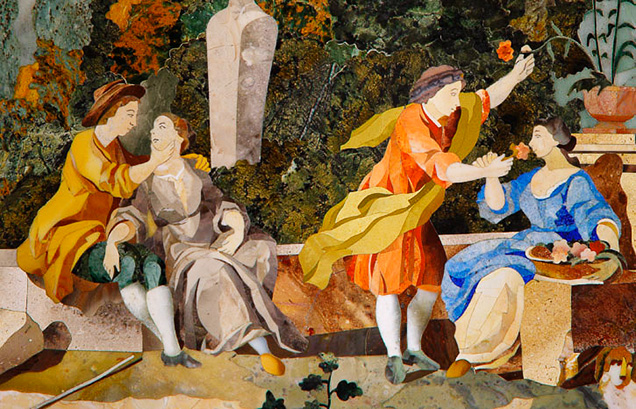
While the golden walls of the Amber Room provided the glow, the Four Florentine Mosaics provided the soul. These were not paintings in the traditional sense of oil and canvas; they were masterpieces of pietra dura “hard stone” painting where thousands of tiny slivers of lapis lazuli, onyx, and jasper were fitted together so precisely they mimicked the brushstrokes of a Renaissance master.
The Artistry: Painting in Stone
Commissioned by Empress Elizabeth in 1752, these mosaics were designed to break the monochromatic warmth of the amber with vibrant, cool-toned allegories. The set depicted the Five Senses, a popular theme in Baroque art intended to celebrate the richness of human experience:

- Sight and Taste: A composition featuring a telescope and a feast of fruit.
- Hearing: Depicted through musical instruments and a singing bird.
- Touch: Illustrated by a lady holding a bird that pecks at her hand.
- Smell: Represented by a figure surrounded by blooming flowers.
The craft was so advanced that from a distance, the transition between stones was invisible. They were the only elements of the room that offered a “window” into a different world, framed by the honey-colored resin that surrounded them.

The Disappearance: 1941–1945
The mosaics were last seen in their intended glory during the summer of 1941 at the Catherine Palace. When the Nazi Army Group North reached Tsarskoye Selo, they dismantled the Amber Room in its entirety.

The mosaics were packed into separate crates along with the wall panels and shipped to Königsberg Castle (modern-day Kaliningrad). They were briefly put back on display in the castle’s museum, where they were documented by German curators. This was the last time the full set of four was seen by the public. As the Red Army closed in during the winter of 1945, the crates were moved to the castle’s basement and then the trail vanished into the smoke of Allied firebombing.
The Miraculous Resurfacing of “Sight and Taste”
For over fifty years, the mosaics were assumed to be dust. However, in 1997, a legal bombshell dropped. A German notary in Bremen was found attempting to sell an original Florentine mosaic titled Sight and Taste on behalf of a client.
Investigations revealed the seller was the son of a German lieutenant who had been tasked with escorting the Amber Room crates to Königsberg. The officer had quietly siphoned off one of the mosaics as a “souvenir” of the war. After a brief legal battle, the mosaic was returned to Russia in 2000, serving as the primary blueprint for the modern reconstruction of the other three.
The Status of the Remaining Three
As of 2026, the remaining three mosaics Hearing, Touch, and Smell remain missing.
They represent some of the most sought-after “small” artifacts of World War II. Unlike the six tons of amber, which may have rotted or burned, these stone-inlay pieces are incredibly durable. Many historians believe they were not destroyed but were looted by individual soldiers and are likely sitting in private attics or basements in Europe, their owners unaware that they hold a piece of the “Eighth Wonder of the World.”