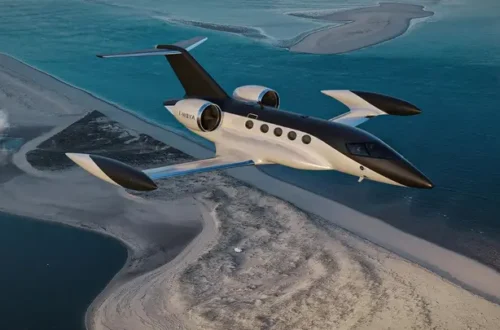
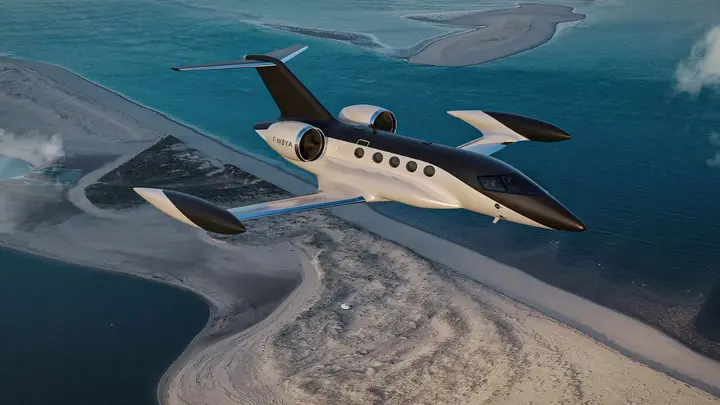
The Beyond Aero BYA-1 is currently the frontrunner in the race to bring zero-emission flight to the business elite. While most hydrogen projects are still stuck in the “science project” phase, this Toulouse-based startup has just cleared a massive hurdle that moves them from theory to reality.

As of late March 2026, Beyond Aero officially completed its Preliminary Design Review (PDR). This isn’t just a technical checkmark; it means the aircraft’s architecture is now finalized and officially “certifiable” by the FAA and EASA.


For the luxury traveler, the “jet age” has always come with a carbon-heavy price tag. Beyond Aero is looking to change that by offering the first clean-sheet aircraft designed specifically around hydrogen-electric propulsion.
Unlike “retrofits” that try to cram tanks into old planes, the BYA-1 is built from the ground up to handle the unique physical demands of hydrogen.

The 2026 Tech Pivot: From Ducts to Propfans
The most significant update from the 2026 Design Review is a major change in propulsion. Beyond Aero has swapped its original “ducted fan” concept for twin pusher-configured propfans.
- The Benefit: Propfans offer significantly better efficiency during climb and cruise, especially in “one-engine-inoperative” (OEI) safety scenarios.
- The Power: Six 400kW fuel cells generate electricity from gaseous hydrogen, driving a total propeller shaft power of 950kW.
- The Sound: Because there are no loud combustion explosions, the cabin noise is reduced by up to 15 dB—making it one of the quietest environments in the sky.
Range and Performance: Regional Dominance
The BYA-1 is designed for the “missions operators actually fly”—meaning it’s not for trans-Atlantic hops, but it’s perfect for regional hubs.
- Range: 800 to 920 miles (approx. 1,480 km).
- Speed: A cruise speed of 345 mph (300 knots), reaching a ceiling of 26,000 feet.
- Capacity: A spacious “club configuration” cabin that seats 6 to 8 passengers comfortably.
The Logistics: Why Gaseous Hydrogen?
While liquid hydrogen is more energy-dense, it is incredibly difficult to store and requires cryogenic cooling (-253°C). Beyond Aero has made the pragmatic choice to use gaseous hydrogen stored at 700 bar in external tanks mounted above the wingtips.
- The Advantage: This allows the BYA-1 to use existing airport infrastructure. Refueling takes just 30 minutes, and the external tank placement allows for natural ventilation, a key safety feature for certification.
When Will It Fly?
Beyond Aero is taking a “safety-first” approach, aiming for CS-25/Part 25 certification—the same rigorous standard applied to large commercial airliners.
- Prototype Status: A sub-scale (85kW) prototype has already completed flight tests.
- Full-Scale Prototype: With the Preliminary Design Review complete, the team is moving into detailed design and verification.
- Entry into Service: Beyond Aero is currently on track for a 2030 delivery date, with over $1 billion in letters of intent already signed by eager corporate and fractional-ownership customers.
The “Lifestyle” Take
For DLifestyleMagazine.com readers, the BYA-1 is about more than just sustainability; it’s about access. With a short takeoff ground roll of only 725 meters, this jet can land at small, exclusive airports (like Cannes Mandelieu or Saanen/Gstaad) that traditional heavy jets can’t touch.
Do you think your readers would prioritize the “guilt-free” aspect of the BYA-1, or is the 800-mile range still too restrictive for the elite traveler?