If the BYA-1 is the pragmatic “workhorse” of the future, the Sirius CEO-Jet is its flamboyant, high-tech counterpart. Designed to combine the vertical versatility of a helicopter with the speed of a business jet, it is widely considered the most ambitious hydrogen aviation project in development today.
As of April 2026, Sirius Aviation AG (now often operating under the Stellar Jet brand following a strategic US relocation) is moving from the “unveiling” phase into critical flight-demonstration milestones.

The Sirius CEO-Jet is designed for a very specific type of traveler: one who wants to take off from a private estate in the Hamptons and land directly at a rooftop in Manhattan—or fly 1,000+ miles to a regional hub—all without a single gram of CO2.
The Tech: 28 Fans and Liquid Hydrogen
The technical architecture of the Sirius Jet is what sets it apart from the “pod-based” eVTOLs like Joby or Archer.
- Vectored Thrust: The aircraft utilizes 28 electric ducted fans (EDFs). Twenty are embedded in the main wings, and eight are mounted on the front canard. For vertical takeoff, these fans pivot; once in the air, they transition to horizontal flight.
- The Liquid Advantage: Unlike many competitors using gaseous hydrogen, Sirius is betting on Liquid Hydrogen. This allows for much higher energy density, enabling a staggering range of 1,150 miles (1,850 km) for the 3-passenger CEO-Jet.
- The Whisper: By using many small fans rather than a few large rotors, the jet targets a noise profile of less than 60 dB at 100 meters roughly the volume of a normal conversation.


The People: A Powerhouse Collaboration
The project is led by Alexey Popov, a CEO with a background in complex engineering who has spent the last five years building a “dream team” of partners:
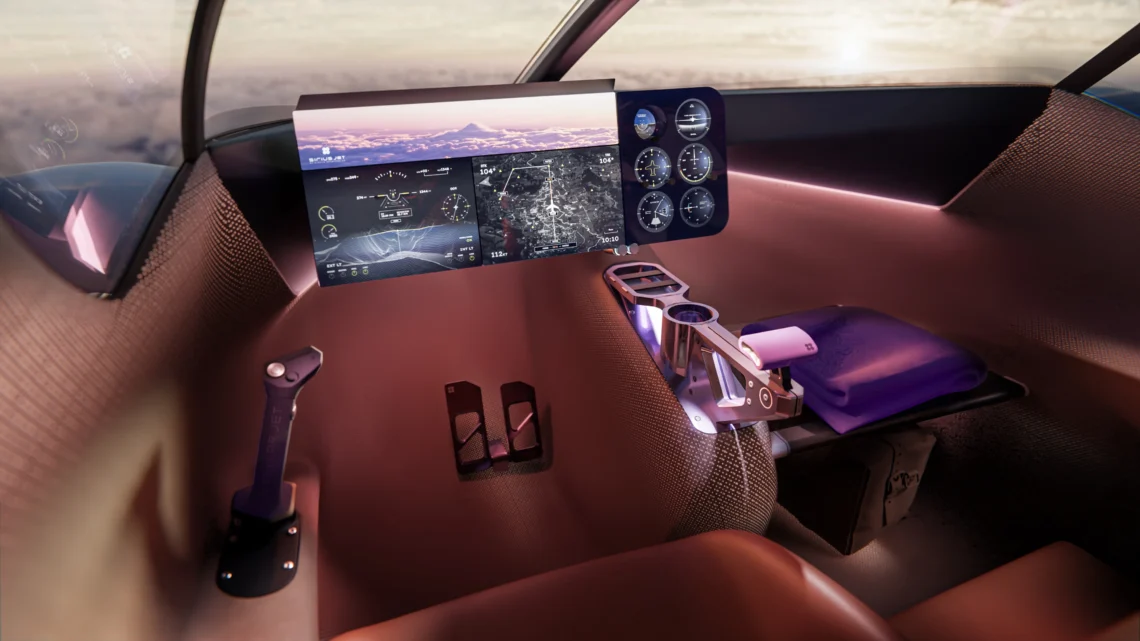
- BMW Group Designworks: Responsible for the striking exterior and the space-capsule-inspired interior.
- Sauber Group (Formula 1): Providing the aerodynamic and composite expertise required to make a hydrogen tank both lightweight and crash-safe.
- Stellar Aviation: The brand’s new US-based identity as it transitions its legal and manufacturing headquarters to Delaware to tap into the American aerospace market.
The Timeline: 2026 is the Year of Truth
- 2024–2025: Successful “initial ignition” and performance validation of the proprietary hydrogen fuel tank and propulsion system.
- Early 2026: Relocation to the US and start of manufacturing for the first full-scale demonstration model.
- Late 2026: Targeted window for the first flight of the full-scale demonstrator.
- 2028: Projected entry into service for commercial and private customers.
The Specs at a Glance (CEO-Jet Edition)
| Feature | Specification |
| Max Range | 1,150 Miles (1,850 km) |
| Cruise Speed | 323 mph (520 km/h) |
| Altitude | 30,000 ft |
| Capacity | 1 Pilot + 3 Passengers |
| Safety | Ballistic Parachute System & Fan Redundancy |
The “Lifestyle” Take
For your readers at DLifestyleMagazine.com, the Sirius CEO-Jet represents the ultimate “flex” in the world of luxury mobility. It isn’t just about saving the planet; it’s about the freedom of the “Point-to-Point” journey. No airports, no runways, and thanks to the liquid hydrogen setup no “range anxiety.”
Does the idea of a 3-passenger “boutique” jet like this feel more exclusive than the larger 8-seat regional planes, or do you think the limited seating might be a dealbreaker for corporate use?