
The Ghost That Wasn’t: London’s Terrifying Halloween Mystery of 1804
In the early 19th century, the people of London were convinced that something supernatural was haunting their streets. Witnesses claimed to have seen a ghost dressed in white, reports spread through the neighbourhood, and fear took hold. But when one man decided to hunt the apparition down, the story ended in a very real tragedy.
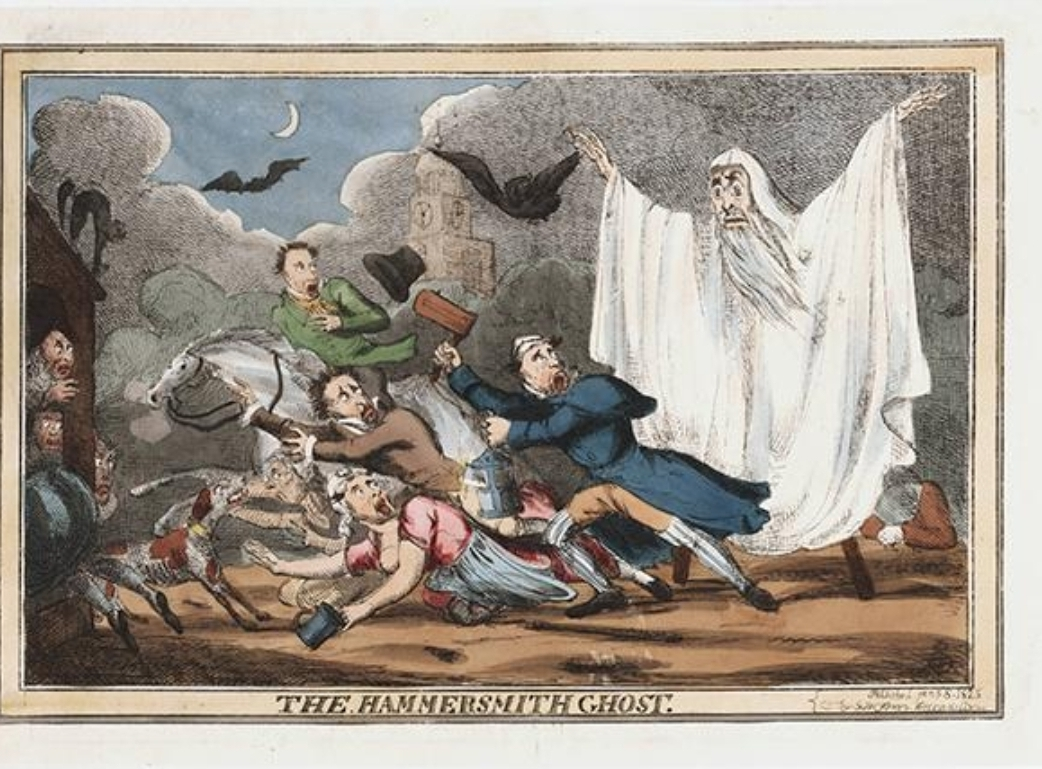
Halloween has always been a night for ghost stories, but some of the most frightening tales don’t come from folklore. They come from real events, recorded in newspapers, courtrooms and the memories of people who lived through them.
One such story unfolded in Hammersmith, London, in the winter of 1804. It became known as the Hammersmith Ghost case, and it remains one of Britain’s most extraordinary encounters between superstition and reality.
### A village living in fear
During the winter of 1803, Hammersmith was gripped by reports of a mysterious apparition. Residents described a large, frightening figure dressed in white, appearing along Black Lion Lane, near the local churchyard and surrounding fields.
Some witnesses claimed it wore a white sheet. Others described something far more disturbing: a figure with horns and glass-like eyes, sometimes appearing in what looked like an animal skin.
The stories became increasingly alarming.
Travellers claimed to have encountered the apparition on deserted roads. One witness, Thomas Groom, described being confronted in the churchyard, where the mysterious figure allegedly emerged from behind a tombstone and seized him by the throat.
Another reported sighting involved a carriage driver who was so frightened that he abandoned his horses and passengers.
Perhaps most disturbing was the story of a pregnant woman who reportedly encountered the figure near the churchyard, fainted from fright and subsequently died. Although this account circulated widely, it should be treated as contemporary reported testimony rather than independently established fact.
The village was becoming consumed by fear. Some believed the ghost was the restless spirit of a man who had taken his own life the previous year. Others suspected a living person was deliberately disguising themselves to terrorise the community.
Eventually, residents organised armed patrols to catch whatever was responsible.
And among those determined to uncover the mystery was a 29-year-old customs officer named Francis Smith. In Custodia Legis +1
### January 3, 1804: The night the ghost was shot

On the evening of January 3, 1804, Francis Smith set out to search for the apparition. He was carrying a blunderbuss, a firearm commonly used during that period.
At roughly the same time, a 32-year-old tradesman named Thomas Millwood was making his way home.
Millwood was dressed in the traditional working clothes of his trade: clean white linen trousers, a white flannel waistcoat and a white apron. His clothing was so bright that he had reportedly been mistaken for the ghost on previous occasions.
His family had even warned him to wear a darker coat when walking outside at night.
Unfortunately, that evening, he was still dressed in white.
As Millwood walked along Black Lion Lane, Smith spotted him in the darkness.
He challenged the approaching figure, demanding to know who or what it was. Millwood did not provide the response Smith expected.
Believing he had finally encountered the phantom that had terrified Hammersmith, Smith fired.
The shot struck Millwood in the face and neck. He collapsed, and it quickly became apparent that the supposed supernatural creature was an ordinary man.
Smith had not killed a ghost. He had killed an innocent tradesman walking home.
Millwood’s body was taken to the Black Lion public house, where medical examination confirmed that a gunshot wound had caused his death.
The ghost hunt had become a murder investigation. The London Archives +1
### The trial that shocked Britain

On January 11, 1804, just eight days after the shooting, Francis Smith appeared before the Old Bailey, London’s famous criminal court.
Smith admitted firing the weapon but maintained that he never intended to kill a person. His defence centred on the belief that he had encountered the notorious apparition and feared for his safety.
The case attracted considerable public attention. After all, how does a court deal with a man who claims he killed someone because he genuinely believed his victim was a ghost?
The jury initially attempted to return a verdict of manslaughter. However, the judges instructed them that they could only find Smith guilty of murder or acquit him entirely.
They ultimately found him guilty of murder.
Smith was sentenced to death.
Yet the story did not end at the gallows. Public sympathy for Smith was considerable, and the case was referred to King George III. His death sentence was eventually commuted, and he received a royal pardon on the condition that he serve one year in prison.
The case also became important in English legal history because it raised difficult questions about mistaken belief, self-defence and the use of deadly force. In Custodia Legis +1
### So who was the Hammersmith Ghost?

Here is where the story takes another unexpected turn.
Following the murder and the publicity surrounding Smith’s trial, a local shoemaker named John Graham reportedly came forward and claimed responsibility for the haunting.
According to his account, he had dressed himself as the ghost to frighten people after his children had been terrified by ghost stories told by his apprentices.
In other words, the terrifying apparition that had brought an entire neighbourhood to its knees was allegedly nothing more than a man playing a cruel practical joke.
But even that revelation did not completely end the legend.
In 1824, reports of another Hammersmith Ghost began circulating. This time, the apparition was supposedly capable of breathing fire.
The ghost had acquired a new reputation, and the story continued to occupy the imagination of Londoners. In Custodia Legis +1
### Two centuries later, the ghost story remains
There is something particularly unsettling about the Hammersmith Ghost story.
It is not simply a tale about a mysterious figure appearing in a churchyard or a phantom wandering through the darkness. It is a reminder of how quickly fear can spread, how rumours can become accepted as truth, and how dangerous superstition can become when people act upon it.
Thomas Millwood was not a ghost. He was a man going home after an ordinary evening, wearing the clothes of his profession.
Francis Smith was not a ghost hunter who discovered the supernatural. He was a man who allowed fear to convince him that an innocent person was something other than human.
And somewhere between the rumours, the sightings and the armed patrols, a practical joke became a tragedy.
Perhaps the most frightening part of this story is that the ghost never needed to exist to claim a victim.
This Halloween, remember the Hammersmith Ghost of 1804. It is one of those rare historical stories where the supernatural was never proven, but the horror was very real.
### DLifestyle Magazine publishing package
SEO title: The Hammersmith Ghost: The Real Halloween Mystery of 1804
SEO slug: `hammersmith-ghost-real-halloween-story-1804`
Meta description: In 1804, a ghost terrified Londoners until an armed ghost hunter shot an innocent man. Discover the true story of the Hammersmith Ghost.
Tags: Halloween, True Ghost Stories, British History, Haunted London, Hammersmith Ghost, 19th Century History, Historical Mysteries.
Featured image concept: A dark Georgian-era London street, illuminated by a single gas lantern, with a mysterious white figure standing in the distance. A historically styled, atmospheric Halloween image.
Historical sources worth embedding:
* [The London Archives – The Hammersmith Ghost](https://www.thelondonarchives.org/blog/the-hammersmith-ghost?utm_source=chatgpt.com) — Historical account and original court references.
* [Library of Congress – The Case of a Ghost Haunted England for Over Two Hundred Years](https://blogs.loc.gov/law/2015/10/the-case-of-a-ghost-haunted-england-for-over-two-hundred-years/?utm_source=chatgpt.com) — Legal and historical examination of the case.
* [The Guardian – Ghostly murder haunts lawyers 200 years on](https://www.theguardian.com/uk/2004/jan/03/johnezard?utm_source=chatgpt.com) — Examination of the case’s lasting legal significance.
Editorial note: The murder, trial and conviction are documented historical events. The ghost sightings and John Graham’s confession are accounts recorded in historical sources, not proof of supernatural activity.