The Bentley Blower, Reimagined: An Icon Finds New Life in Smaller Forms
Nearly a century after it conquered the imagination of motoring enthusiasts, Bentley’s legendary Blower brings its unmistakable character to a new generation of craftsmanship — from a road-going electric miniature to exquisitely detailed scale models.
There are cars that become famous for their speed, others for their beauty, and a rare few that achieve something greater: they become part of a marque’s identity. The Bentley Blower belongs firmly in the latter category.
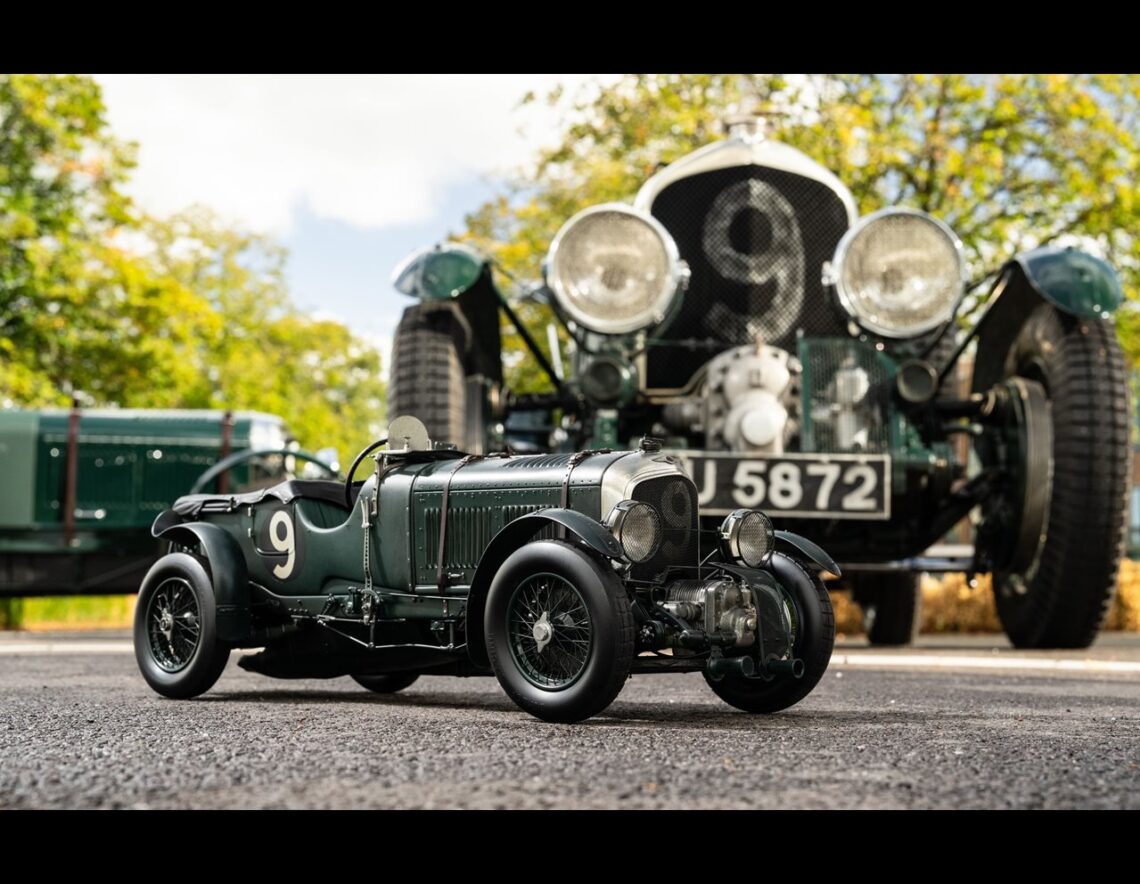
At Bentley’s headquarters in Crewe, four interpretations of one of the marque’s most recognisable historic machines have come together, uniting almost a century of automotive history in a single display. At the centre stands the original 1929 Bentley 4½ Litre Supercharged Team Car No. 2, accompanied by three smaller creations from Hedley Studios and Amalgam Collection.
Their proportions may differ dramatically, but their inspiration remains the same: a machine whose exposed mechanical character and uncompromising racing heritage helped establish its place in British motoring history.
The original: A racing legend that refuses to retire
The story begins with Team Car No. 2, registered UU 5872, one of four supercharged Bentley Team Blowers built for competition. The car competed at the 24 Hours of Le Mans in 1930 and remains an important part of the Bentley Heritage Collection.
The Blower’s distinctive identity came from its supercharged engine, imposing proportions and unmistakable mechanical presence. It represented an era when motor racing demanded not only engineering ingenuity but also courage, endurance and a willingness to push machinery to its limits.
Its legacy is closely associated with the Bentley Boys, the wealthy and adventurous drivers whose exploits helped establish Bentley’s early sporting reputation. Nearly a century later, the original Team Car No. 2 continues to appear at events and historic driving experiences, allowing its story to be experienced beyond the confines of a museum.
That continued presence is significant. Rather than treating the Blower as a relic of a distant age, Bentley preserves it as a living connection to the competitive spirit that helped shape the marque.
Blower Jnr: A smaller Bentley with a modern purpose
One of the most striking interpretations is the Blower Jnr, developed through a collaboration between Bentley Motors and The Little Car Company, now known as Hedley Studios.
First revealed in 2023, the Blower Jnr recreates the proportions and visual character of the 1929 original at 85 per cent of its scale. Unlike a conventional miniature, however, this is a fully electric vehicle designed for road use.
Its electric powertrain produces 31 bhp (23 kW), with a top speed exceeding 50 mph (80 km/h) and a certified range of up to 75 miles (120 km).
The challenge was never simply to make a smaller car look like a Blower. It was to translate a pre-war design into a modern road-going vehicle while preserving the analogue character that makes the original so appealing.
That required considerable engineering beneath the familiar silhouette. Lighting, indicators, braking systems and electrical architecture had to meet contemporary requirements, with modern safety and usability features integrated into the design. Even a reversing camera finds its place in a vehicle intended to retain the visual spirit of 1929.
According to Hedley Studios founder Ben Hedley, the complexity lies in the elements that cannot immediately be seen. Recreating the appearance is only the beginning; making the vehicle function as a properly homologated production car is an entirely different undertaking.
The programme is planned for a production run of 349 cars. The first 25 have been completed at Hedley Studios’ Bicester atelier, with the initial examples preparing for customer delivery. Bentley’s own Blower Jnr has also been delivered to the company’s Crewe campus.
It is a fascinating reinterpretation of heritage: electric propulsion and modern road requirements beneath a body inspired by one of Britain’s great racing machines.
Amalgam Collection: Engineering captured in miniature
Where Blower Jnr translates the original into a driveable vehicle, Amalgam Collection approaches it from the perspective of the collector.
The company’s new 1:18-scale Bentley Blower joins its larger 1:8-scale model, first revealed in February 2020. Both seek to reproduce the complexity of the original car, including the exposed mechanical elements that make the Blower such a distinctive subject for model-making.
Working at a smaller scale creates its own demands. Components that are readily visible on a full-size car must be recreated in miniature without losing their visual definition or relationship to the surrounding structure.
Amalgam Collection founder Sandy Copeman described the challenge of translating the car’s mechanical complexity into a model one-eighteenth of its original size. The new release represents the company’s most technically accomplished 1:18-scale model to date.
For owners of Bentley’s Blower Continuation Series, the connection can become more personal. Amalgam can produce 1:8- and 1:18-scale models configured to mirror the specifications of individual full-size cars, allowing the miniature to serve as a detailed counterpart to the owner’s own machine.
There is also a more evocative interpretation of the Blower’s competitive history. Amalgam has created a race-weathered version of its 1:8-scale model, limited to 30 examples. Each is hand-painted and detailed to reproduce the dirt, patina and damage associated with competition.
The model depicts Team Car No. 2 after the 1930 running of the 24 Hours of Le Mans, including bent rear fenders attributed to tyre failures.
It is an approach that moves beyond the traditional idea of a pristine collector’s model. Instead of presenting the Blower as an immaculate object, it preserves the marks of a car that has been used, tested and pushed hard.
One icon, four interpretations
Together, the original Bentley Blower, the electric Blower Jnr and Amalgam Collection’s two scale models form a compelling study in how automotive heritage can be preserved.
Each interpretation serves a different audience. The original remains a significant piece of Bentley’s racing history. Blower Jnr offers a way to experience the design in a modern, driveable form. The Amalgam models bring the car’s intricate details into the world of collectors, with the option to recreate either its carefully maintained appearance or its battle-worn racing character.
What connects them is not simply the shape of the bodywork. It is the preservation of a design whose appeal has survived changes in technology, manufacturing and the expectations of motorists.
The Blower was born in an era when engineering was often on display, when mechanical components formed part of a car’s visual identity, and when competition helped define a manufacturer’s reputation. Its continued influence demonstrates that those qualities still resonate.
Almost 100 years after Team Car No. 2 first competed at Le Mans, Bentley’s supercharged icon has become more than a historic racing car. It is a reference point for designers, engineers and craftspeople seeking to translate the past into something that can still be experienced in the present.
The scale may change. The powertrain may evolve. The materials and manufacturing techniques may be entirely different.
Yet the Blower remains unmistakably Bentley — a reminder that true automotive icons are not confined to the period in which they were created. They continue to inspire long after their original moment has passed.
Source: Bentley Motors, Iconic Bentley Blower Honoured by Smaller Siblings — “Bentley Media” (https://www.bentleymedia.com/en/newsitem/1843-iconic-bentley-blower-honoured-by-smaller-siblings).