
There are faster cars.
There are more famous cars.
And there are hypercars backed by manufacturers with decades of racing history and billion-dollar engineering departments.

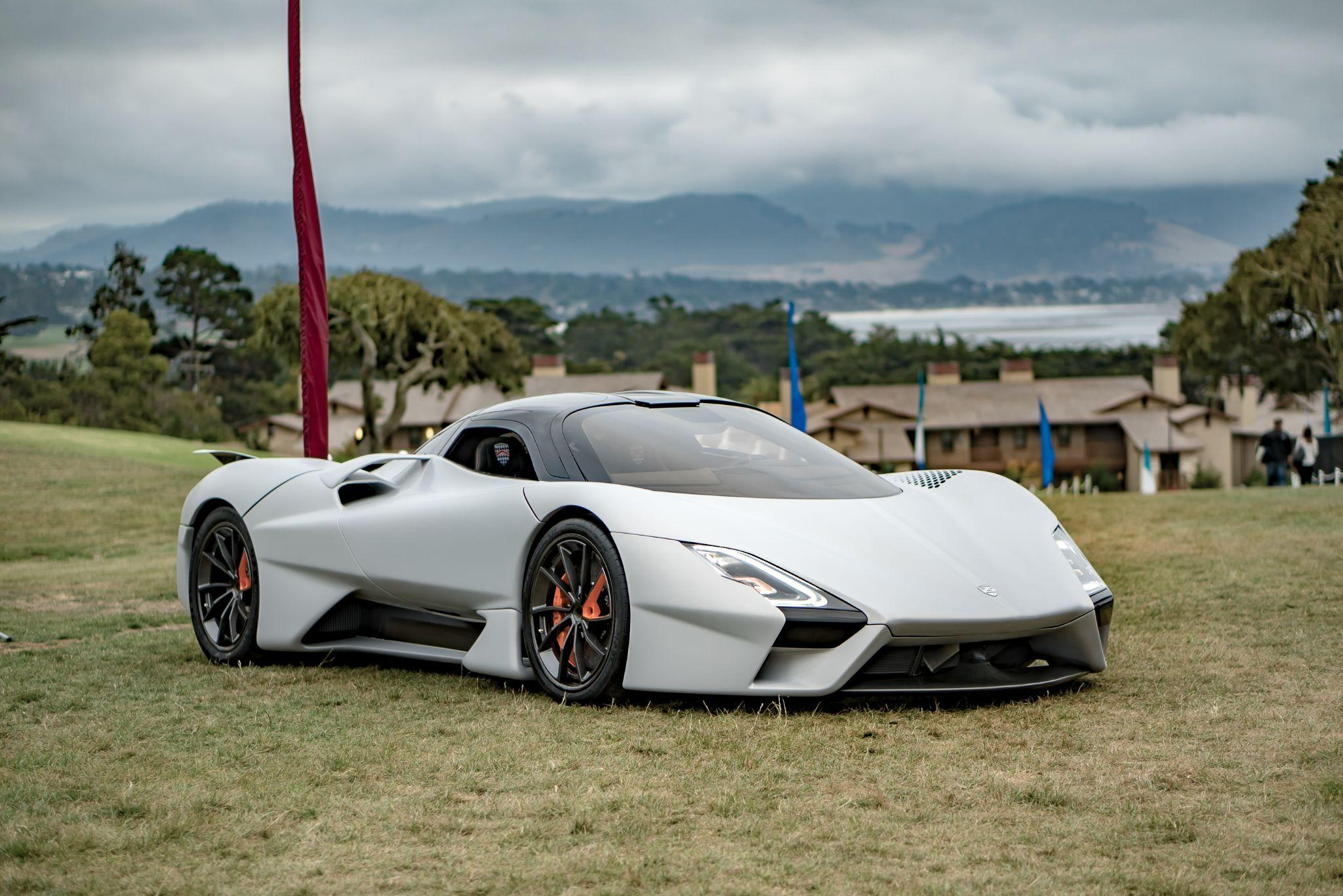
Then there is the SSC Tuatara—a car born from an American company that decided the fastest production car in the world should come from somewhere other than the usual names.
The story of the Tuatara isn’t simply about horsepower. It is about obsession: carbon fiber, aerodynamics, a bespoke V8 and an ambition that has followed SSC North America for decades.
And, inevitably, it is also a story about the pursuit of 300 mph.
The Successor to the Ultimate Aero
SSC North America was founded by Jerod Shelby in 1998, with the goal of putting an American-built hypercar into the same conversation as Bugatti and Koenigsegg.
Its first major statement was the Ultimate Aero, which reached 256.18 mph in 2007.
The Tuatara was supposed to take that idea much further.
The design came from Jason Castriota, whose background included work associated with Ferrari and Maserati, while the engineering philosophy was built around one central objective: create an exceptionally fast car without turning it into an undriveable science experiment. (Car and Driver)
The result is one of the most recognizable silhouettes in the modern hypercar world.
Low.
Wide.
Extremely clean.
And seemingly designed to cut through the air rather than fight it.
The Carbon-Fiber Core
At the center of the Tuatara is a carbon-fiber monocoque.
That gives SSC the rigid structural foundation necessary for a car dealing with extraordinary power and speed while keeping mass under control. Contemporary reporting put the Tuatara’s dry weight at roughly 2,750 pounds. (Car and Driver)
And this is where the Tuatara becomes interesting.
SSC didn’t simply take a huge engine and put it into a lightweight body.
Almost every component was developed around the same objective.
The engine uses custom titanium connecting rods, a billet-steel crankshaft and Inconel components designed to survive the extreme heat and pressures generated by the twin turbochargers. Even the electrical connections were engineered with unusually high attention to durability. (Car and Driver)
This isn’t a car built around one impressive specification.
It is an entire system built around speed.
Meet the V8
Then there’s the part that makes the Tuatara truly ridiculous.
A 5.9-liter twin-turbocharged flat-plane-crank V8.
On E85, SSC quotes 1,750 horsepower and approximately 1,341 lb-ft of torque, with the engine capable of revving to 8,800 rpm. On 91-octane fuel, output is reduced to 1,350 horsepower. (Car and Driver)
That flat-plane crankshaft is important, too.
Rather than simply relying on displacement and boost, the engine was designed to deliver a high-revving character more commonly associated with exotic naturally aspirated engines.
Except this one has two enormous turbochargers helping it along.
The result is an engine that isn’t merely powerful.
It’s violent.
Seven Gears to Control 1,750 Horsepower
All of that power is sent through a seven-speed automated manual transmission.
The gearbox was developed by Cima in Italy and uses a hydraulic, paddle-shifted configuration. SSC integrated the transmission with the car’s traction-control systems, with shifts in track mode engineered to occur in less than 100 milliseconds. (Car and Driver)
That’s an important distinction.
At this level of performance, shifting isn’t simply about changing gears.
It’s about keeping the engine operating inside its power band while managing the enormous amount of torque being sent through the drivetrain.
Every fraction of a second matters.
The 300-MPH Question
And then we arrive at the part of the Tuatara story that made the car famous—and controversial.
In October 2020, SSC announced that the Tuatara had averaged 316.11 mph over two runs on a closed section of Nevada highway, including a claimed one-way peak of 331.15 mph. (Car and Driver)
The numbers were extraordinary.
They were also immediately questioned.
The video footage and data surrounding the run generated substantial scrutiny, and SSC eventually acknowledged that the Tuatara had not reached the originally claimed 331 mph or 301 mph figures during that attempt. (Car and Driver)
That could have ended the story.
Instead, SSC went back to work.
The Run That Counted
In January 2021, SSC took the Tuatara to the Johnny Bohmer Proving Grounds at Kennedy Space Center in Florida.
This time, the testing involved multiple independent measurement systems, including Racelogic VBOX equipment.
The Tuatara recorded:
279.7 mph in one direction.
286.1 mph in the other.
Average:
282.9 mph. (Car and Driver)
That was a dramatically different number from the original claim, but it was independently documented and represented a genuine production-car speed achievement.
It also demonstrated something important about hypercar development:
Getting a car to 280 mph is one thing. Getting it beyond 300 mph is an entirely different engineering problem.
Why 300 mph Is So Difficult
At normal road speeds, aerodynamic drag is already significant.
At 200 mph, it becomes enormous.
At 280 mph, the air is effectively becoming an opponent.
And approaching 300 mph, tiny aerodynamic, tire, gearing, power-delivery and stability considerations become increasingly important.
You need enough downforce to keep the car stable.
But downforce creates drag.
You need massive power to overcome that drag.
But more power creates additional heat.
You need tires capable of surviving the loads.
You need gearing that allows the engine to continue accelerating.
And you need a driver capable of keeping a machine moving at extraordinary speed in a straight line.
The Tuatara sits right in the middle of that engineering conflict.
More Than a Number
That’s why the Tuatara remains fascinating.
It isn’t simply an American answer to the Bugatti Chiron or Koenigsegg Agera RS.
It represents a different philosophy.
SSC didn’t begin with a massive luxury manufacturer behind it.
It came from a small American hypercar company whose identity was built around going extraordinarily fast.
The Tuatara is therefore almost a mechanical statement:
What happens if you make speed the priority?
The answer is a carbon-fiber machine with a 1,750-hp V8, a seven-speed transmission, a radically aerodynamic body and the ability to travel at speeds most people will never experience from behind a steering wheel.
The Tuatara’s Place in Hypercar History
The Tuatara’s story is complicated by the controversy surrounding its first claimed record.
But that doesn’t erase what the car actually accomplished.
The independently documented 282.9-mph average is itself an extraordinary achievement. (Car and Driver)
And perhaps that is what makes the Tuatara more interesting today.
The car doesn’t need the original 316-mph claim to be fascinating.
Look at what actually exists:
A lightweight carbon-fiber chassis.
A bespoke 5.9-liter flat-plane V8.
Twin turbochargers.
1,750 horsepower on E85.
An 8,800-rpm redline.
A seven-speed automated manual transmission.
And an American manufacturer willing to build a road car around the idea of breaking one of motoring’s most intimidating barriers.
300 mph.
The Tuatara may not have conquered that number in the way SSC originally announced.
But it remains one of the clearest examples of just how far the modern hypercar has pushed the boundary between road car and land-speed machine.
And somewhere beneath all those numbers is the real story of the Tuatara:
SSC wasn’t interested in making another supercar.
They wanted to build an American hypercar capable of challenging the world.
And they came remarkably close.