If Robert Zemeckis and Steven Spielberg were casting the ultimate time machine today, they wouldn’t look toward Northern Ireland’s stainless-steel vault of the 1980s. They would look straight at South Korea.

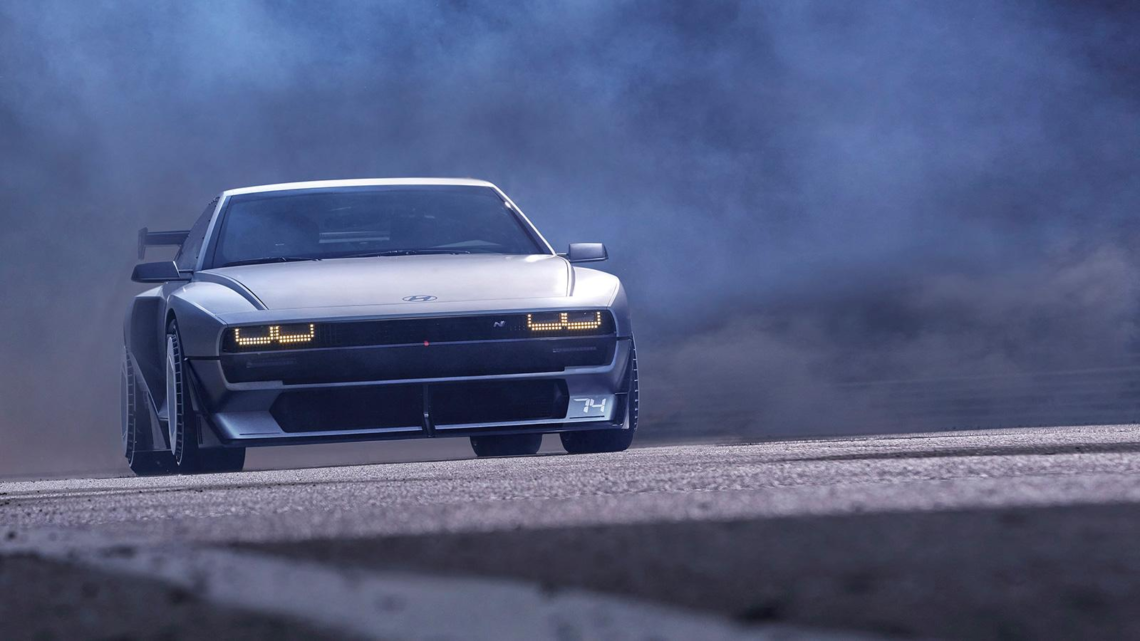
There is something undeniably cinematic about the Hyundai N Vision 74. It carries that same aggressive, dystopian edge reminiscent of the brute-force, high-tech visuals in Judge Dredd—all sharp angles, exposed mechanical cooling grids, and an uncompromising, road-warrior stance. But looking past the pop-culture nods and retro-futuristic visual cues reveals that the most revolutionary aspect of the Vision 74 sits hidden beneath its sharp skin.
Like every piece of true cutting-edge engineering, it abandons standard formulas entirely. The N Vision 74 is a high-performance hydrogen-electric hybrid.
The Arsenale
The Anatomy of a Hydrogen Hyper-Hybrid
Rather than choosing between a pure battery-electric vehicle (BEV) or a traditional hydrogen fuel cell system (FCEV), Hyundai engineered a dual-source “rolling lab” architecture that utilizes both.
Technical Feature | Specification Detail |
|---|---|
Powertrain Layout | Rear-wheel drive, dual independent rear motors |
Combined System Power | 500 kW / 670+ hp (Production targets up to 800 hp) |
Max System Torque | 900 Nm (664 lb-ft) |
Battery Capacity | 62.4 kWh (800V fast-charging architecture) |
Fuel Cell Stack | 85 kW net power mounted on front axle |
Hydrogen Storage | Two 2.1 kg tanks (4.2 kg total capacity at 700 bar) |
Driving Range | Over 600 km (372+ miles) |
Refueling Time | 5 minutes for hydrogen fill-up |
How the Dual Powerhouse Works
The genius of the N Vision 74 lies in its power management system:
- Dual-Motor Torque Vectoring: With two independent traction motors powering the rear axle, software precisely meters torque to each wheel. This acts as a virtual differential for razor-sharp turn-in or instant, controllable drift angles.
Wikipedia - Separated Cooling Channels: High-performance hydrogen setups generate extreme heat. Hyundai built a three-channel cooling system separating the battery pack, the fuel-cell stack, and the dual electric motors to ensure track-level durability without heat soak.
- Instant Discharge + Rapid Refuel: The 62.4 kWh battery supplies the burst of energy needed for immediate acceleration, while the onboard 85 kW hydrogen fuel cell acts as a range extender to continuously charge the battery on the move—yielding zero emissions, water vapor output, and 5-minute stops at a hydrogen pump.
Top Gear
The Reality Check
It is easy to craft a futuristic concept, but turning it into a production reality requires serious conviction. Building on the heritage of the original 1974 Pony Coupe concept designed by Giorgetto Giugiaro, Hyundai has confirmed a ultra-limited production run for this halo machine.
The N Vision 74 doesn’t just borrow from the past—it redefines what high-performance mobility looks like for the future.