
Apollo IE Samurai Dragon: The Hypercar Named for a Warrior
There are only ten Apollo Intensa Emoziones in existence. Each one is extraordinary, but one carries a name that immediately suggests something different: Samurai Dragon.
It is not difficult to see why the name stuck.
The Apollo IE was already conceived as something closer to a road-going piece of motorsport theater than a conventional hypercar. Its bodywork is dominated by exposed carbon, enormous aerodynamic surfaces and a cabin designed around the driver. Beneath it sits a naturally aspirated 6.3-liter V12 producing 780 PS, connected to a six-speed sequential transmission. Apollo’s published philosophy for the IE was as much about emotion and theater as outright numbers.
But the Samurai Dragon has another story to tell.
Number Eight
The Samurai Dragon is generally identified as chassis 08/10, making it the eighth customer Apollo IE.
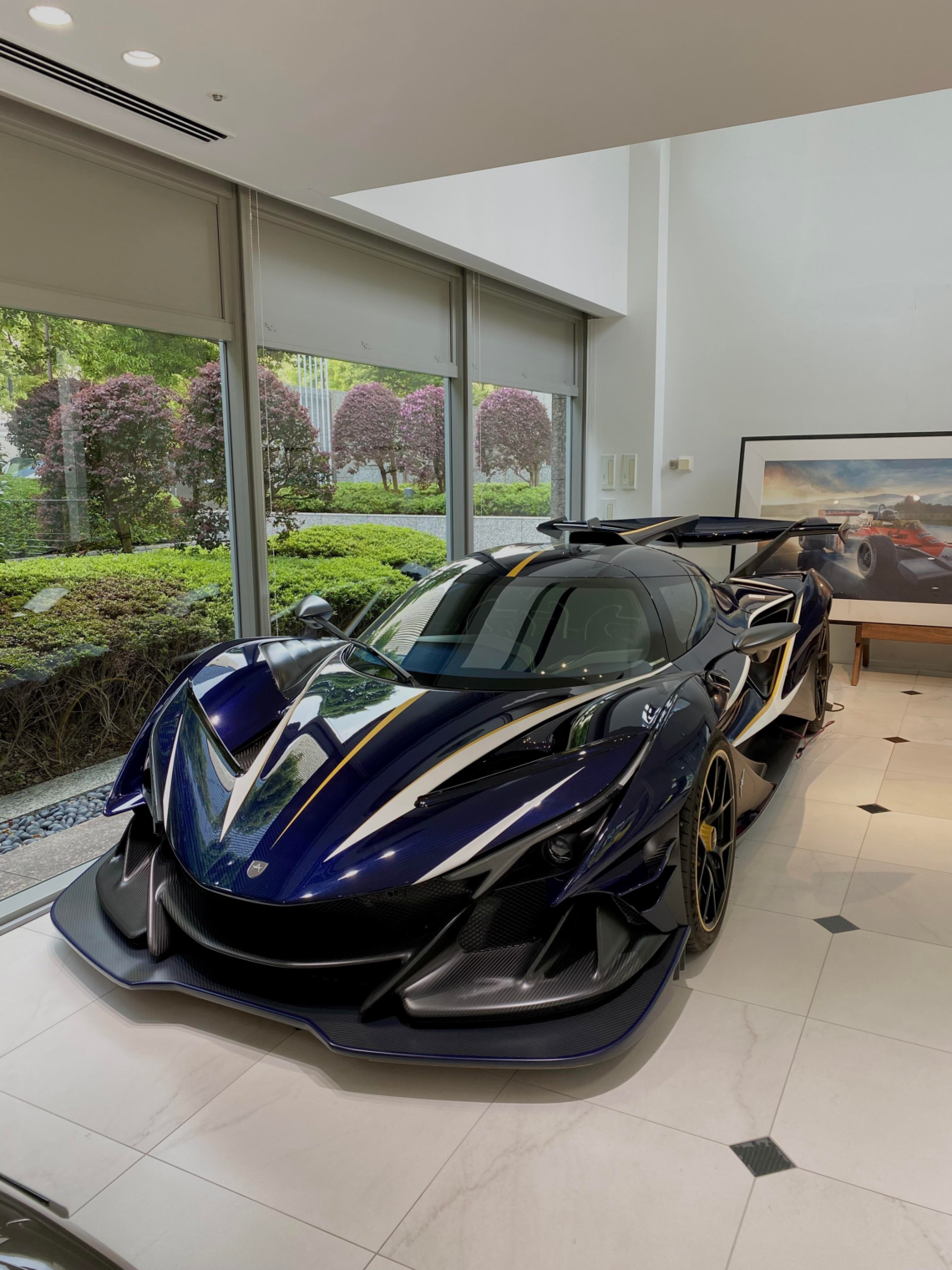
The car eventually became associated with Japan and was offered through Bingo Sports in Tokyo, one of the country’s specialist exotic and collector-car dealers. Public registry information identifies the specification as blue-tinted carbon with yellow and white accents and black wheels.
And that specification is where the Samurai connection becomes much clearer.
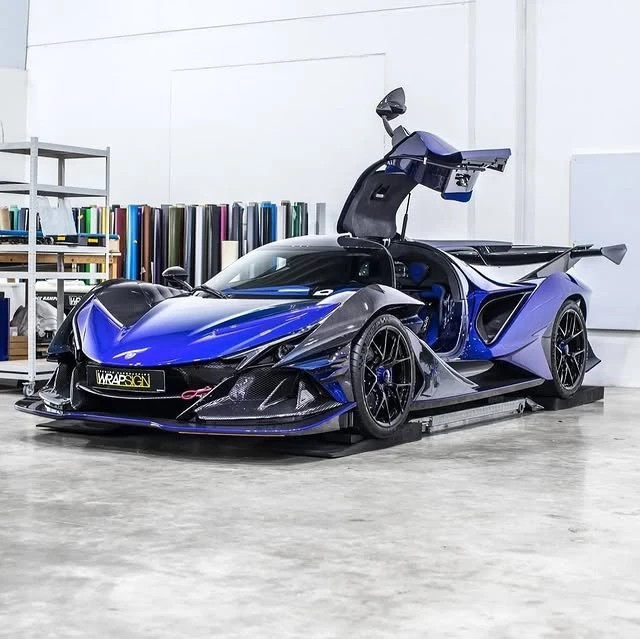
The car’s carbon fiber is not simply blue paint over a conventional body. The exposed carbon receives a blue tint, with reflective particles incorporated into the finish. The result gives the body a deep, almost metallic blue appearance while allowing the carbon weave beneath it to remain part of the visual identity.
It is a very Japanese-looking interpretation of an otherwise ferocious European hypercar.
Why “Samurai”?
There is an important distinction here.
The Dragon names were not factory model names assigned by Apollo. According to specialist reporting, the ten customer cars acquired individual Dragon names through their owners, rather than Apollo operating an official factory naming system.
That means we should be careful about saying Apollo officially named this particular car “Samurai Dragon” because of a documented corporate naming ceremony or published explanation.
What can be established is the connection between the car’s specification and Japan.
The specialist registry Exclusive Car Registry describes the Samurai Dragon as having a specification reminiscent of the Japanese national football team’s colors, while also connecting the car to the iconic indigo blue associated with Japanese culture.
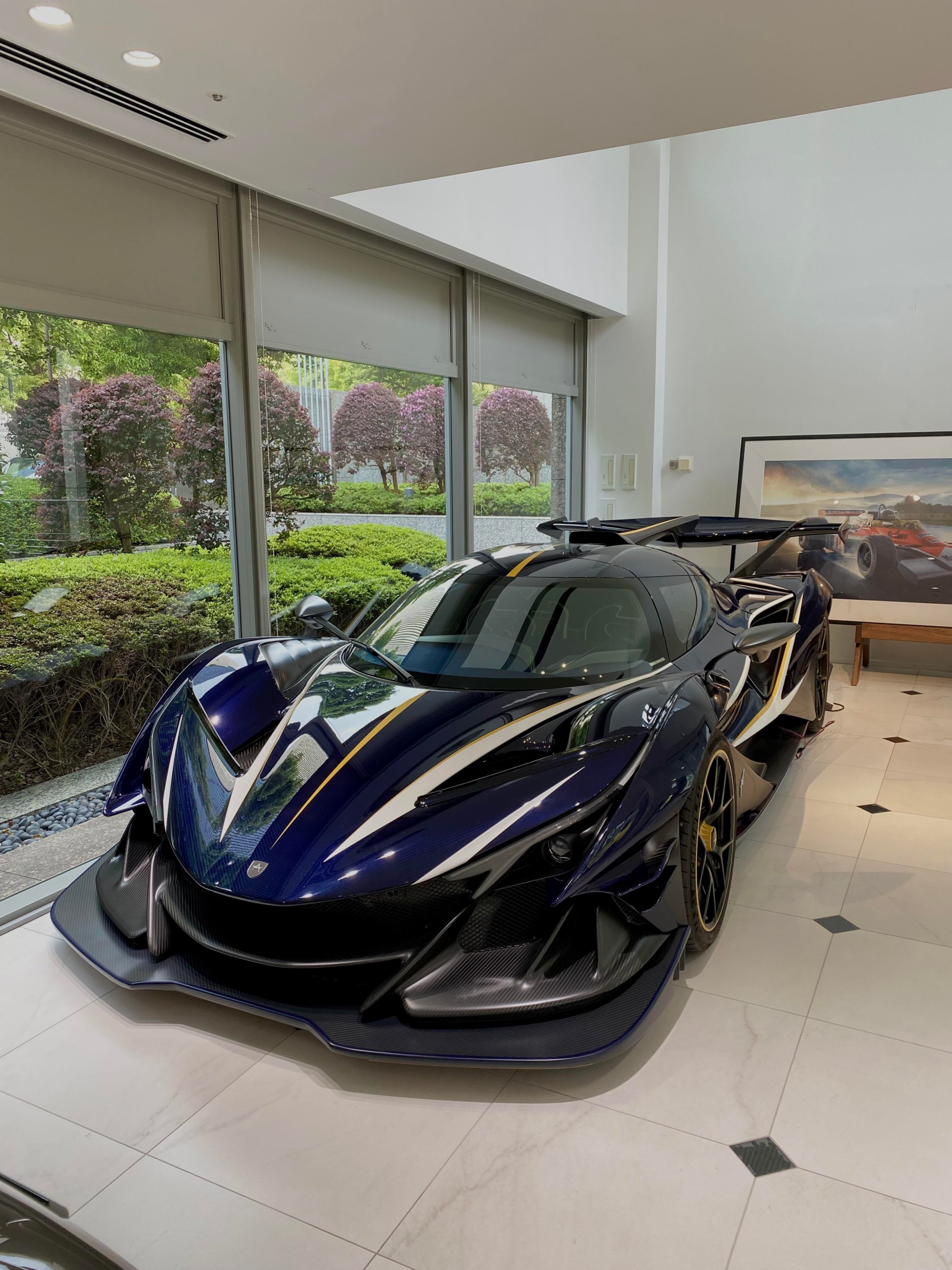
Another registry records the car as having blue-tinted carbon with yellow and white accents, explicitly noting the Japanese national-team color connection.
So the name appears to work on two levels.
The Samurai evokes Japan’s warrior tradition.
The Dragon connects it to Apollo’s broader identity for the ten IEs.
And the blue, white and yellow specification gives the nickname a physical identity.
A Dragon With a Japanese Identity
Apollo’s decision to associate the IE series with dragons was particularly appropriate.
The Intensa Emozione is not a subtle automobile.
Its front end is dominated by enormous aerodynamic structures. Its doors rise vertically. The body appears to have been carved around airflow rather than conventional automotive proportions. At the rear, the exhaust and aerodynamic architecture reinforce the impression that this is something built to attack a circuit.
The Samurai Dragon therefore doesn’t need an elaborate badge to communicate its personality.
The shape does it.
The name simply gives that shape a cultural reference.
And unlike many special editions where the name is essentially a marketing exercise, the Samurai Dragon’s specification provides something tangible behind the nickname.
The Indigo Connection
The color may actually be one of the most interesting parts of the car.
The Samurai Dragon has been described as using a Samurai Blue-tinted carbon, with light-reflecting particles incorporated into the finish. Specialist reporting has also described the car as having white and yellow accents.
That matters because Apollo wasn’t taking a normal blue-painted car and putting a Japanese-themed badge on it.
The carbon itself remained central to the design.
That creates an unusual combination: advanced composite construction presented almost like traditional Japanese lacquerwork, with the deep blue surface changing depending on the light.
It is easy to understand how a collector could look at the finished car and arrive at Samurai Dragon.
And Then There Is the Machine Beneath It
The Samurai Dragon is still an Apollo IE first and a themed collector car second.
At its heart is the naturally aspirated 6.3-liter V12 derived from Ferrari’s F140 engine family, producing approximately 780 PS and 760 Nm in the IE specification.
The engine revs to approximately 9,000 rpm.
Power is sent through a six-speed sequential Hewland gearbox to the rear wheels.
The IE weighs approximately 1,250 kilograms, while Apollo claimed as much as 1,350 kilograms of downforce.
Those numbers explain why the Samurai Dragon doesn’t feel like a decorative collector’s special.
It is an extreme machine underneath the visual treatment.
Ten Dragons, Ten Personalities
This is what makes the Apollo IE particularly fascinating.
Apollo produced only ten customer cars, and each specification became part of the identity of the individual vehicle. Specialist registries and collectors have consequently come to refer to the cars by their Dragon names rather than simply their chassis numbers.
There is, however, an interesting complication.
The names aren’t always consistent between sources.
For example, the car commonly identified as the Carbon Dragon has also appeared in published material as the Black Dragon. Specialist reporting notes that these inconsistencies exist precisely because the Dragon names were not controlled by an official Apollo registry.
That makes the Samurai Dragon particularly useful as a case study.
Here, the name, location, specification and cultural reference all line up.
More Than a Color
The Samurai Dragon is therefore not simply “the blue Apollo.”
It represents something much more interesting: what happens when an ultra-low-production hypercar becomes individualized by the person who owns it.
The Apollo IE was already an unusual proposition — a carbon-intensive, naturally aspirated V12 hypercar built in an era when the industry was rapidly moving toward turbocharging, electrification and increasingly complex hybrid systems.
Then ten customers turned those ten cars into individual personalities.
The eighth became the Samurai Dragon.
Its blue carbon, yellow and white accents, Japanese connection and aggressive bodywork gave it an identity that seems almost inevitable once the car is seen as a whole.
There may only be ten Apollo IEs.
But there aren’t really ten identical cars.
There are ten interpretations of the same idea.
And Samurai Dragon is one of the most recognizable of them.

