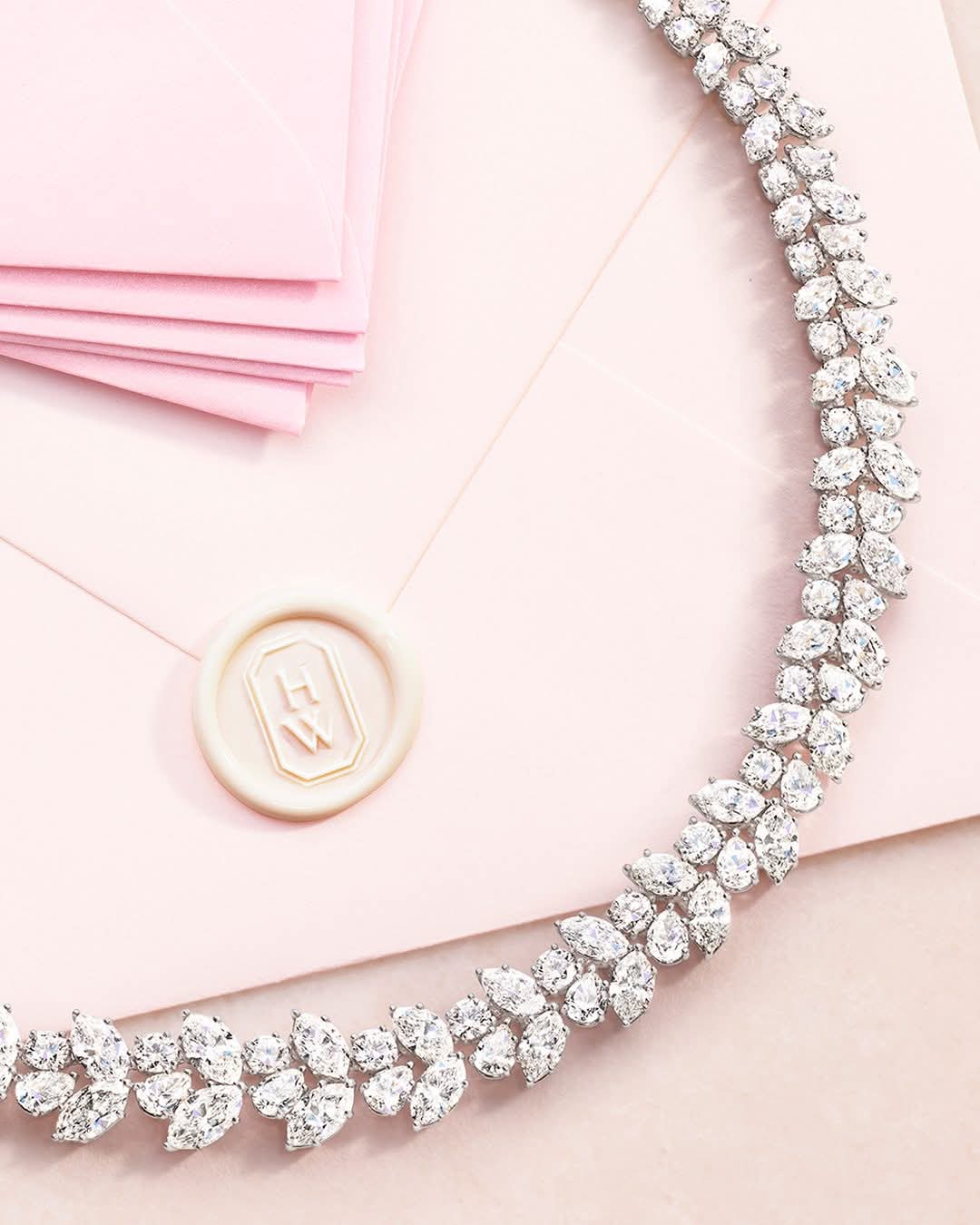
There are jewelry designs that look beautiful, and then there are jewelry designs that completely rewrite the rules of gemology. The Harry Winston Cluster Diamond Wreath Necklace belongs firmly in the latter category.

Featuring an arrangement of 180 marquise, pear-shaped, and round brilliant diamonds weighing an astronomical 48.80 carats, this piece represents the pinnacle of the “King of Diamonds” design philosophy. It is the purest architectural expression of a house style that revolutionized high watchmaking and jewelry houses forever.
The Birth of the Wreath: “Pinkies Down” Artistry
The origin story of the Winston Cluster is legendary. One wintry evening in the 1940s, Harry Winston returned to his Scarsdale, New York estate and stopped to look at the holly wreath hanging on his front door. He noticed how the thick frost and snow clung to the leaves, obscuring the rigid wire framework beneath. The greenery created a fluid, organic shape all on its own.
Until that moment, mid-century jewelry design was heavy, structural, and rigid—diamonds were forced into heavy, geometric platinum or gold matrix plates.
Winston had an epiphany: the diamonds should dictate the design, not the metal.
[Traditional Setting: Heavy Metal Grid] ➔ [Winston Cluster: Multi-Angle Prongs] ➔ [Result: Pure, Floating Light]
He task-forced his master craftsmen to develop the “clustering” technique. By setting fine marquise and pear-cut diamonds at varying angles next to one another using minimal, delicate platinum claws, the metal practically disappears when the necklace hits the collarbone. The stones look less like they are pinned down by a setting and more like they are floating seamlessly on the skin.
Anatomy of the Stone: The Marquise Cut
While the Wreath Necklace gracefully interweaves pear-shaped and round brilliant cuts to create its signature three-dimensional texture, it is the sharp, striking profile of the marquise cut that defines its sweeping geometry.
Named in the 18th century after the Marquise de Pompadour (King Louis XV famously commissioned a stone cut to match the perfect silhouette of her lips), the marquise is a “fancy cut” characterized by its elliptical, boat-like shape ending in two sharp, delicate points.
[The Marquise Blueprint]: 58 Facets ➔ Inverted Pavilion ➔ Elongated Waterline ➔ Pointed Terminals
The Method Used to Shape the Stones
Transforming raw, rough octahedral diamond crystals into the fiery marquise stones featured in this 48.80-carat wreath requires a level of engineering precision that pushes human technical mastery to its absolute limit:
- Mapping and Cleaving (Laser Planning): Master cutters map the internal grain of the rough diamond crystal. The marquise shape is notoriously difficult because any internal inclusions (flaws) get magnified right in the center of the stone—an effect known as the “bowtie” anomaly.
- Bruting (Shaping the Girdle): The diamond is placed in a lathe against another diamond to slowly wear down the rough edges, forming the distinct, elongated oval outline with pointed tips. The proportions must be mathematically perfect; if the stone is cut too narrow, it loses fire; if it is cut too wide, it loses its elegant, elongating sweep.
- Faceting the Crown and Pavilion: The cutter introduces 58 precise facets across the crown (top) and pavilion (bottom). The angles of the pavilion facets must be cut with micro-metric precision to ensure that light entering the face of the diamond bounces internally and fires straight back up through the table, rather than leaking out through the sides.
- Protecting the Points: The absolute hardest part of shaping a marquise diamond is faceting the sharp tips. These points are incredibly vulnerable to fracturing during the cutting and polishing phase. Master cutters use specialized “French facets” at the terminals to reinforce the structural integrity of the points while maintaining a flawless, blinding scintillation.
The Material Standard: Pure Winston Quality
You don’t collect 48.80 carats of diamonds for a piece like this by compromising. In keeping with house tradition, the 180 stones selected for the Cluster Wreath Necklace are sourced only from the top tier of the Gemological Institute of America (GIA) grading scale.
The collection consists primarily of D, E, and F color ratings—the absolute highest tiers of colorlessness, ensuring the stones emit a crisp, icy brilliance unmarred by yellow undertones. Combined with clarity grades ranging from Internally Flawless (IF) to VS1, the gems capture, refract, and spit back ambient light from every single direction.
The Takeaway: The Winston Cluster Wreath Necklace isn’t just an accessory; it is an engineering feat. By letting 48.80 carats of elite marquise and pear-cut diamonds dictate their own structural form, Harry Winston created a timeless piece of wearable sculpture that proves unpretentious, material-first excellence will always outlast passing trends.