Before looking at the spec sheets, the wind tunnels, or the carbon fiber tub, you have to look at the name pinned to the rear decklid.

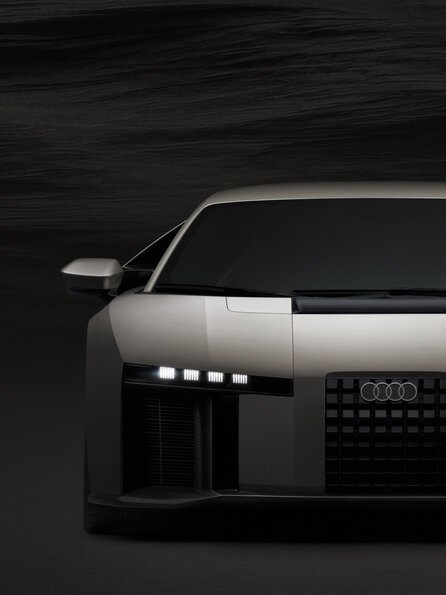
Audi has just unveiled the Nuvolari, a 1,001-horsepower hybrid beast limited to 499 units. But putting that specific name on a car carries a historical weight that most modern supercar badges could never hope to match.

To understand why this car exists, you have to understand a story of defiance, broken bones, and a bitter corporate divorce that shook pre-war Europe.
The Ghost in the Machine: Tazio, Enzo, and the ACC Split
In the 1930s, Grand Prix racing was a blood sport. The cars were heavy, lacked power steering, and ran on skinny tires with zero cockpit protection. The undisputed king of this terrifying era was Tazio Nuvolari—”The Flying Mantuan.”

Nuvolari didn’t just drive cars; he wrestled them, pioneering the “four-wheel drift” by steering the car entirely on the throttle. He was short, thin, and completely fearless.
[Alfa Romeo Factory Team] ──> Fears Failure ──> Ships Cars to Privateer Team:
│
▼
[Scuderia Ferrari]
Managed by: Enzo Ferrari
Star Driver: Tazio Nuvolari
For years, Nuvolari was the golden goose for a young, ambitious team manager named Enzo Ferrari, who ran the semi-official Alfa Romeo racing squad under his new Scuderia Ferrari banner. Together, they achieved the impossible—most famously at the 1935 German Grand Prix, where Nuvolari drove an outdated, underpowered Alfa Romeo P3 and utterly humiliated the silver factory cars of Mercedes-Benz and Auto Union on their own turf at the Nürburgring.
But the relationship between Enzo and Tazio was volatile. They were two massive, unyielding egos. By 1937, frustrated by Alfa Romeo’s inability to build a chassis that could reliably fight the German technical onslaught, Nuvolari did the unthinkable: he walked out on Enzo Ferrari.
Nuvolari signed directly with Auto Union—the hyper-advanced, mid-engined Silver Arrows engineered by Ferdinand Porsche. Enzo was furious. In 1938, Enzo severed his own ties with Alfa Romeo and formed Auto Avio Costruzioni (AAC), a company legally forbidden from building cars under his own name for four years due to a non-compete clause.
While Enzo sat in Maranello plotting his revenge, Nuvolari was cementing his legacy in the mid-engined Auto Union Type D, winning the 1938 Italian Grand Prix at Monza and the British Grand Prix at Donington Park.
Those four interlocking rings on the front of an Audi? They represent the merger that formed Auto Union. When Audi puts the Nuvolari name on a mid-engined supercar, they aren’t borrowing history they are reclaiming the driver who defined their golden era.
Visceral Architecture: What Makes the Nuvolari Special
The Audi Nuvolari is a massive technical departure from anything the brand has done before. It drops the clean, clinical, everyday usability of the old R8 and targets the upper echelons of modern hypercar performance.
The Powertrain (The F1 Connection)
The engineering under the skin reads like a modern Formula 1 blueprint, utilizing a complex four-unit hybrid split.
- The Heart: A mid-mounted, twin-turbocharged 4.0-liter V8 engine that screams all the way to 10,000 RPM—a rev range previously reserved strictly for motorsport. On its own, the V8 kicks out 800 horsepower.
- The Electric Boost: The V8 is paired with three axial-flux electric motors (two on the front axle, one sandwhiched between the engine and transmission), adding an extra 330 kW of instant electric power.
- The Numbers: Total system output is a staggering 1,001 PS (736 kW). It hits 0-100 km/h in 2.6 seconds, clears 200 km/h in 6.8 seconds, and tops out north of 350 km/h.
Designing for the Eye: The Fluid Shift
The visual design is likely the toughest pill to swallow initially. Audi is calling this their new “monolithic volume” philosophy. It features a stark, powerful, block-like stance that feels heavily inspired by their upcoming Formula 1 program, coated in a brutalist “Titanium” signature paint scheme.
If the hard, chiseled lines and geometric front fascia feel a bit too rigid right now, the design language is actually chasing the exact same trend as the AMG GT and the newest all-electric luxury spaces.
[Traditional Supercar: Organic Curves] ──> [New Era: Structural Minimalism]
│
▼
Taut, seamless surfaces that hide active aero channels.
The boxier, monolithic aesthetic isn’t laziness—it’s functional minimalism. The car’s body is a single, uninterrupted mass designed to manage airflow without needing massive, ugly wings tacked onto the back. The active aerodynamics are integrated completely into the bodywork, adjusting channels seamlessly depending on whether the car needs high-downforce cornering grip or slippery, low-drag straight-line speed.
Just like the aggressive stance of the new AMG GT, it’s a shape that prioritizes visual presence and engineering reality over traditional, delicate Italian curves. Once you see it crouching on a road, handling the immense cooling requirements of a 10,000 RPM hybrid V8, the geometry starts to make perfect sense. It’s a machine designed to look like it was carved out of a solid billet of titanium uncompromising, focused, and thoroughly technical.