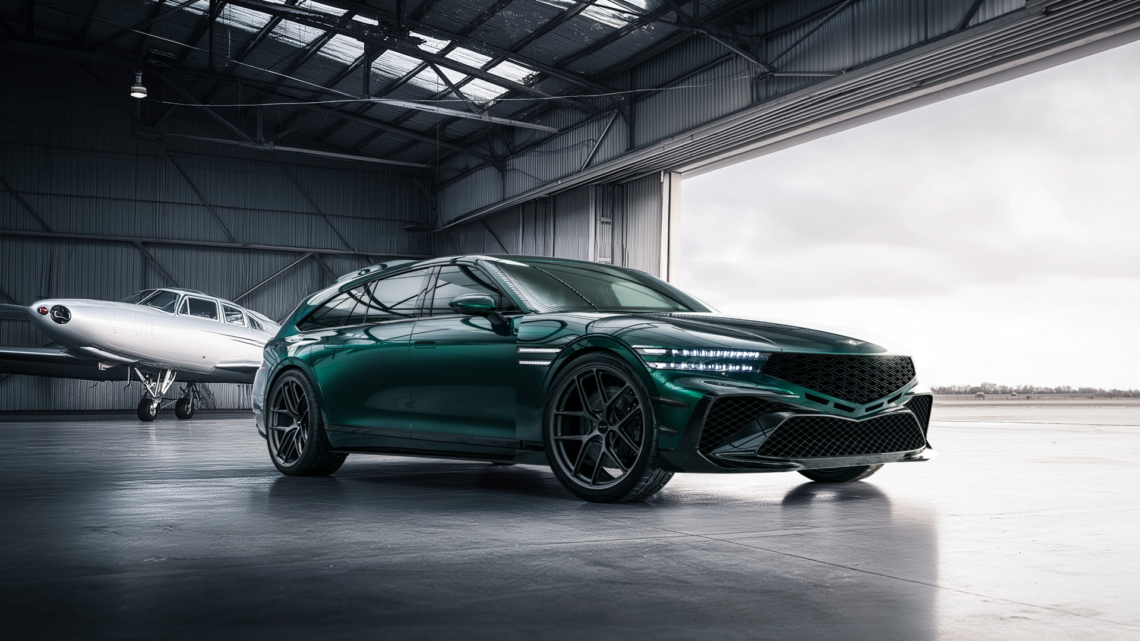
Let’s be honest: Genesis has spent years walking a fine line. On paper, the Korean luxury brand gets everything right—their cars are engineering marvels, quiet as cathedrals, packed with tech, and priced to make traditional European marques sweat.
Yet, for many car enthusiasts, something has always been missing. Distinctive? Absolutely. Those massive diamond-mesh crest grilles and double-lined LED light bars are impossible to mistake for anything else. But “distinctive” doesn’t always translate to desirable. Much of the lineup’s styling has oscillated between slightly awkward proportions and an over-reliance on grand, sweeping chrome that feels a bit too try-hard.

Then came the Genesis G90 Wingback Concept—and suddenly, the design language clicked.
Proportions That Demand Respect
The issue with most full-size luxury flagship sedans—the standard G90 included—is that they are designed primarily for the person sitting in the rear seat. They look like chauffeur cars. They are long, heavy, and decidedly regal, often sacrificing athletic posture for rear-headroom dominance.
The Wingback completely rewrites that narrative by transforming the ultra-luxurious G90 into a sweeping, shooting-brake-style grand tourer.
- The Stretched Silhouette: By pulling the roofline back over its massive 125-inch (3.2-meter) wheelbase, Genesis gave the car the sleek, muscular stance of a high-performance estate.
- Flared Stance: Widened wheel arches wrap around custom 22-inch wheels, completely changing how the car sits on the tarmac. It looks planted, aggressive, and purposeful.
- Rear-End Drama: Instead of a conservative, slab-sided trunk, the back end drops into a sharply raked rear tailgate fitted with twin functional spoilers and a track-inspired rear diffuser.
It takes the aristocratic bones of the flagship sedan and turns it into a road-devouring long-distance runner.
The “Iron Fist in a Velvet Glove”
Part of what makes the Wingback so striking is that it doubles as a canvas for Genesis’s high-performance Magma division, but without the loud, boy-racer tropes.

Rather than painting it in screaming neon or searing orange, Genesis finished the concept in a deep, moody emerald green that changes under the light.
Inside, the cabin leans heavily into driver-focused theater. Dark, suede-like Chamude covers the seats and dash, tied together with subtle green contrast stitching and Magma badging. It preserves all the plushness of a $100,000 executive cruiser—massaging seats, whisper-quiet cabin acoustics, floating displays—while adding a subtle edge that hints at serious power underneath.
Why the Wingback Works Where Others Missed
The primary flaw in previous Genesis designs was tension—or rather, a lack of it. A great car design needs a balance of elegance and underlying aggression. Where previous models leaned heavily on ornamental chrome details to signal luxury, the G90 Wingback lets its proportions do the talking.
- Purpose-Driven Lines: The signature Parabolic Line running down the side of the car finally has a destination. In the sedan, it peters out at the trunk; on the Wingback, it seamlessly feeds into the muscular rear haunches.
- Aggressive Restraint: The front fascia keeps the iconic Crest Grille and Two-Line headlights, but surrounds them with darker trim, subtle front-bumper canards, and larger intake cooling vents. It feels integrated rather than tacked-on.
- Typology Disruption: In an era dominated by homogenous luxury SUVs, a full-size shooting brake feels daring. It proves that utility and presence don’t require an elevated ride height.
The Verdict
The Genesis G90 Wingback is proof that Genesis’s core design DNA isn’t flawed—it just needed the right application. By breaking away from traditional sedan shapes and refusing to build yet another cookie-cutter SUV, Genesis accidentally created their most compelling design study to date.
If this “iron fist in a velvet glove” is an indicator of where the brand’s design language and Magma program are headed, even the skeptics might have to start paying attention.