Every automotive dynasty has a starting line, but few are born from the sheer, desperate grit of post-war survival quite like Porsche.
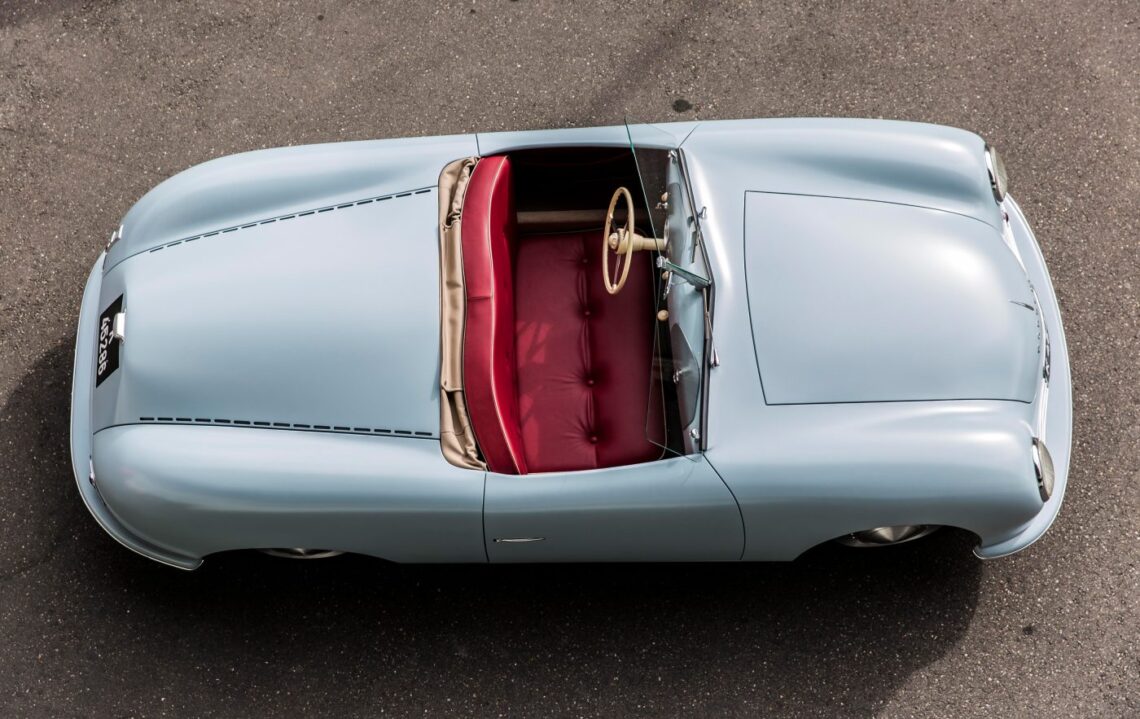
On June 8, 1948, a minimalist, silver open-top vehicle rolled out of a converted sawmill in Gmünd, Austria, and received its official road permit. This was the Porsche 356 “No. 1” Roadster. Today, it stands as the absolute patriarch of the brand. Yet, the very traits that make it a legendary collectible its mid-engine layout, its radical tubular space frame, and its status as a total one-of-one—were actually the result of severe financial hardship, structural desperation, and a relentless need for cash.
Born in a Sawmill: The Post-War Financial Crisis
To understand why the “No. 1” is unique, you have to look at the economic rubble of 1947 Europe. Professor Ferdinand Porsche was imprisoned in France, and his son, Ferry Porsche, was left running a design consultancy that had been forced to relocate from Stuttgart to a remote, makeshift sawmill in Gmünd to escape Allied bombing.
The company had plenty of engineering genius but virtually zero money, zero raw materials, and no factory infrastructure.
[Post-War Gmünd Sawmill]
│
▼ (Severe Shortages: No Steel, No Capital)
[The Swiss Solution] ──► Rupprecht von Senger finances raw materials
│
▼ (The Proof of Concept)
[356 “No. 1” Roadster] ──► Sold instantly for 7,000 CHF to fund survival
Steel was strictly rationed and nearly impossible to acquire in occupied Austria. Aluminum, however, could be sourced—largely because post-war Switzerland had supply lines open. Ferry Porsche formed a vital alliance with Swiss Zurich-based advertising executive and investor Rupprecht von Senger. Von Senger provided a lifeline: he pre-financed subsequent cars and supplied precious lightweight metals from Switzerland. In return, the Austrian government mandated that any cars built with these luxury materials had to be exported to bring desperately needed foreign currency back into the nation.
Why the Genesis Became a “One-of-One”
Ferry Porsche famously stated that he looked around, couldn’t find the car he dreamt of, so he decided to build it himself. He wanted a lightweight machine that used its power efficiently. To prove the concept, the team built the “No. 1” using an intricate tubular steel space frame clothed in a hand-hammered aluminum body.
Mechanically, it was a masterpiece of inversion. They took the air-cooled flat-four engine, transmission, and suspension from the humble Volkswagen Beetle and flipped the entire package inside out. By placing the engine in front of the rear axle, they created a pure, mid-engine sports car.
So, if the mid-engine layout provided such excellent balance and weight distribution, why did they build only one?
1. The Cost of Volume Production
The tubular space frame required intense, specialized manual welding. For a startup looking to scale up production, it was a manufacturing nightmare. It couldn’t be stamped on a production line.
2. Radical Impracticality
By placing the engine in the middle, the “No. 1” completely sacrificed interior space. There was no room for a luggage compartment or rear vestigial seats. Ferry Porsche realized that to survive, his sports car needed to be a practical daily driver—a car you could drive to work or take on a weekend trip.
3. The Pivot to the Rear
Even before the “No. 1” was fully finished, Porsche engineers began drawing its successor: the 356/2. To cut costs and gain space, they flipped the engine back behind the rear axle, bolted it to a simpler, stamped steel box-chassis, and created the rear-engine layout that would define the production 356 and, ultimately, the iconic 911.
The mid-engine architecture was locked away, not to return to a production Porsche road car until the 914 arrived more than two decades later.
The Ultimate Irony: Selling the Firstborn
By September 1948, the financial walls were closing in again. Porsche was attempting to build a small production run of the rear-engined, aluminum-bodied 356/2 models in Gmünd, but they desperately needed working capital to pay workers and buy parts.
With no other choice, Porsche did the unthinkable: they sold their firstborn.
The “No. 1” was sold to Swiss car dealer Jöss Heintz for 7,000 Swiss francs. It spent the next ten years living a nomadic, grueling life in Switzerland. It passed through multiple owners, survived a major rear-end collision, and was repeatedly modified. Owners modernized its body panels to resemble a 1950s Speedster and swapped out the original 1.1-liter engine for a larger 1.5-liter unit.
The Great Trade of 1958: Recognizing that the company’s entire heritage was floating around in a foreign country, Porsche’s racing media head, Richard von Frankenberg, tracked the car down in 1958. Porsche bought back its own history by offering the current owner a straight trade: the worn, modified “No. 1” prototype in exchange for a brand-new, modern 356 Speedster.
What Makes it Truly Special
The 356 “No. 1” is special because it represents a philosophy of functional minimalism before “marketing hype” ever existed. Weighing a mere 585 kg (1,290 lbs), it didn’t need a massive, heavy engine to achieve high-performance dynamics.
It used an elegant power-to-weight ratio, a slippery aerodynamic profile penned by Erwin Komenda, and structural simplicity to out-maneuver everything else on the road. It proved that a sports car could be built on real-world, unpretentious components—like a modified VW powertrain—if the engineering integrity was flawless.
Today, it rests in the Porsche Museum in Zuffenhausen. It is not a pristine, over-restored garage queen; Porsche intentionally left the car with the scars, modifications, and patina accumulated during its wild journey through Switzerland. It stands as a one-of-one anomaly: the mid-engine car that saved a company, defined a philosophy, and was sold just to keep the lights on.