Lotus Type 135: Renault, Geely and the Return of the Hybrid V8 Supercar
With a new 4.0-litre twin-turbocharged V8 developed by HORSE Powertrain, Lotus is preparing a 1,000 PS hybrid supercar that could mark a significant change in direction for the British marque.
The automotive industry has spent much of the last decade preparing for an electric future. Manufacturers have invested heavily in battery technology, electric platforms and software, while traditional combustion engines have increasingly been viewed as technology approaching the end of its commercial life.
But the transition has not been as straightforward as many once anticipated. Different markets are moving at different speeds, manufacturers are reconsidering their electrification strategies, and hybrid technology is becoming an increasingly important part of the industry’s future.
One of the most interesting developments is emerging from a partnership between Renault and Geely, whose joint venture, HORSE Powertrain, has introduced a new 4.0-litre twin-turbocharged V8. Its first announced application is the upcoming Lotus Type 135, a mid-engined hybrid supercar targeting more than 1,000 PS.
For Lotus, this represents a significant change in direction. For Renault and Geely, it demonstrates how their partnership is evolving beyond conventional engine manufacturing into high-performance propulsion technology.
The foundations of this relationship were established on 8 November 2022, when Renault and Geely signed a framework agreement to create a global powertrain business. Their intention was to combine Renault’s experience in combustion and hybrid engineering with Geely’s manufacturing capabilities and technological resources.
The agreement progressed into a formal joint venture in July 2023, with HORSE Powertrain officially established on 31 May 2024.
The ownership structure was subsequently expanded to include Saudi Aramco, with Renault and Geely each holding 45% and Aramco holding the remaining 10%.
Headquartered in London, HORSE operates internationally, developing and manufacturing combustion engines, hybrid systems, transmissions and other propulsion technologies. Its purpose is to serve manufacturers seeking alternatives across different powertrain categories rather than concentrating exclusively on battery-electric vehicles.
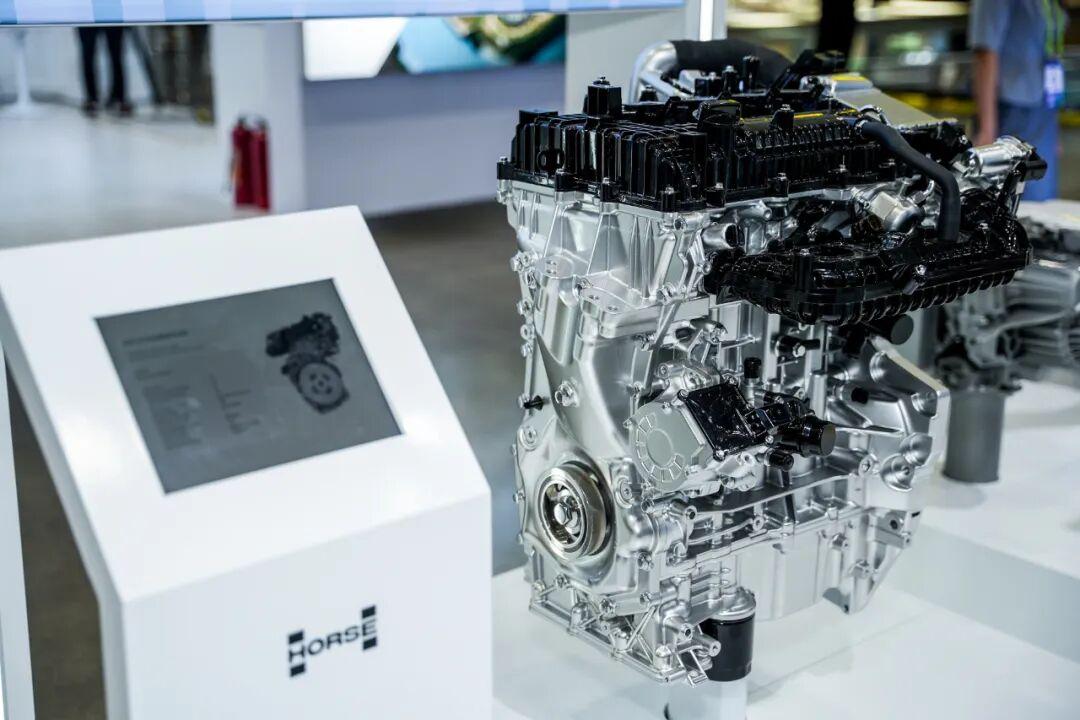
The latest development is its W40 V8, an engine designed specifically with hybrid integration in mind.
The W40 is a 4.0-litre, twin-turbocharged V8 featuring a hot-V configuration, placing the turbochargers between the cylinder banks. This arrangement allows for a compact installation while supporting the engine’s performance objectives.
Its published specifications include more than 670 horsepower, 800 Nm of torque and an approximate weight of 200 kg.
The engine is paired with HORSE’s eight-speed 8LDCT dual-clutch transmission, designed to accommodate up to 1,050 Nm of torque.
However, the V8 is only part of the proposed package. Lotus is targeting a combined hybrid-system output exceeding 1,000 PS, with electric assistance supplementing the combustion engine.
The complete electric-motor configuration, battery capacity and detailed power distribution have not yet been disclosed. Consequently, the W40’s individual engine output should not be confused with the eventual combined output of the Type 135.
This is not a fully electric supercar, nor is it simply a conventional petrol-powered vehicle. It is a performance-oriented hybrid, combining a twin-turbocharged combustion engine with electric propulsion.
The vehicle’s development remains a Lotus programme, rather than a jointly designed Renault–Geely model. The British manufacturer retains responsibility for the car’s identity and vehicle development, while HORSE provides the powertrain technology.
Lotus has maintained its own design organisation, historically associated with Russell Carr, who led the company’s sports-car design operations, and Ben Payne, appointed Vice-President of Design at Lotus Group in August 2023. However, the company has not publicly identified a specific individual as the lead designer of the Type 135.
The car is expected to retain the principles that have traditionally defined Lotus sports cars: aerodynamic efficiency, driver engagement, carefully developed chassis dynamics and performance-led engineering.
Its arrival also reflects a broader change in Lotus’s strategy.
The company had previously pursued an aggressive electric-only direction for its future sports cars. However, its Focus 2030 strategy, announced in May 2026, outlined a more flexible approach incorporating internal-combustion engines, plug-in hybrids and battery-electric vehicles.
That adjustment recognises that electrification does not necessarily mean abandoning combustion technology altogether.
For Lotus, the Type 135 offers an opportunity to combine its established sports-car engineering with a new generation of hybrid propulsion. For Renault and Geely, it provides a high-profile application for technology developed through their joint venture.
The companies have confirmed 2028 as the planned delivery year for the Type 135, with production expected to take place in Europe.
As of 12 November 2026, Lotus has not announced a specific date for a full concept or production-design unveiling. The Type 135 has been officially confirmed and its powertrain direction established, but the complete vehicle has yet to be presented publicly. Lotus has indicated that further information will follow, although a specific motor-show debut should not be assumed.
What makes this project particularly interesting is not simply the return of a V8 to a Lotus performance car. It is the industrial relationship making it possible.
Renault and Geely have created a business capable of supplying combustion and hybrid technology to manufacturers beyond their own respective vehicle brands. HORSE Powertrain’s involvement in the Type 135 demonstrates that this ambition extends into the performance-car market.
For Lotus, the partnership could provide the mechanical foundation for an entirely new chapter.
The electric future of the automobile remains firmly in motion, but the Type 135 offers a reminder that the combustion engine still has room to evolve. This time, however, it will not be working alone.