
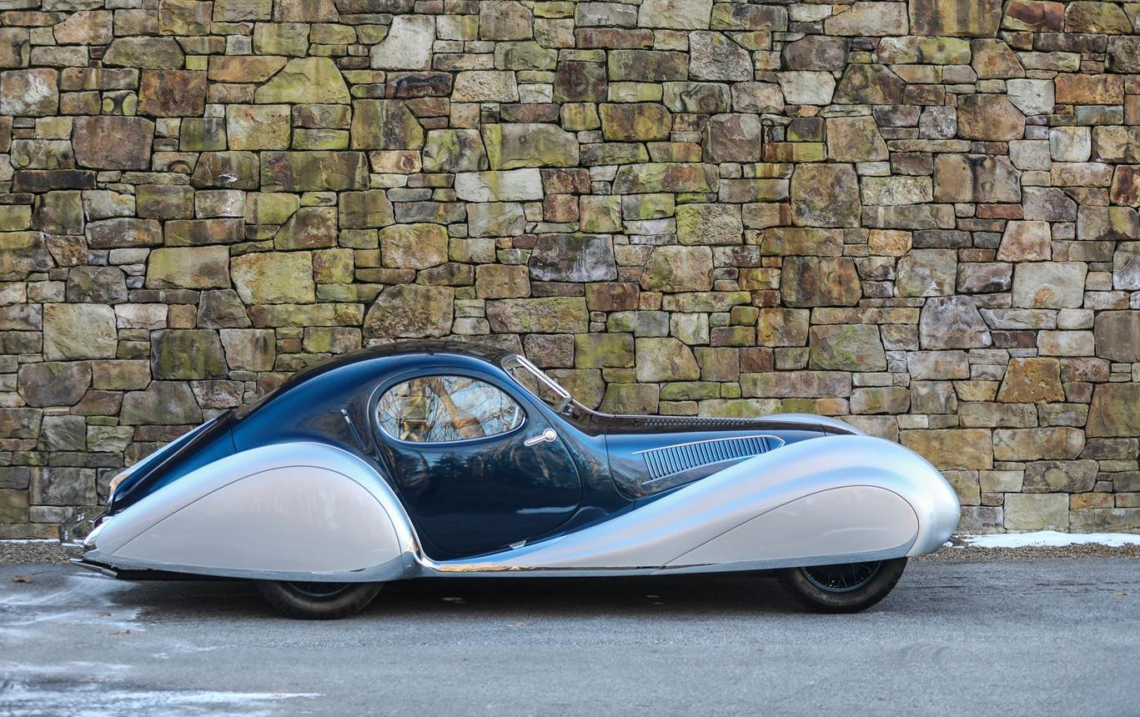
Before the age of supercars, there was a French automobile that understood something the industry would spend decades rediscovering: performance means very little if a car cannot make you feel something.
A different kind of ambition
The 1930s were an extraordinary period for European motoring. Manufacturers were experimenting with performance, aerodynamics and mechanical engineering, while wealthy customers were increasingly demanding automobiles that reflected their personalities.
In France, this created an opportunity for independent coachbuilders. Rather than simply purchasing a finished automobile, customers could commission a chassis and have a specialist construct an entirely individual body around it.
It was in this world that Anthony Lago and the Parisian coachbuilding house Figoni et Falaschi created one of the most recognisable automobiles of the pre-war era.
The result was the Talbot-Lago T150-C-SS Teardrop Coupé.
The engineering beneath the curves
Beneath its extraordinary bodywork was a serious sporting automobile.
The T150-C-SS used a 3,996cc inline-six-cylinder engine, producing approximately 140 horsepower in its road-going configuration. Power was delivered through a four-speed Wilson pre-selector gearbox, an interesting piece of period engineering that allowed drivers to select their next gear before engaging it.
Its chassis featured independent front suspension, while the rear used a conventional live axle.
This was not simply a beautiful touring car designed to look impressive outside a hotel. Its sporting foundations were genuine, and the T150-C-SS platform was developed with competition in mind.
A race-prepared example of the model family demonstrated that capability at the 1938 24 Hours of Le Mans, finishing third.
Figoni’s signature
The real magic, however, was in the bodywork.
Joseph Figoni understood that automotive design could borrow from architecture, fashion and sculpture. His work transformed the conventional proportions of the automobile into something far more expressive.
The Teardrop’s flowing roofline, elongated bonnet, sculpted wings and carefully integrated headlights created a silhouette that appeared to move even when standing still.
Its French name, Goutte d’Eau, translates to waterdrop.
There were different interpretations of the design, including the notchback Jeancart and the fastback Modèle New York. The latter became particularly recognisable after its appearance at the 1937 New York Auto Show.
Each body was individually crafted. The Saint Louis Art Museum records approximately 2,100 hours of coachbuilding work for each custom body. This was a different philosophy of manufacturing: the objective was not to make thousands of identical cars, but to create something extraordinary for a very small number of customers.
A world interrupted
The Teardrop arrived during a period of extraordinary European creativity, but its production years were short.
Between 1937 and 1939, these automobiles emerged from a world that was about to change dramatically. The outbreak of the Second World War would disrupt Europe’s manufacturing industries, its luxury markets and the independent coachbuilding culture that had helped produce cars like this.
The Teardrop consequently became a reminder of a particular moment in automotive history, when engineering and individual craftsmanship occupied equal positions in the creation of a motor car.
The price of history
Today, surviving examples are among the most sought-after pre-war automobiles in the collector world.
In 2022, a 1937 Talbot-Lago T150-C-SS Teardrop Coupé, chassis 90107, sold through Gooding & Company for $13.425 million.
That particular car featured extraordinary all-alloy coachwork with fully enclosed front fenders and an impressive history of concours recognition.
It was not simply a purchase of an old automobile. It was the acquisition of a surviving piece of French industrial and artistic history.
More than a beautiful car
Modern performance cars are measured through horsepower, lap times, acceleration figures and aerodynamic efficiency. The Talbot-Lago reminds us that there was another way to define automotive excellence.
It was an era when the person designing the body could have as much influence on a car’s identity as the engineer developing its engine.
And perhaps that is why the Teardrop remains so captivating.
Almost nine decades later, its proportions still look deliberate, its details still reward attention, and its silhouette remains difficult to confuse with anything else.
Some cars become classics because they were fast. Others because they were expensive or rare.
The Talbot-Lago became something else entirely.
It became a reminder of what happens when engineering meets imagination, and when an automobile is treated not merely as a machine, but as a work of art.