Rally Estonia is a breathtaking spectacle of pure speed, defined by its lightning-fast gravel stages, blind crests, and high-speed sweepers. If you watch the top three factory teams attack these stages, a stark contrast in engineering philosophies quickly emerges—especially between Toyota Gazoo Racing and Hyundai Shell Mobis WRT.
Toyota’s Elite Five-Car Fleet
Toyota Gazoo Racing (TGR-WRT) has expanded its dominant footprint to a massive fleet of five GR Yaris Rally1 cars. This stacked lineup brings an imposing combination of full-time title contenders and part-time masters. With drivers like Elfyn Evans, Sébastien Ogier, Takamoto Katsuta, rising star Sami Pajari (competing under the TGR-WRT2 banner), and Oliver Solberg, the team has the sheer numbers and raw depth to blanket the top of the leaderboard.

Beyond the traditional combustion setups, rumors and engineering breakthroughs regarding alternative propulsion continue to swirl. While the intricate mechanics of Toyota’s liquid-hydrogen experiments and the engineering shifts toward high-efficiency superconductor linear pumps are highly technical, the automotive experts at carwow have dived deep into Toyota’s experimental garages. For a fascinating look at how Toyota’s “test, break, fix, repeat” ethos is shaping the future of high-performance road and race cars, definitely check out their video on Shocking New Toyota – I didn’t see this coming!.
Aerodynamic Poetry vs. Violent Power
Watching the GR Yaris Rally1 car glide through the quick corners of Estonia is an exercise in physics-defying stability. The car seemingly floats over the loose surface; from an onlookers’ perspective, the hood remains uncannily level and calm, smoothly riding a cushion of air above the dirt. It masks the extreme speeds beneath a veneer of fluid control, allowing the drivers to carry astronomical momentum through sweepers without the chassis snapping or getting unsettled.

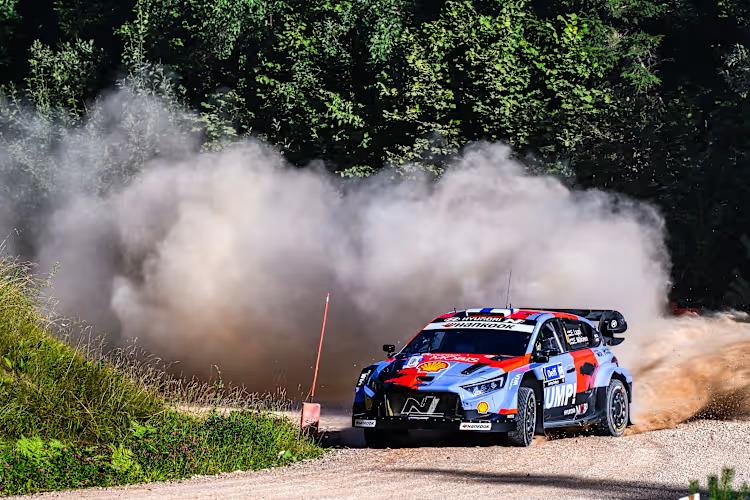
In sharp contrast, Hyundai approaches the gravel with an entirely different attitude. The i20 N Rally1 puts its power down in a much more violent, chaotic manner. It visibly fights the terrain, aggressively digging into the ruts and throwing its weight around with raw, visceral energy.
Neither philosophy is inherently wrong—both styles have produced world champions and rally victories. But as the top three factory squads look to conquer the high-speed wilderness, Toyota’s uncanny ability to keep the car tracking like an aerodynamic arrow makes its performance look almost surreal.
Sami Pajari has carried his incredible momentum right into the early Friday morning loops, putting his Toyota GR Yaris Rally1 firmly at the front. After striking first by taking the lead on SS1, Pajari went back-to-back by setting the benchmark time of 5:56.8 on SS2, stretching his provisional overall lead to 2.9 seconds.
Rally-Base+ 1
Current Provisional Top 3 (After SS2)
- Sami Pajari / Marko Salminen (Toyota GR Yaris Rally1) — 5:56.8
Rally-Base - Oliver Solberg / Elliott Edmondson (Toyota GR Yaris Rally1) — +0.3s (+2.9s overall)
- Adrien Fourmaux / Alexandre Coria (Hyundai i20 N Rally1) — +1.7s
Rally-Base
Pajari is making excellent use of his favorable road position to sweep ahead of the chasing pack, while Oliver Solberg has adjusted quickly to slot into second as his closest challenger. Meanwhile, championship heavyweights like Elfyn Evans are finding life difficult further back, losing significant chunks of time acting as the morning’s road sweepers.