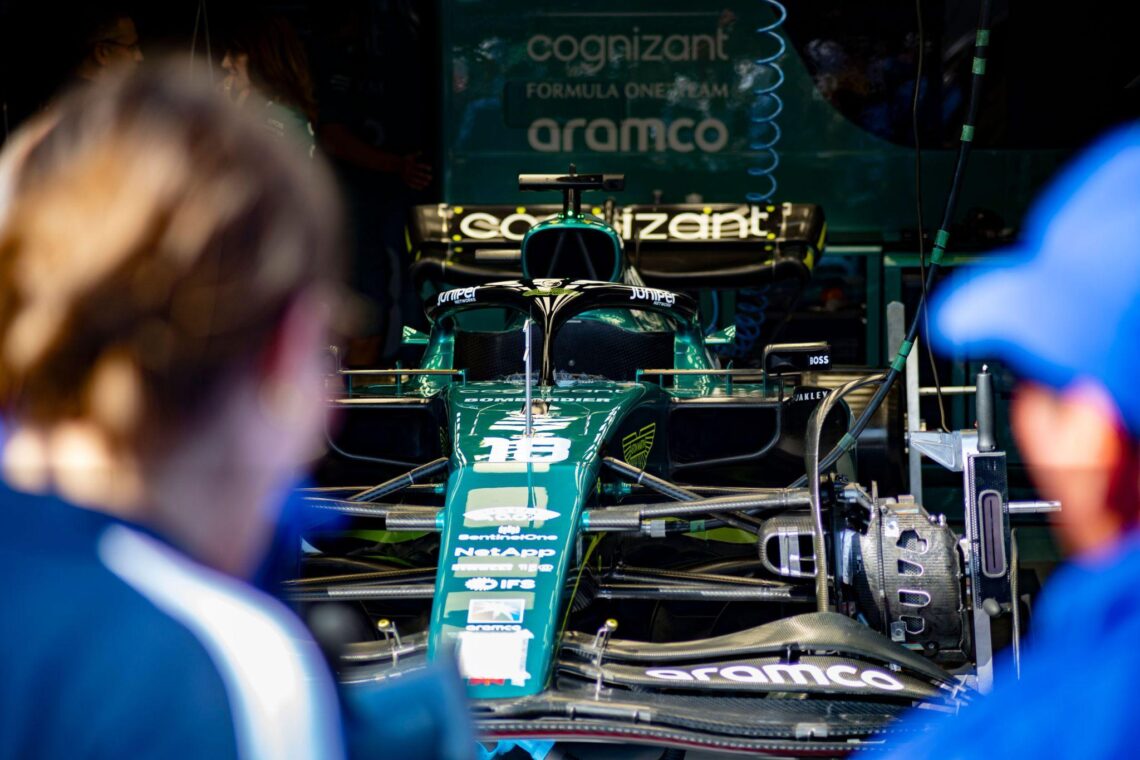
When Aston Martin launched its 2026 Formula 1 campaign alongside works power unit partner Honda, the message was clear and ambitious: a ground-up, holistic integration designed around the new 50/50 combustion-to-electric split. There would be no structural compromise, no awkward chassis workarounds, and no “patch jobs.”
Yet, as the early rounds unfolded, the reality on track proved painfully stark. Managing just a single point from the opening salvos, Aston Martin found itself lagging at the back of the grid—leaving two-time World Champion Fernando Alonso, Lance Stroll, and reserve driver Jak Crawford visibly frustrated.

Following a candid admission from Team Principal and Managing Technical Director Adrian Newey, the narrative behind the team’s struggles is coming into focus. The performance drought isn’t down to the drivers behind the wheel—it is an engineering trial born from a delayed learning curve, severe chassis-engine disharmony, and a high-stakes development strategy that demands ultimate patience.
Newey’s Admission: The Human Element Behind the Upgrades
In an interview reported by The Race, Adrian Newey admitted that Aston Martin had erred in how it communicated its mid-season strategy with its drivers.
“Whilst it might not seem like it, we are very much listening to their comments and trying to act upon it,” Newey insisted. “If people don’t feel as if they’re being heard then they of course get very frustrated; it’s human reactions. So perhaps we’ve been guilty of not spending enough time with Fernando and Lance, Jak [Crawford, reserve driver] here, kind of going through exactly what we are trying to achieve with the upgrade package.”
For a veteran leader of Newey’s stature, acknowledging this communication gap reinforces two critical points:
- The frustration in the cockpit is entirely justified. Driving an unpredictable, uncompetitive car at $200\text{ mph}$ without visible step-by-step progress taxes even the most seasoned champions.
- The drivers are not the root cause. Alonso and Stroll are squeezing every tenth out of a package currently compromised by deep-seated mechanical and aerodynamic flaws.
Diagnosing the Pit Lane Reality: Engineering vs. Execution
The narrative that Aston Martin’s package simply needs “tuning” ignores the mechanical harshness occurring beneath the carbon fiber. The struggles plaguing the AMR26 stem from severe engineering hurdles that cannot be solved with minor setup tweaks:
- Harmonic Engine & Chassis Vibrations: The early-spec Honda RA626H suffered from destructive internal combustion harmonics. These vibrations echoed directly into the AMR26 chassis, punishing driver comfort, degrading electrical components, and compromising aerodynamic balance.
- Aggressive Gearbox Downshifts: Harsh shift characteristics under rapid deceleration have constantly destabilized the rear axle during corner entry, severely undercutting driver confidence in hard braking zones.
- Weight & Aero Deficit: The AMR26 launched significantly overweight—estimated to be 10 to 15 kilograms above the minimum weight limit—while carrying aerodynamic concepts that proved ineffective under real-world track testing compared to wind tunnel data.
Recognizing that minor, piecemeal upgrades under the strict cost cap would only burn through financial resources without solving the structural issues, Newey and the engineering team took a deliberate, high-risk gamble: freeze small-scale development and save everything for a massive structural overhaul.
The Counterattack: Honda’s ADUO Token & Newey’s Aero Package
To fix a car built on holistic integration, the solution itself must be holistic. The comeback plan relies on two distinct, synchronized upgrade packages arriving on either side of the summer break.
ASTON MARTIN-HONDA RECOVERY ROADMAP
[ SPA-FRANCORCHAMPS / HUNGARY ] [ ZANDVOORT (DUTCH GP) ]
• Adrian Newey Aero Overhaul • Honda RA626H ADUO Upgrade
• Heavily Revised Bodywork Geometry • Redesigned Pre-Chamber & Combustion Shape
• 10-15kg Weight Reduction Push • Revised Lubrication System
• Structural Chassis/Floor Rebalance • Elimination of Destructive Harmonic Vibrations
Honda’s Engine ADUO Upgrade (Zandvoort)
Utilizing their allotted ADUO (Additional Development and Upgrade Opportunities) performance tokens, Honda’s update tackles the power unit’s core mechanical flaws:

- Combustion & Pre-Chamber Redesign: Altering the internal combustion chamber profile to smooth out peak pressure spikes and optimize power delivery under the 2026 sustainable fuel rules.
- Lubrication System Overhaul: Redesigned oil pathways and friction-reduction measures aimed directly at curing the destructive harmonic vibrations that plagued the chassis early in the season.
Newey’s Chassis & Aero Package (Hungary / Spa-Francorchamps)
Preceding the engine update, Newey’s aerodynamic and chassis overhaul aims to transform the AMR26’s fundamental balance:
- Aerodynamic Redefinition: Completely revised floor and sidepod geometry designed to bring real-world downforce into alignment with simulation models.
- Significant Weight Reduction: Shaving off the excess bulk to bring the car down toward the minimum limit, immediately unlocking lap time across all track profiles.
The Path Ahead: Why Patience Remains the Only Strategy
Will this combined chassis and engine overhaul be enough to leapfrog the midfield instantly? In a field as tightly packed and fiercely developed as the 2026 grid, there are no guarantees. The early-season deficit was substantial, and rivals have not stood still.
However, understanding why the team took the long way around changes the perspective. Aston Martin did not falter due to a lack of effort or driver talent; they hit a sharp learning curve on a brand-new set of technical regulations and chose to address the root cause rather than applying cosmetic band-aids.
Newey’s track record has always been defined by steady, methodical iteration rather than knee-jerk reactions. With the technical fixes now in motion between Spa and Zandvoort, the fight remains in the pits and on the CAD screens. For the drivers, the team, and the fans standing behind them, patience isn’t just an option—it is the prerequisite for rebuilding a contender.