When a Volcano Creates New Land: Two New Islands Appear After Anak Krakatau Eruption
Sometimes, an eruption doesn’t just reshape a landscape — it creates one.
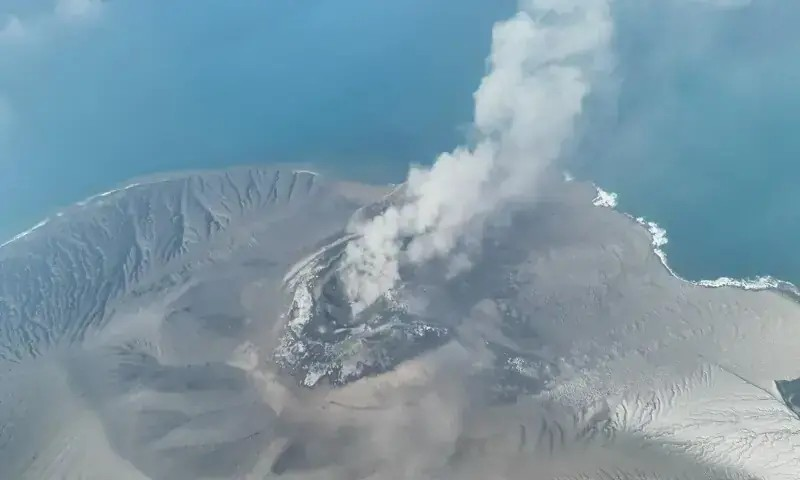
In the waters surrounding Indonesia’s Anak Krakatau volcano, two new land formations have appeared following a major eruption that lasted for 25 hours in September.
The formations were identified through satellite imagery in the water-filled caldera surrounding Anak Krakatau, according to Indonesia’s Centre for Volcanology and Geological Hazard Mitigation (PVMBG). The discovery was reported by Dawn, citing AFP.
The two formations were identified in the Sunda Strait, between the Indonesian islands of Java and Sumatra.
One is located approximately 760 metres northwest of Anak Krakatau, while the second sits roughly 495 metres southwest of the volcano.
But despite the remarkable appearance of two new islands, Indonesian volcanologists are being cautious about exactly what they represent.
Two Islands — But Are They Here to Stay?
Rita Susilawati of Indonesia’s PVMBG told AFP that Sentinel satellite imagery showed two formations resembling small islands.
However, scientists have not yet determined precisely how the formations were created.
One possibility is that they are emerging from the base of the caldera in a process similar to the formation of Anak Krakatau itself.
Another is that the formations are simply accumulations of volcanic material deposited by the recent eruption.
That distinction matters because volcanic islands can be temporary.
The history of Anak Krakatau itself provides an extraordinary example.
Following the catastrophic eruption of the original Krakatau volcano in 1883, several landmasses appeared beginning in 1927. Those early formations were subsequently eroded away before a more permanent island eventually formed in 1930.
The newly observed formations could therefore change considerably in the months and years ahead.
The Child of Krakatau
The name itself tells part of the story.
“Anak” means “child” in Bahasa Indonesia.
Anak Krakatau emerged from the caldera left behind by the enormous 1883 eruption of Krakatau, one of the most significant volcanic events in recorded history.
The volcano has remained active ever since, periodically adding new layers of volcanic material to its surroundings.
The appearance of the latest formations therefore demonstrates one of the most dramatic aspects of volcanic geology: land can be created, destroyed and reshaped within remarkably short periods of geological time.
A Major Eruption
The discovery follows a substantial eruption in September.
Anak Krakatau erupted continuously for approximately 25 hours, sending volcanic ash into the atmosphere and affecting communities and transportation across the region.
Several airports were forced to close, while more than 300,000 passengers were left stranded as a result of the disruption.
The eruption also had a tragic human dimension.
Five journalists who had travelled to cover the September eruption were later declared presumed dead, along with three boat crew members, after the vessel they were travelling on disappeared without trace.
Still an Active Volcano
Despite the dramatic eruption, Indonesia’s volcano monitoring authorities currently place Anak Krakatau at Alert Level 2, the second-lowest of the country’s four volcanic danger categories.
Authorities have advised people to remain at least three kilometres from the eruption centre.
That restriction remains particularly important because the landscape around an active volcano can change rapidly.
A formation that appears to be solid land from satellite imagery may not remain stable, and volcanic activity can continue beneath or around newly deposited material.
A Living Landscape
The emergence of the two formations is a reminder that the Earth is not a static landscape.
The islands of the Sunda Strait sit within one of the world’s most volcanically active regions. Indonesia lies along the Pacific Ring of Fire, where the interaction of tectonic plates contributes to frequent volcanic and seismic activity.
For now, scientists are watching.
Further research will determine whether the two formations are genuine new volcanic islands developing from the caldera floor or temporary accumulations of material produced by the latest eruption.
They may eventually be eroded away.
Or, as happened with Anak Krakatau itself, one or both could become a lasting part of the Indonesian landscape.
For the moment, two new shapes have appeared on the map — and the volcano that created them is still very much alive.