The Living Room That Drove: The 1935 Stout Scarab, America’s Forgotten Car of the Future
Before the minivan, before the luxury people carrier, and long before the idea of a mobile office became fashionable, one American engineer imagined that a car should be more than somewhere to sit behind a steering wheel.
There are automobiles that change the world, and then there are automobiles that arrive decades too early.
In 1935, while much of the automotive industry was still preoccupied with conventional sedans, imposing grilles and increasingly powerful engines, an American engineer named William Bushnell Stout was working on something altogether different.
He wasn’t particularly interested in building another beautiful automobile.
He wanted to build a room on wheels.
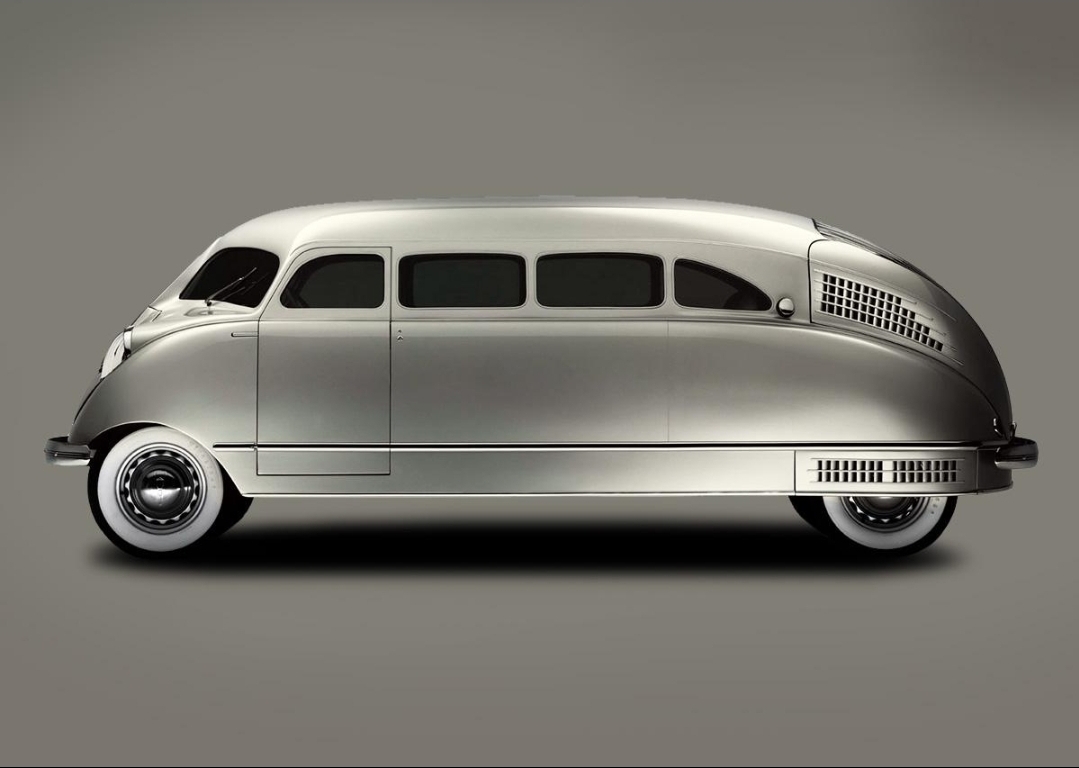
The result was the Stout Scarab, a machine so unusual that contemporary observers struggled to understand what they were looking at. Its rounded body, unconventional proportions and aviation-inspired engineering seemed to belong to another era.
And in many respects, they did.
The Scarab was not simply an experimental exercise in styling. It was an attempt to reconsider how people travelled, how passengers occupied space and what a luxury automobile could actually offer.
Nearly a century later, its ideas feel remarkably familiar.
### The man who thought like an aircraft engineer
To understand the Scarab, one must first understand its creator.
William Bushnell Stout was not an ordinary automobile designer. Born in 1880, Stout established himself in American engineering through aviation, industrial design and mechanical innovation.
He became particularly associated with the Ford Trimotor, the famous all-metal aircraft that helped establish a new direction in commercial aviation.
His engineering philosophy was built around simplifying structures, reducing unnecessary weight and making better use of available space.
Those principles would eventually find their way into the automobile.
Stout believed that the conventional car was fundamentally compromised by its architecture. The engine occupied valuable space at the front, the transmission tunnel intruded into the passenger compartment, and the traditional chassis and body construction restricted what designers could achieve.
He saw no reason why an automobile had to remain that way.
His answer was the Scarab.
### A car designed from the inside out
The first thing that catches your attention is its silhouette.
The Scarab looked nothing like the American luxury cars of its time. Instead of a long bonnet and separate passenger compartment, it adopted a rounded, streamlined, almost aircraft-like body.
Its inspiration was reportedly the shape of the scarab beetle, an ancient Egyptian symbol associated with regeneration.
The design also reflected the Art Deco movement, which was influencing architecture, furniture, fashion and industrial design during the period.
But the unusual appearance served a practical purpose.
Stout moved the Ford V8 engine to the rear, driving the rear wheels. This eliminated the need for a conventional driveshaft running through the passenger compartment and allowed the floor to be lowered and made more spacious.
The vehicle also employed an integrated body structure rather than the traditional separate body-and-chassis arrangement common to many automobiles of the period.
The result was an interior that made the Scarab feel less like a conventional car and more like a private lounge.
### The world’s first mobile executive lounge?
.
* [Detroit Historical Society – Philip K. Wrigley’s Scarab](https://www.detroithistorical.org/learn/online-research/blog/philip-k-wrigleys-1935-stout-scarab?utm_source=chatgpt.com).
* [Detroit Historical Society – William Bushnell Stout](https://www.detroithistorical.org/learn/online-research/blog/william-bushnell-stout-automotive?utm_source=chatgpt.com).
* [Frist Art Museum – 1936 Stout Scarab](https://fristartmuseum.org/1936-stout-scarab/?utm_source=chatgpt.com).
Editorial note: I found no matching Stout Scarab article in the DLifestyle archive search, although this cannot guarantee that no unpublished or unindexed version exists.
I think this is precisely the sort of automotive history worth building into the magazine: an overlooked machine, an extraordinary inventor and an idea that was decades ahead of its market.